Data Classification Challenges That Undermine DLP Effectiveness
Mislabeled and untracked data leaves most sensitive information invisible to DLP systems.
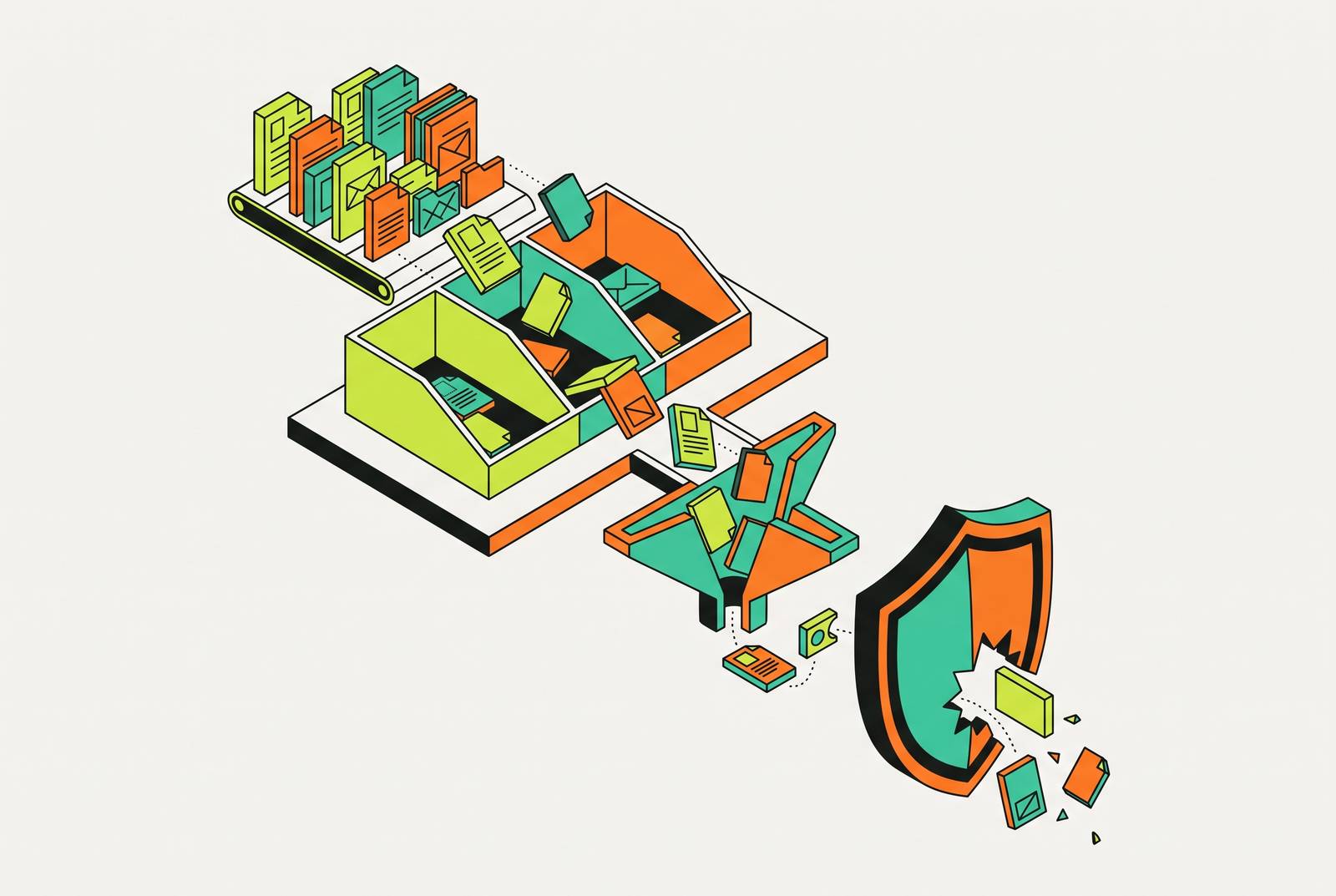
Data classification is the foundation every DLP policy sits on, and getting it wrong means the policy built on top of it fails right along with it. Concentric AI's research says as much, bluntly: without accurate classification, DLP, DSPM, and data privacy programs can be rendered close to useless. Worth asking why that happens, and what it would actually take to fix it.
A rule that fires on "confidential" data only works if the thing wearing that label is actually confidential. When the label is wrong, missing, or three years stale, the whole detection chain inherits the mistake. Classification does three jobs nothing else in the stack can do: it scopes which assets fall under which policy, it decides which violations get surfaced and which get quietly suppressed, and it supplies the context that separates a risky data movement from a routine one. Take classification out of the equation, or botch it, and DLP stops functioning as a security control, becoming pattern-matching against noise instead. Mislabeled data trips the wrong policy, or none at all; an analyst burns an afternoon chasing an alert that turns out to be a labeling error; and somewhere else, actual risk moves through the network with nobody watching.
How much data enterprises are failing to classify in the first place
Palo Alto Networks found that more than 80% of sensitive data sits out of sight of security teams. Sit with that number for a second, because it means most of what a DLP program is supposed to protect isn't being tracked, let alone classified correctly.
"Out of sight" here doesn't mean unlabeled in some minor, fixable sense. It means actively untracked, spread across environments security teams believe they control but don't actually see into. Data has fanned out across multi-cloud infrastructure, hybrid setups, SaaS platforms, and now AI interfaces faster than classification programs have managed to follow it. Shadow data does a lot of the damage here: duplicate files, orphaned cloud storage buckets, old backups nobody remembers exist, legacy repositories that outlived the project they were built for. None of it enters a classification workflow, because nobody owns the job of finding it in the first place.
A 2024 report found that roughly one-third of breaches involved shadow data sitting in unmanaged sources, and the same visibility gap contributed to a 27% jump in intellectual property theft. Traditional tools work off telemetry: logs of what moved, when, and to where. A firewall can tell you a file left the building, but it cannot tell you the file had a customer's social security number sitting in paragraph four. Tools built to watch traffic were never built to read content, so they don't.
Even a well-tuned DLP policy, then, is governing a minority of the sensitive data estate. Most of it lives in the space between what's tracked and what's actually out there.
Why unstructured data breaks every classification scheme built on rules
Most corporate data isn't structured. It's emails, chat threads, slide decks, contracts, code, research notes, the actual stuff people produce while doing their jobs. Structured data, like an account number sitting in a SQL column, is classifiable by pattern, and regex catches a properly formatted account number every time, no exceptions.
Unstructured data won't sit still for that. It has to be read for meaning. The same account number a regex rule flags instantly in a database field goes invisible the second it's typed into paragraph two of a quarterly business review deck, or dropped into a Teams message between two people making small talk about a client. A DLP system that catches PII in a database but misses it in a document isn't solving half the problem. It's solving the easier half, the half that already had access controls doing some of the work anyway.
Legacy DLP was built to match patterns, not parse meaning, and that's not something you fix with better tuning, because it's architectural. The tool was never designed to read a document the way a person reads it, for context and intent, rather than for a string that happens to resemble a known format.
This matters more now than it used to, because unstructured data is also the material most likely to get pasted into an AI tool for a quick summary. The classification gap and the AI-exposure risk aren't two problems. They're the same problem seen from two angles.
Code deserves its own mention. Source code, API keys, proprietary algorithms, all of it sits in version control systems that most classification programs never touch. A company can have a mature DLP rollout across email and file shares and still have zero visibility into what's sitting in its Git repos.
How shadow IT and personal cloud apps create data that was never classified to begin with
Netskope's 2025 analysis found that 88% of enterprise employees use personal cloud apps monthly, and 26% of them upload corporate data into those apps. Classification never sees this happen, because by the time the data crosses that line, it's already left the only environment where a classification control had any authority.
The mechanism is almost boring, which is exactly why it's hard to catch. Someone pastes a contract into a chatbot to get a quick summary, someone else copies a customer list into a personal Google Drive folder because it's easier to pull up from home, and a deck gets shared through a personal Dropbox link because the corporate file tool is crawling that afternoon. None of it looks malicious, and most of it isn't. But each move slides classified data into a space where no classification exists.
GenAI has sped this up. Palo Alto Networks' 2025 research found GenAI-related DLP incidents have more than doubled year over year and now make up 14% of all DLP incidents across enterprise SaaS traffic. IBM has put a dollar figure on the fallout: shadow AI incidents add an average of $670,000 to the cost of a breach. That number is what unclassified, ungoverned data movement costs once it's already out the door.
DLP tools miss this because it's low-friction and triggers nothing. The data was properly labeled while it lived in SharePoint, but the label doesn't travel with it. A "confidential" tag attached in SharePoint does not survive a copy-paste into someone's personal Gmail draft; the metadata just doesn't make the trip. Security teams are left holding growing volumes of sensitive content that traveled outside the perimeter with no record of where it went and no classification status once it got there.
What static classification rules actually produce: false positives, policy gaps, and analyst paralysis
Static rules and regex evaluate data at one moment in time. They match patterns. They don't understand meaning and they don't adjust when the data or its business context shifts underneath them, so whatever's wrong with the classification, every policy downstream inherits it.
Overly broad labels make rules fire on routine, harmless movement, which floods analysts with noise, while missing labels let real sensitive data move without tripping anything. Stale labels, data that got reclassified because the business changed but the DLP system never got the memo, create a mismatch between what the policy assumes and what's actually true. More than 70% of data loss incidents in 2024 were expected to originate from endpoints, a channel older DLP architectures monitored in isolation, largely blind to the flows moving through Teams, SharePoint Online, Google Workspace, and cloud storage.
The effect on analysts is corrosive. Trust in the system erodes fast when detection accuracy is low, and teams end up spending more hours tuning policies than investigating actual incidents, which is the exact outcome DLP was supposed to prevent. Organizations building in intent detection and real-time remediation are positioned to materially reduce insider risk exposure. Everyone else is leaving that reduction on the table.
There's a feedback loop here worth naming. False positives from bad classification wear analysts down; fatigue pushes real events lower in the queue; and because nobody has the time to trace those deprioritized events back to their root cause, the classification errors that caused them never get fixed. More false positives follow, and adding rules doesn't solve this, because it's a structural consequence of building detection on a classification foundation that was incomplete from day one.
Why insider threat cases expose the classification gap more than any other risk scenario
Insider cases make this problem visible in a way external attacks rarely manage. Verizon's 2025 Data Breach Investigations Report puts internal actors in 30% of all breaches. Insiders already have authorized access, so DLP can't lean on an access violation to catch anything. It has to lean on classification and behavioral context instead, to tell an employee's ordinary Tuesday apart from something that isn't ordinary at all.
An insider moving classified data doesn't trip an access control, because they're allowed to be exactly where they are. The only signal left is what they do with the data once they have it, and reading that signal depends on classification that's actually correct. Platforms built for this problem, such as Candor Security, a behavioral DLP platform for enterprises, work from the full user timeline rather than a single data-movement event. Get the label wrong and there's nothing left to interpret.
The dollar figures back this up. Ponemon Institute and DTEX research put the average annual cost of insider risk per organization at $19.5 million in 2025, up from $17.4 million the year before. The Montefiore case shows what this looks like on the ground: a $4.75 million HIPAA settlement, the result of a malicious insider with authorized access who sold patient data. Standard DLP rules never caught it, because the movement pattern looked exactly like routine, authorized work. Because it was, right up until it wasn't.
Confidence across the industry is low. A 2025 survey of 635 CISOs and security professionals found 93% consider insider threats as hard to detect as external attacks, or harder. Only 23% said they felt strongly confident about stopping one before serious damage was done. Classification is a big part of why. Without labels tied to sensitivity or business context, a DLP rule can't tell routine file access from the early stages of staged exfiltration; at the data-movement layer, they look the same. Only 25% of organizations report a fully mature insider risk program, complete with defined metrics and executive oversight, and program immaturity tends to travel with classification immaturity. The two rarely get better on their own.
How behavior-based detection compensates for classification gaps — and where it needs classification to work
Behavioral DLP works from a different unit of analysis. Rather than judging individual events, it tracks data lineage and reads the full sequence of a user's actions over time, treating the pattern itself as the thing worth watching. That shift does things static classification alone can't manage.
It can tell a legitimate file share apart from staged pre-exfiltration, even when the data, the destination, and the surface action all look identical; the difference lives in the behavior surrounding it. It can catch risk building across a string of individually low-sensitivity moves, none of which would trip a single rule on its own but which, stacked together, signal intent. It can flag anomalies in how data gets accessed, not just in what's moving.
Industry research points to a genuine shift away from pure rule-based monitoring, with a growing share of organizations now favoring user behavior-based tools for insider threat detection. Some vendors report false-positive reductions of up to 90% when AI-driven classification and behavioral detection work in tandem, and the gain traces back to reading context instead of just matching strings.
None of this removes the dependency on classification; it just moves it somewhere else. Behavioral detection works better when classification hands it usable signal upfront; a system that knows a given file is source code, or customer PII, can weight anomalies around that file the right way. Working against unlabeled data, a behavioral system is still pattern-matching, just doing it in the dark with more sophistication. Combine automated classification, the kind that recognizes contracts and proprietary research the way legacy DLP never could, with behavioral context layered on top, and the volume of noise a behavioral system has to sort through drops. What lands on an analyst's desk starts to be worth the time spent on it.
What a more defensible classification foundation actually requires
Point-in-time classification scans can't keep pace with how fast a modern data estate moves. Continuous, automated discovery has to replace the quarterly review as the baseline, because data that shifted three months ago and never got rescanned is already a liability sitting on the books.
Classification also has to read for meaning, not just pattern. That means NLP-capable engines that can parse a quarterly business review deck or a Teams thread the same way they'd parse a structured database field, with coverage stretching across documents, email, code, chat logs, and AI-generated content. It means visibility into shadow data: cloud storage nobody's tracking, unmanaged SaaS, personal apps. Data nobody can see is data nobody can classify, no matter how good the engine is.
Labels have to survive the trip. Classification metadata needs to persist through export, copy, and paste, not just sit intact in the source repository while vanishing the moment the data leaves it. And classification has to plug into the rest of the stack, identity systems, HR data, endpoint telemetry, feeding context back so a label actually means something in behavioral terms. Who's touching the data, in what role, at what point in their time at the company, matters as much as what the data is.
Feedback loops matter here too. When behavioral detection turns up a real incident, the classification state of the data involved should update in response, so detection and classification sharpen each other over time instead of running as two disconnected processes. Only a quarter of organizations report a fully mature insider risk program, and that traces back to a shared root cause: classification infrastructure built to satisfy a compliance checklist, never designed with behavioral detection in mind.
Get classification precise enough, and DLP policies start reflecting real risk instead of labeling error. That's the whole point: the cases that land on an analyst's desk should be worth deciding on, not worth triaging away.