Source Code Exfiltration Patterns in Technology and Semiconductor Firms
Recognizable patterns in source code theft can help companies catch insiders before damage occurs.
Source code exfiltration in technology and semiconductor firms is not random. It follows a small set of recognizable patterns across channels, behavior, and timing, and the firms that can name those patterns are the ones with any real chance of catching them before the damage is done. This piece maps those patterns across the data that moves, the people who move it, and the moments when the odds of theft rise.
Source Code as the Primary Exfiltration Target in Tech and Semiconductor Firms
Source code is the manufacturing blueprint behind a company's entire competitive position. Losing it does not just cost money; it hands a rival years of research and development in a single transfer. In technology and SaaS firms, the insider theft cases that matter most center on source code, API keys, and access tokens, the exact assets that let someone replicate a product or walk straight into a company's systems. Cycode, which has tracked source code leaks from 2020 through 2026, puts the stakes this way: losing source code is comparable to revealing Coca-Cola's formula or the F-22 Raptor's architecture, and the fallout runs through trust erosion, lost revenue, and regulatory penalties.
Semiconductor process IP raises the stakes further. A single stolen process specification can compress years of a competitor's R&D into a shortcut, as the Samsung DRAM case made clear: the stolen technology represented years of development at enormous cost, and prosecutors estimated the downstream impact on Samsung's sales could run into the trillions of won. Three forces are pushing this target into sharper focus at once. Geopolitical rivalry is accelerating state-sponsored recruitment of insiders. AI tools now make it easier for someone to pull off exfiltration without outside help. Hybrid work, cloud repositories, and CI/CD pipelines also give would-be thieves a surface far larger than the one that existed a decade ago.
How the exfiltration surface expanded beyond the code repository
The paths by which source code can leave a company have multiplied faster than the controls meant to watch them, and several recent incidents show how wide that gap has grown. Developer tooling itself is now a target: in May 2026, a group called TeamPCP breached GitHub's internal systems and stole code from roughly 3,800 internal repositories by compromising a Visual Studio Code plugin, entering through a developer's own environment rather than the repository's front door.
AI coding tools have opened an exposure class of their own. In March 2026, Anthropic left the source code for Claude Code, its terminal-based AI coding agent, sitting inside a publicly available npm package by accident. The leak happened during a fast product release, and it shows how the risk to intellectual property is now built into the AI development process rather than bolted on after the fact. Shadow AI adds another layer to the problem. Samsung engineers in the semiconductor division put source code for testing programs, test sequences for semiconductor equipment, and internal meeting notes directly into ChatGPT prompts. Nobody had to steal anything; a productivity tool was the channel. SentinelOne's 2026 insider threat data found that more than half of companies now give AI tools full access to cloud systems, collaboration suites, and productivity platforms, creating paths that did not exist when most data loss prevention policies were written.
Third parties can widen the surface even when no employee ever goes rogue. The July 2025 breach of Dell by a group called World Leaks moved 1.3 terabytes of data, including employee folders, infrastructure scripts, and system backup and configuration data, all through a supply chain attack rather than a direct intrusion. Plain human error belongs on this list too. A Mercedes-Benz employee's authentication token sat exposed in a public GitHub repository starting September 29, 2023, and was not found until January 2024, by which point it gave unrestricted access to internal source code on the company's GitHub Enterprise Server. Nobody meant for that to happen, but the access it granted was real all the same. Cycode's research puts a number on how exposed this makes companies generally: every company it tracked now has AI-generated code somewhere in its codebase, yet only a small share can say they have full visibility into how AI gets used across development workflows. Code is being written by systems nobody is watching closely.
The three exfiltration archetypes security teams encounter
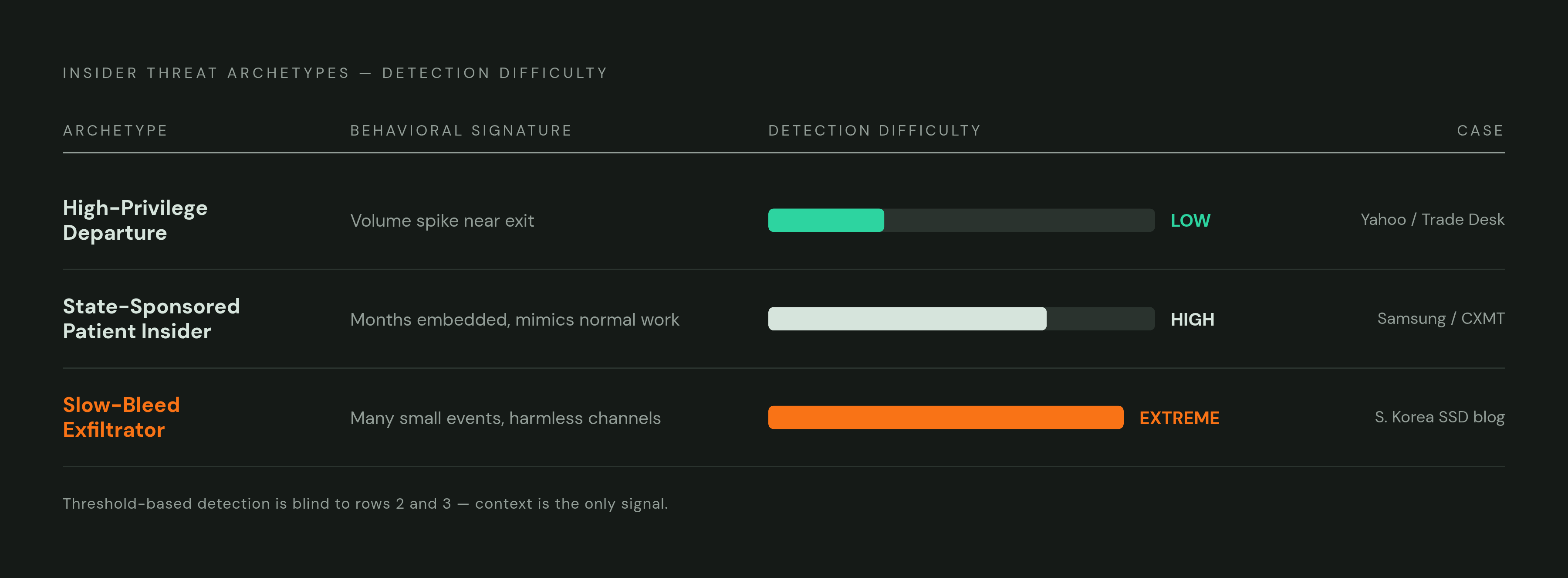
Once you map the channels, the behavior behind them settles into three recognizable patterns, and each one has its own signature and demands a different kind of detection.
The first is the high-privilege departure, the pattern most people picture when they hear "corporate espionage." A senior or technically privileged employee, with departure imminent, downloads a large volume of proprietary material on the way out. The Yahoo case is the clearest illustration: a senior research scientist downloaded roughly 570,000 pages of trade secrets tied to the AdLearn product before leaving for a competitor, The Trade Desk. Here, you see a spike in download volume, access that reaches outside the employee's usual project scope, and unusual destination behavior, all clustered in the weeks around departure. This archetype gets documented more than the other two, but it also tends to get caught late, because the access used was authorized the whole time. The only thing that gives it away is pattern and volume, not the act of access itself.
The second is the state-sponsored patient insider, operationally sophisticated and often embedded for months or years with tradecraft built specifically to dodge standard detection. The Samsung/CXMT case, with indictments handed down in December 2025, is the most detailed documented example in the semiconductor sector: a former Samsung employee copied hundreds of DRAM process steps by hand, while a former department head set up a shell company that kept changing offices and built a private coded language for use in case of travel bans or arrests. A related SK Hynix case shows the same patience applied to physical exfiltration: a former employee was arrested at a South Korean airport carrying somewhere between 3,000 and 4,000 printed pages of semiconductor process data suspected of being bound for Huawei. AnySecura's 2026 insider threat analysis describes geopolitically driven insiders as patient and technically skilled: they embed quiet persistence mechanisms or hidden access paths and fold their activity into normal administrative work so it never trips a standard alert. The hard part about catching this archetype is that the activity often looks exactly like legitimate engineering work; telling it apart from the real thing requires understanding which combinations of data someone is touching.
The third is the slow-bleed exfiltrator, who spreads the theft across many small events over time, often through channels that look harmless taken one at a time. A South Korean SSD controller case shows the pattern well: an employee repeatedly posted technical material to a personal blog before getting caught, and two days after discovery, the same employee displayed confidential material on an office screen and typed it manually into a personal iPad. The theft kept going even after it had already been found once. No single event here crosses a volume or sensitivity threshold, so you only see the signal once you look across the full timeline. Generative AI is making this archetype easier to pull off at scale: even employees with little technical background can now build custom exfiltration scripts with AI assistance, automating what used to require sustained manual effort over a long stretch of time.
Organizational moments that elevate exfiltration risk
Risk is not spread evenly across the calendar. It concentrates at specific organizational moments, and departure and offboarding sit at the top of that list across every documented archetype: the Yahoo case, the Samsung/CXMT case, and the SK Hynix airport case all involved employees in the exit or post-exit phase of their employment, and the mass-download signature tends to intensify in an employee's final weeks. Layoffs and workforce reductions carry a similar risk, because financial pressure and grievance combine with the knowledge that access is about to disappear, and that produces strong motivation on a compressed timeline. Flashpoint's analysis names financial strain itself as a documented warning sign, whether it shows up as significant debt, financial trouble, or a sudden and unexplained financial gain; employees under that kind of pressure are actively approached through illicit forums and marketplaces, and Flashpoint's 2025 research found 10,475 channels carrying insider-related illicit activity.
Competitive hiring and acquisition activity raise the temperature too. When a competitor is known to be recruiting from a given firm, or when a merger or acquisition unsettles the organization, employees with contacts across company lines represent a sharper risk than usual. AnySecura's research notes that companies often recruit geopolitically motivated insiders from outside altogether, and you can see that pattern in Tesla's lawsuit against engineer Alexander Yatskov, filed in May 2022 and settled in April 2023, which alleged he copied substantial confidential information related to Tesla's Dojo supercomputer project onto personal devices and handed over a dummy laptop to cover his tracks (the complaint made no allegation that the material was shared with a foreign entity). New tool and platform rollouts create their own window of exposure: the moment a company adopts a new AI coding assistant, migrates to the cloud, or integrates a new SaaS platform, there's a stretch of time where data flows haven't been mapped yet and policy hasn't caught up. The Samsung ChatGPT incident happened inside exactly that kind of gap. Flashpoint also points to behavioral signals that appear before any technical indicator does: increasingly impulsive or erratic conduct, disregard for rules and policy, withdrawal from colleagues, and contact with competitors are all precursors worth watching on their own terms.
Why legacy DLP misses these patterns
Most of the cases above were detectable in hindsight. A structural failure in how legacy data loss prevention tools process signals keeps these cases from being caught in real time. Static, rule-based DLP cannot tell authorized access apart from malicious access when the credentials and permissions used are identical in both cases. The Samsung employee who copied process steps by hand, the Yahoo engineer who downloaded hundreds of thousands of pages, and the SSD employee posting to a personal blog were all operating well within the bounds of their own access rights the entire time.
Alert fatigue compounds the problem, and it is a math problem more than a people problem. Enterprise security operations teams face upwards of tens of thousands of alerts a day, and if manual investigation of each one runs tens of minutes, nearly every SOC ends up buried under a backlog it cannot clear. Many alerts never get investigated. Legacy DLP in semiconductor and technology environments was built around centralized enforcement points, data classification that stays stable over time, and tuning done by hand. None of those assumptions hold up in environments shaped by SaaS sprawl, cloud data gravity, and generative AI workflows that shift by the week.
Shadow AI sits almost entirely outside what legacy tooling can see. Use of generative AI through non-corporate accounts, AI agents operating locally inside applications, and machine identities, which SentinelOne reports now outnumber human employees by a ratio of 82 to 1, all generate data flows that sit beyond the reach of central identity management and legacy DLP alike. The slow-bleed and state-sponsored archetypes are, by their nature, immune to threshold-based detection: hundreds of small blog posts carrying individually modest technical content, or months of access to manufacturing documentation that overlaps cleanly with someone's actual job, will never trip a rule built around a single event. Nothing in a security team's tools connects events across a person's timeline into a pattern that reveals intent, even when the tools observed the activity, so a team can have full data coverage and still lose the IP.
Effective detection across the data, the person, and the surrounding activity
Closing this gap means combining three signals that legacy tools have always treated as separate: what the data is and where it's headed, what a person's role and history suggest about that movement, and what the surrounding pattern of behavior looks like across the full timeline, not just a single event.
Understanding the data has to go beyond labeled or classified assets, because the material that matters most often carries no label. The Samsung DRAM process steps were not sitting in a file marked "top secret," and the Yahoo AdLearn data was sensitive because of what it meant to the business, not because it matched a regex pattern somewhere in a DLP rule set. Source code, process specifications, and technical documentation become sensitive because of what they mean competitively, so you have to assess what information actually represents rather than rely on its filename or storage location. Where that data is headed matters just as much as what it is: a file moving to a personal cloud account, a public blog, a personal iPad, or a contractor's system overseas carries a different weight than the same file moving between two engineers on the same team.
To understand the person, you read access against role and history, not against a static permission list. A download that looks ordinary from a team lead who touches that repository daily looks very different from the same download coming from someone two weeks from their last day, or from someone whose job function has nothing to do with the files in question. And to understand the surrounding activity, you watch the full timeline rather than any single event in isolation, because the slow-bleed and state-sponsored patterns only become visible once hundreds of small actions are strung together and read as one story. Candor, the company publishing this analysis, builds its approach around exactly that combination: reading the data, the person, and the behavior pattern together, so that a single download spike or repository access event gets judged against the full context around it instead of being flagged as noise or missed. Platforms built only on static rules or sensitivity labels tend to generate thousands of false positives across a large engineering organization, so you get the same alert fatigue problem in a different form. If an approach reads role, history, and behavior together, it can turn detection from an overwhelming queue of alerts into a short list of investigations that actually matter.