Reducing Security Alert Fatigue with AI Triage in Enterprise SOCs
AI triage prioritizes high-risk alerts by evaluating behavior, not just events.
Alert fatigue in enterprise security operations centers isn't a volume problem. It's a triage problem, and the fix isn't fewer alerts. It's faster, better decisions about the ones already sitting in the queue. Daily alert volume actually dropped, from 4,484 per day in 2023 to 2,992 in the most recent measurement (Vectra AI, 2026), yet 63% of alerts still go unaddressed. The share ignored hasn't budged, and that's the tell: this was never about how many alerts land in the queue. It's about how much investigation time exists per alert, and no amount of rule-writing fixes a time problem.
Run the math on a single shift. Alert queues routinely grow faster than analysts can address them. An analyst cannot properly investigate something in less time than it takes for someone, anyone, to start looking at it. More headcount doesn't close that gap, and neither does buying more tools. Tools just generate more of the exact alerts that already can't get investigated in time.
Vendors love to sell "more visibility" as the fix. It isn't. Forty percent of alerts never get investigated at all, and 61% of security teams admit they've dismissed alerts that later turned out to be genuinely critical (2025 AI SOC Market Landscape report). That's the real cost of alert fatigue: not the noise itself, but what hides inside it while an analyst too buried to notice moves on to the next ticket.
How desensitization turns a workflow problem into a security vulnerability
Constant high-volume alerting produces a specific cognitive effect: desensitization. It's the same mechanism documented in clinical alarm fatigue research in hospitals, where nurses exposed to hundreds of monitor alarms per shift start filtering them as background noise, regardless of what any individual alarm means. Put a security analyst through the same exposure pattern, and the brain does the same thing. Severity stops registering as severity. It just registers as another ping.
That shows up in specific ways. Pattern blindness sets in after a misconfigured rule throws the same false positive a few hundred times: analysts learn, correctly by their own logic, that the alert type is worthless, and they stop opening it, including the one time it isn't. Rushed triage follows from queue pressure, since a review that should take several minutes gets compressed into 30 seconds once 200 alerts sit unread. And the backlog compounds. Monday's uninvestigated alerts don't disappear. They become Tuesday's starting deficit, carried forward day after day, never caught up, only ever added to.
Seventy-six percent of organizations name alert fatigue as a top SOC concern (Cybersecurity Insiders, 2025), and 73% name false positives as their single biggest detection challenge (SANS 2025 Detection and Response Survey). Those aren't two separate complaints. They're the same complaint viewed from two angles.
The people cost is where this turns serious, and it's the part most SOC leaders still underweight. Seventy percent of SOC analysts with five years of experience or less leave the job within three years (SANS, 2025). There's no hiring path out of a gap this size: the people who'd fill these seats don't exist at the scale needed, so the industry cannot solve a triage capacity problem by adding more triage capacity. Burnout isn't a soft complaint here. It's an attrition mechanism that guarantees the queue keeps growing faster than staffing can answer it.
Desensitization doesn't just cause missed alerts, either. It wears down the judgment applied to the alerts that do get looked at. An exhausted analyst clicking through case 180 of the day isn't working with the same rigor as case 12. The failure isn't only in what gets skipped. It's in what gets rubber-stamped.
What legacy detection infrastructure contributes to the noise before a human sees anything
Part of this is architectural, not human, and it's the part rule-writers can't fix by writing better rules. Organizations manage alerts from roughly 28 separate security tools on average, each with its own alert logic and no shared definition of what severity means across them (AI SOC Market Landscape report). An analyst working a real incident is translating between 28 different vocabularies for what "high severity" means, often without a single screen that reconciles any of them.
Underneath that sprawl sits a rule hygiene problem that rarely gets discussed outside SOC operations teams. Around 18% of all rules deployed in production SIEMs can't fire at all, whether from misparsed log fields or missing data sources the rule was written against. Those rules still burn processing cycles, and they still trigger downstream heuristics that generate more noise, even though they catch nothing. It's dead weight: it costs compute and adds friction without ever catching anything real.
Static thresholds make it worse. A rule built to flag "anomalous" behavior with no behavioral baseline treats a user who fat-fingers a password once the same way it treats an actual brute-force attempt. Both trip the same trigger, because the rule has no concept of context, pattern, or history. It only knows the event crossed a line.
Then there's alert chaining. A single real incident, phishing email, malware download, lateral movement, can throw multiple separate alerts across multiple separate platforms, each firing in isolation with nothing connecting it to the others. An analyst has to manually recognize that four unrelated-looking tickets are actually one attack. Only about 59% of security tools even feed data automatically into a SIEM in the first place (Microsoft and Omdia, 2026), so a large share of that correlation work gets stitched together by hand, on every alert that crosses a tool boundary.
The result: false positive rates that frequently exceed 50%, with some organizations reporting rates as high as 80%. Close to half, sometimes closer to four-fifths, of an analyst's daily workload produces no security value at all.
SOAR platforms were supposed to fix this, and they didn't, not really. Playbook-based automation works fine for scenarios the playbook anticipated, but the moment an alert falls outside a predefined path, it escalates straight to a human. SOAR ends up routing exactly the ambiguous, judgment-heavy cases back to the people it was meant to relieve. It automates the easy decisions and leaves the hard ones exactly where they were. If a vendor still pitches SOAR as the endpoint rather than a stepping stone, that's worth pushing back on directly.
None of this is a tuning failure. A rule can only ever check whether an event crossed a static line. It has no way to ask whether the event fits the person, the timing, or the pattern around it, and no committee rewriting thresholds changes that math.
What AI triage actually evaluates that a rule cannot
Rules evaluate events. Behavioral AI evaluates patterns. That's the actual difference, and it's the one that matters. A single data transfer, on its own, tells an analyst almost nothing. The same transfer checked against who did it, when, from what device, and against that person's normal behavior, carries an actual risk signal, or it doesn't.
Behavioral AI systems built for this work examine several layers per alert. There's the user baseline: typical login hours, typical data volumes, typical destinations, how this person compares to peers doing the same job. There's entity context, where devices, accounts, and applications each get treated as behavioral actors with their own histories, not just objects an event happened to. There's timeline stitching, where activity across multiple tools and sources gets assembled into one coherent narrative instead of sitting as disconnected log lines. And there's anomaly scoring measured against the individual's own history, not some fixed population-wide threshold that treats every user the same.
User and entity behavior analytics, UEBA, is the detection engine underneath most of this. Machine learning models build a per-user, per-entity behavioral baseline and flag deviations, unauthorized access attempts, logins at unusual hours, file transfers that don't match the person's normal pattern, without needing a predefined rule to say "this specific thing is bad." The model doesn't need to have seen the exact attack before. It just needs to recognize the behavior doesn't fit.
This matters most for insider risk, where motive is the whole question and motive never shows up in a single log line. A suspicious data movement by itself proves nothing. What matters is whether it's part of a pattern: off-hours access building over several days, a shift toward unfamiliar destinations, drift away from that person's established routine. Only timeline-aware analysis surfaces a sequence like that, because a rule engine evaluating each event in isolation never connects the dots.
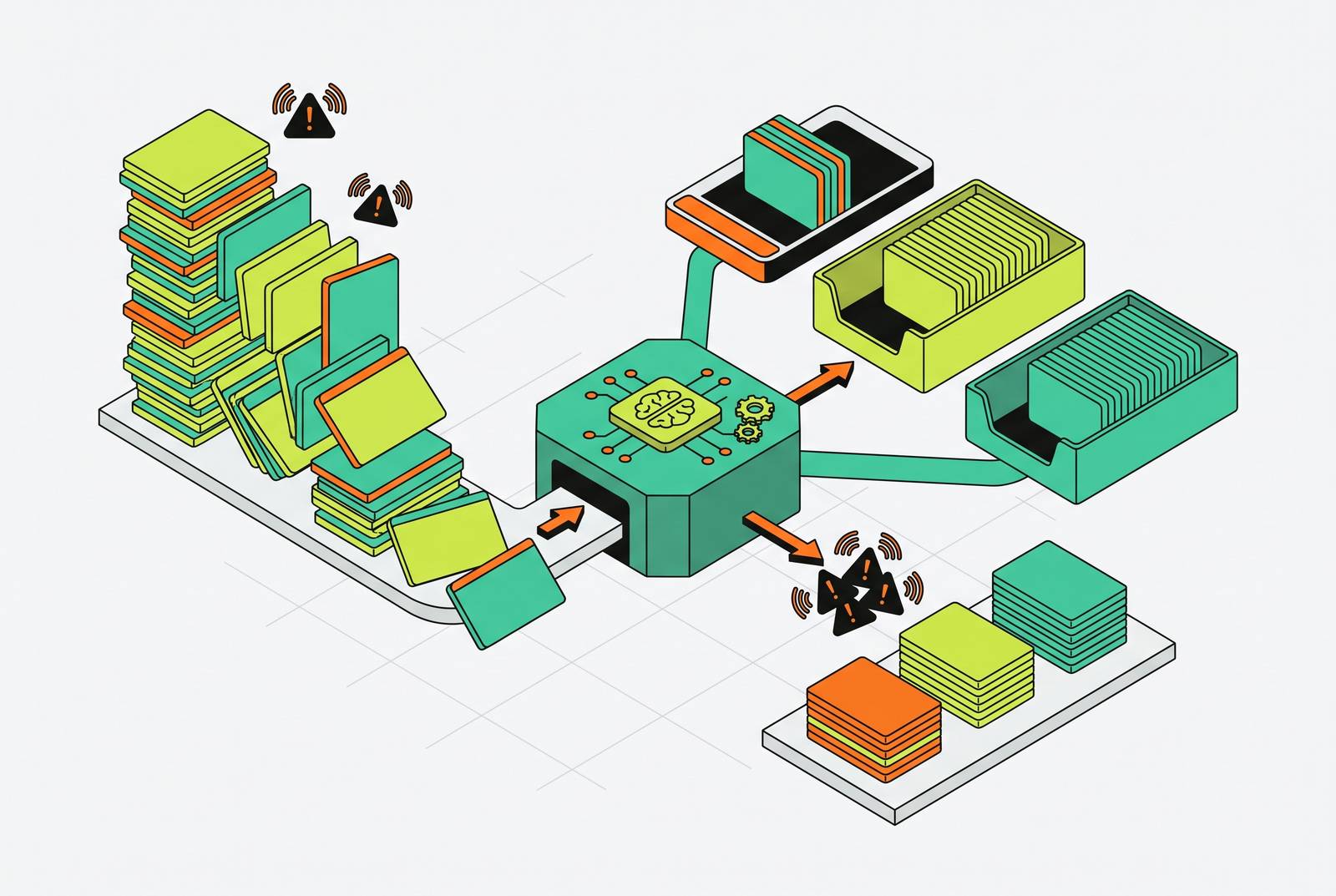
By the time an alert reaches an analyst under this model, most of the investigation is already done. Correlation has already connected related signals across tools that would otherwise look like unrelated events. Context has already been assembled: user history, peer comparisons, recent access changes, anything relevant from prior incidents. And a severity judgment has already been made, sorting the alert into informational, likely false positive, or probable true positive, before it ever hits a queue.
What lands on the analyst's desk isn't a raw alert anymore. It's an assembled case, with a verdict, the evidence behind it, the behavioral context, and the related events tied together. The analyst's job shifts from investigating from zero to deciding on something mostly built. Gartner formally recognized this shift on October 16, 2025, naming "AI SOC Agents" as its own category, covering systems that autonomously triage, investigate, and recommend response actions without relying on pre-built playbooks.
What the shift from sorting to deciding looks like in analyst workflow
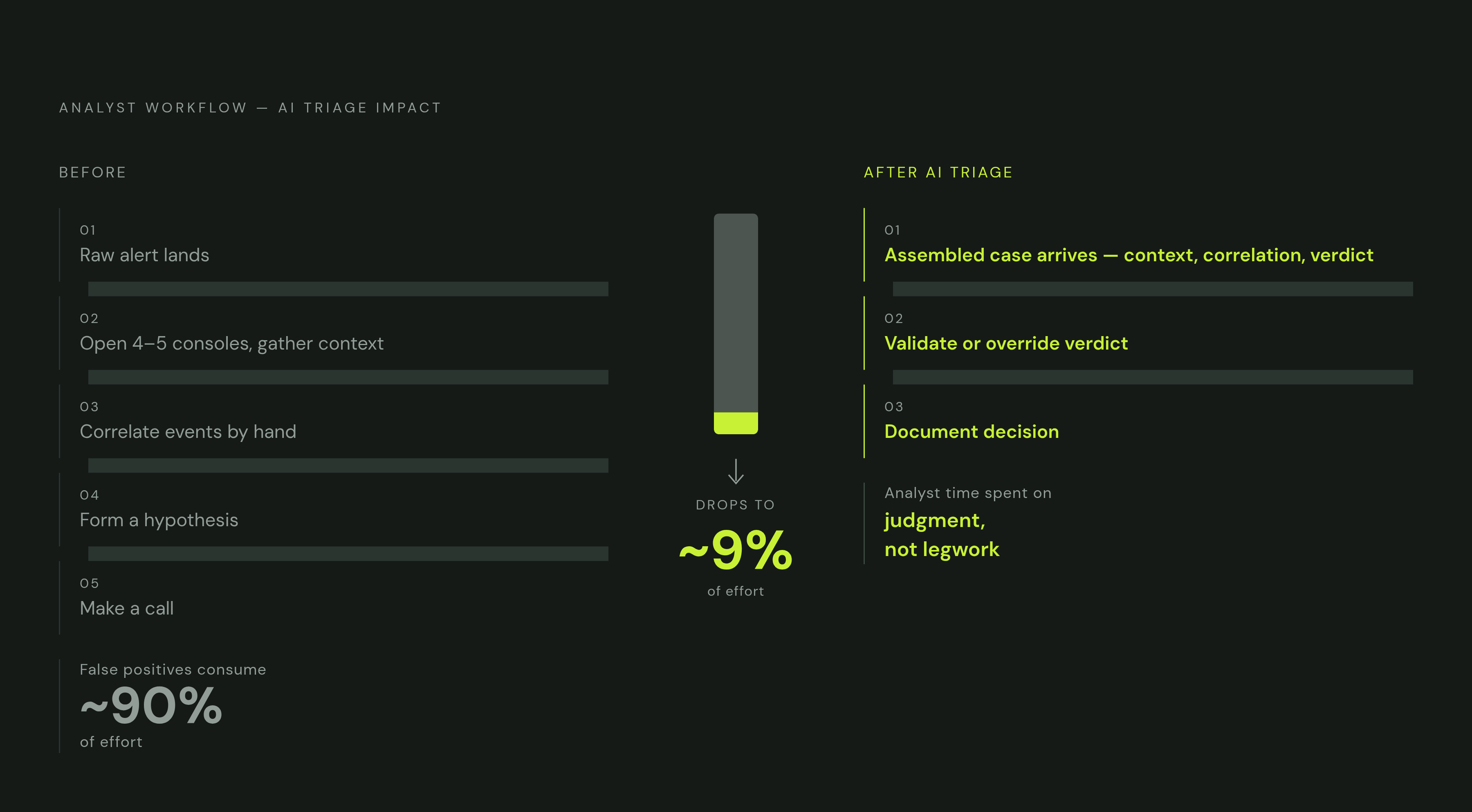
Before this kind of triage exists in a SOC, an analyst's day looks like this: raw alert lands, analyst opens four or five different consoles to gather context by hand, correlates anything that looks related, forms a hypothesis, and only then makes a call. Most of the time in that sequence goes to legwork, not judgment.
After AI triage, the sequence compresses. The analyst opens an assembled case that already has context, correlation, and a suggested verdict attached, and the job becomes validating or overriding that verdict, then documenting the decision. The investigative steps that used to eat most of the shift are already finished by the time a human looks at it.
What analysts do with the freed-up time is the part that actually matters: validating ambiguous verdicts the system flagged as uncertain, working the genuinely complex edge cases that need strategic reasoning, checking the quality of the AI's own workflow, and escalating confirmed incidents that need an immediate response. That's judgment work, and it's a different job than sorting, even inside the same title.
Production deployments back this up. Teams running AI triage report spending around 9% of analyst time on false positives, against roughly 90% in traditional triage workflows, a gap that reframes what "workload" even means in a SOC. Organizations automating Tier 1 alert handling report significantly faster resolution times, with up to 80% fewer alerts ever reaching a human analyst.
Some of the sharpest examples come from named deployments rather than aggregate survey data, and they're worth sitting with individually rather than averaging together. Torq's customer deployments show Carvana automating all of its Tier 1 alert handling, Valvoline saving 6 to 7 analyst hours a day, and HWG Sababa nearly doubling throughput without adding headcount. Dropzone AI's work with Assala Energy reported a 70% drop in false positives requiring manual review after AI investigation went live. One documented Microsoft Security Copilot case involved an analyst uncovering a link between a Defender XDR credential theft incident and a separate Sentinel incident tied to an SAP file downloaded from a known malicious IP, a cross-platform connection manual triage hadn't caught on its own. CrowdStrike's Charlotte AI Detection Triage is among the platforms vendors cite for high automated alert assessment accuracy and material weekly time savings per SOC.
That's not a smaller role for security analysts. It's a different one, and the industry should stop pretending otherwise.
Where AI triage is most consequential, and where human judgment remains irreplaceable
AI triage earns its keep fastest on high-volume, well-defined categories: known malware signatures, established attack patterns, policy violations with a clear behavioral precedent already in the data. It also does something no human team can do at scale: correlate signals across identity, endpoint, cloud, and application layers simultaneously, which exceeds the working memory of any analyst trying to hold it all in their head. And it applies the same triage logic to the alert at 3 a.m. that it applies at 3 p.m., without the fatigue-driven variance a tired human brings to hour ten of a shift.
Human judgment doesn't get replaced by any of that, and pretending otherwise is where a lot of AI SOC deployments go wrong. Ambiguous insider risk cases are the clearest example: a behavioral anomaly might indicate something malicious, or it might just reflect a legitimate change in someone's job responsibilities, and only a person with actual organizational context, who reports to whom, what changed last quarter, can tell the difference. Novel attack patterns that don't match any baseline the model has seen get flagged as uncertain, correctly, but a human still has to decide what that uncertainty means and what to do about it. And when a verdict comes back confident but the supporting evidence is thin, someone has to own that decision, because auditing a weak case is a human function, not a scoring function.
High-stakes escalations, the ones that end in termination, legal action, or a regulatory notification, need a human name attached to the decision. That's not a technology limitation. It's an accountability requirement, and no vendor roadmap changes that.
Explainability follows from this directly, and it isn't optional. AI-driven detection has to show its work: which signals triggered the assessment, what baseline got violated, which related events got pulled into the case. An analyst who can't audit a verdict can't trust it, and a system nobody trusts becomes exactly the thing this shift was meant to eliminate: another source of noise to tune out.
The insider threat numbers make the stakes concrete. Insider-driven incidents took an average of 81 days to detect and contain (Ponemon 2025 Cost of Insider Risks Global Report). Those are precisely the cases where faster AI triage matters most, and precisely the cases that demand the cleanest possible evidence chain before anyone acts on the conclusion.
What security teams should verify before deploying AI triage at scale
Start with integration scope. A triage system that only sees one layer, endpoint but not identity, say, misses the cross-source behavioral pattern that would have made the case obvious. Ask directly whether it connects across identity providers, endpoint tools, productivity platforms, HR systems, and the SIEM, or whether it's really only watching one slice of the environment.
Check time-to-value next. A system that needs months of rule configuration before it produces a usable verdict has just imported the tuning burden legacy SIEM already carries. One that's live and producing real signal within days is starting from behavioral baselines instead of waiting on a backlog of hand-built rules.
Ask hard questions about data handling, too. If customer behavioral data trains a shared model across customers, that's a privacy exposure, and for competitors in the same industry, a real competitive risk. Inference should run on private, isolated infrastructure, so an organization's own behavioral data never ends up training somebody else's detection model.
Demand explainability on every verdict, not just the confident ones. Before trusting a system's conclusions, verify each one comes with the actual evidence behind it: the timeline, the anomalies, the correlated events, not just a bare risk score with no reasoning attached.
Verify false positive rates against the organization's own environment, not the vendor's demo. CrowdStrike's documented high accuracy figure on Charlotte AI is real, but it reflects CrowdStrike's own dataset and customer mix. What matters is how a system performs against a specific organization's own tool sprawl and user population, and that only gets known by testing it there, not by trusting the brochure. Skip this step and the deployment inherits someone else's baseline instead of building its own.
Watch how analysts actually use it. A system analysts can override, annotate, and audit builds trust over time, the kind that compounds. One that routes verdicts with no visibility into how it got there just adds a new layer of noise dressed up as automation.
And measure before and after: mean time to triage, mean time to respond, the false positive rate actually reaching analysts, and the share of analyst hours going to Tier 1 work. Those four numbers, tracked pre- and post-deployment, are what prove the shift from sorting to deciding is actually happening, rather than just being promised in a sales deck.
The real evaluation question isn't whether a system produces fewer alerts. It's whether it hands analysts cases they can act on immediately. That's the line between a vendor selling noise reduction and a system that's actually changed what triage means.