Machine Learning Approaches to Behavioral Anomaly Detection in Security
Pattern-based detection catches insider threats that static rules miss entirely.

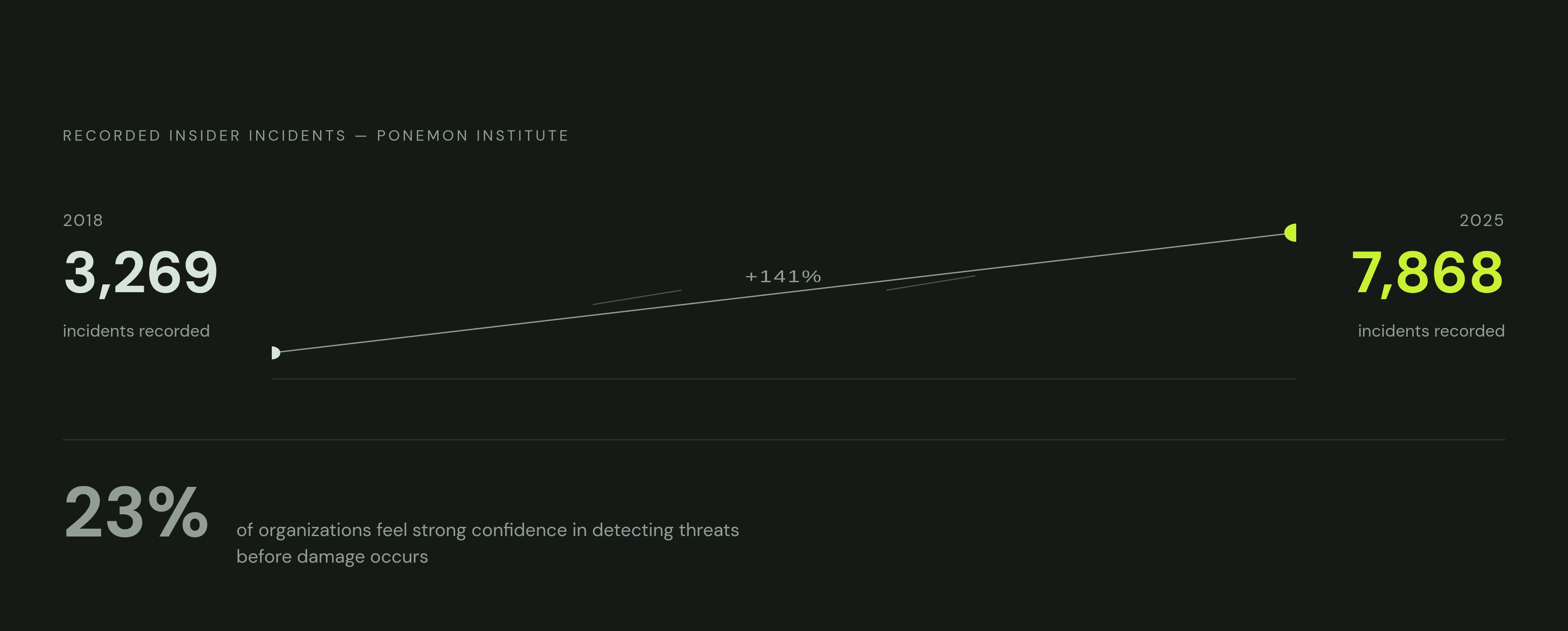
Insider incidents nearly doubled between 2018 and 2025, according to Ponemon Institute tracking, from 3,269 recorded cases to 7,868. According to Syteca, only 23% of organizations feel strong confidence in their ability to catch an insider threat before it does real damage, and most security teams respond to that number by hiring. Hiring treats a symptom while leaving the underlying methods untouched, and no amount of headcount fixes a detection method built on the wrong premise. The actual problem is methodological: static rules judge single events against fixed thresholds, when the real risk almost always lives in a pattern across time, not in any one action, which is the gap platforms like Candor Security, a behavioral DLP tool built around multi-source profiling, are designed to close. Fixing it means retiring the threshold-and-alert model as the primary line of defense.
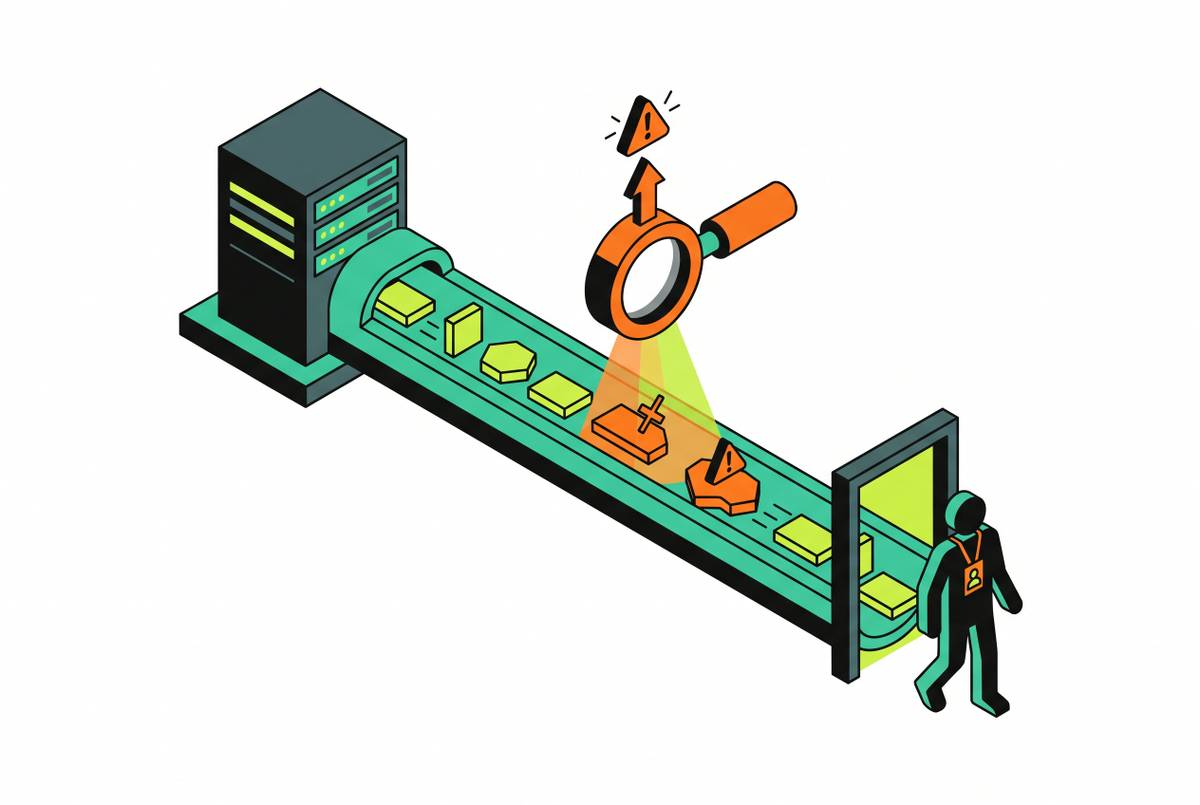
Static rules flag a download, a login at an odd hour, a large file transfer. They generate floods of alerts rather than prioritized cases, because a single event in isolation carries almost no information about intent. Downloading files, sending an email, connecting to a remote server: any of these can be entirely routine or genuinely malicious depending on what surrounds it. Insiders know their own environment, and they often act within ranges that look statistically normal even when something has changed underneath. The population behind these incidents is not monolithic, either. In 2025, 75% of insider incidents were non-malicious, split between 55% negligence and 20% credential misuse, per Exabeam's data. Any detection method that treats all insider activity as one threat class, or assumes bad intent from the start, is fighting the wrong shape of problem before it runs its first query.
What a behavioral baseline actually means in ML terms
Most people picture a baseline as a static average: "this user downloads 50 files a day." That framing does not survive contact with how these systems actually work, and clinging to it is the fastest way to build a detector that misses everything interesting. A baseline, in machine learning terms, is a learned probability distribution over a user's behavior space: time of activity, resource types touched, volume, sequence of actions, and how that user sits relative to peers. An anomaly, properly defined, is a point that falls far enough outside that distribution to justify a second look.
That distinction changes what counts as anomalous in practice. A shallow baseline built on volume alone misses pattern-level risk entirely; it will not notice that a user's sequence of actions has quietly shifted even if the daily totals look fine. A deeper baseline, one that folds in sequence, timing, and peer context, surfaces behavioral drift that a volume count would never catch.
The field leans this hard on unsupervised methods for a structural reason: labeled data for insider threats is scarce, because confirmed malicious cases are rare by definition. Renaudet et al. (2024) point to exactly this data sparsity as a core challenge, since insider activity tends to be subtle as well as infrequent. Training a supervised classifier the way one trains a spam filter, on thousands of confirmed positive and negative examples, simply is not possible here. Privacy limits on what user data can even be collected and modeled add a second constraint on top of the algorithmic one, shaping what a baseline can see before the modeling question comes up at all.
Unsupervised methods: building a picture of normal without labeled examples
Unsupervised learning became the workhorse of behavioral detection for the reason described above: there is rarely enough labeled bad data to train against. These models train on activity presumed normal, then flag whatever deviates from the distribution they learned. No prior attack example is required to catch a new one.
Clustering methods, k-means and DBSCAN chief among them, group users by behavioral similarity and treat anything that fails to fit any cluster as an outlier. They catch gross deviations from peer norms fast; a user whose behavior looks nothing like any group in the organization stands out immediately. Their weakness is that clusters are snapshots. A user who drifts slowly within a cluster, shifting week over week without ever leaving the group's rough shape, will not trip this kind of detector. That blind spot matters more than the clustering literature tends to admit, and it is exactly the shape of drift that precedes most negligence-driven incidents.
Isolation Forest and related tree-based scorers work on a different principle: they measure how quickly a data point can be isolated through random partitioning, on the logic that anomalies split off faster than normal points do. This runs efficiently even on high-dimensional enterprise telemetry, which makes it a practical fit for large environments. It struggles, though, when anomalies cluster densely together, or when an adversary deliberately mimics normal group behavior to blend in.
One-Class SVM takes yet another approach, learning a tight boundary around what normal looks like and treating anything outside that boundary as anomalous. Renaudet et al. (2024) found it particularly strong at identifying anomalies from benign behavior alone. Its weak point is sensitivity: kernel choice and hyperparameter tuning matter a great deal, and on small datasets it overfits to quirks in that particular sample rather than genuine behavioral structure.
Autoencoders, a self-supervised neural approach, train to compress and then reconstruct normal behavior; a high reconstruction error on new activity signals something the model does not recognize. These handle unstructured or mixed data well, logs, text, and file metadata together, in ways simpler statistical methods cannot.
The autoencoder should rarely be the first reach, and teams that grab for it first are usually solving for the wrong thing. Start with the simplest model that fits the data, clustering or Isolation Forest in most cases, and add depth only once that simpler model demonstrably fails to catch something it should. Skipping straight to the most sophisticated architecture on offer produces an output nobody in the room can defend during a postmortem. That failure does not show up on day one. It shows up months later, when someone finally asks why the model flagged a case and nobody can answer.
Sequence modeling and why order of events matters more than event counts
The core insight behind sequence modeling is that the same set of actions carries wildly different risk depending on the order they happen in. Accessing HR records, then downloading them to a personal device, then connecting to cloud storage, is a pattern worth flagging. Any single step in that chain, taken alone, is unremarkable; plenty of employees access HR records or use cloud storage on any given day. Rule-based systems evaluate each event on its own. Sequence models evaluate the trajectory, and that difference is the entire argument for using them over anything that scores events one at a time.
LSTM networks (Long Short-Term Memory) hold memory across sequences of variable length, which lets them learn something like "this user always follows a login with these three resource accesses" and flag it when that order breaks down. They perform well on log sequences where order carries meaning, though they run heavier computationally and need enough history per user before the model becomes reliable.
Convolutional neural networks, typically associated with image data, get applied here to temporal activity windows to catch local patterns: bursts of activity or short repeated sequences that tend to precede exfiltration. They are often paired with LSTMs in hybrid setups, one layer catching local bursts, the other tracking long-range dependencies across a session or a week.
Transformer-based models bring attention mechanisms into the picture, which means the model learns to weight which past events matter most to judging a current action, not just what happened but which prior events make this one suspicious. These are seeing growing use in security log analysis, particularly where sequences run long and anomalies sit sparse within them.
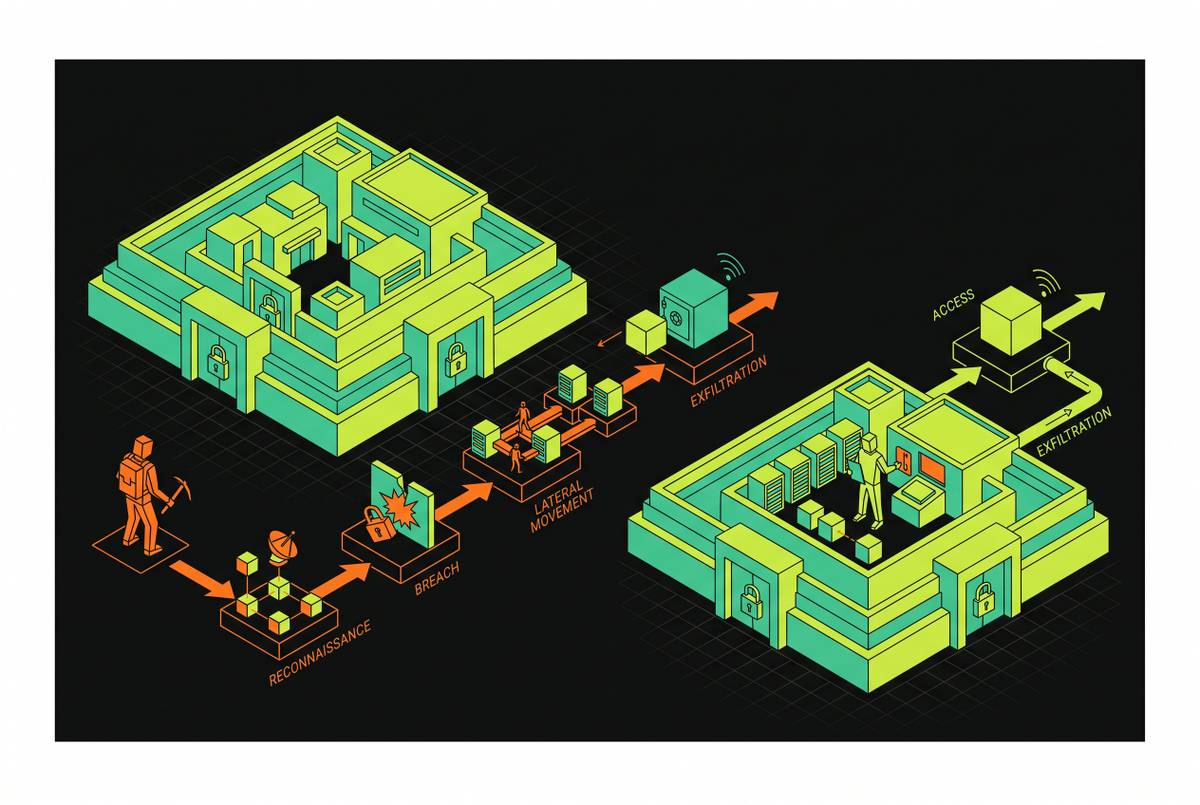
Song et al. (2024), in the BRITD framework, made a further point explicit: aligning detection with a user's natural behavioral rhythm, the hours and days that person typically works, cut false positives by 15% in their results. Temporal context is not only about the order events occur in; it is also about whether an action happens at a moment consistent with that person's own established rhythm. Sequence modeling gives practitioners something rule-based systems structurally cannot produce: the difference between noting that a user moved some data, and recognizing that a user's last six actions trace a staging-and-exfiltration pattern.
Ensemble and hybrid architectures: why combining methods outperforms any single approach
No single algorithm covers the full behavioral surface, and betting a detection program on one is the second major mistake teams make here, right after treating this as a hiring problem. Point detectors like Isolation Forest catch volume and access anomalies well. Sequence models catch pattern and order anomalies. Peer-group models catch relative deviation within a role. Combine the three, and the blind spots each one carries alone start to close.
Work cited in arxiv 2601.00893 found that combining traditional statistical tools with neural architectures produced better results, faster detection, and more resilience than either approach running alone. A 2024 ACM framework that integrated deep learning with multi-model ensemble techniques for enterprise systems showed measurable gains on large real-world datasets, improving detection precision and processing speed while cutting false positive and false negative rates at the same time.
In practice, ensemble voting works by having multiple models each score an event or a session, then aggregating those scores into a single risk value. An action flagged by only one model out of several might be noise. The same action flagged by three models across three dimensions, volume, sequence, and peer deviation, earns escalation. It is the architectural version of requiring corroborating evidence before a case reaches a human.
This structure also attacks the false positive problem head-on. Industry practitioners widely recognize that false positive rates remain high in systems that score on a single dimension. Multi-model confidence scoring cuts down on exactly that kind of single-signal false escalation. The trade-off is that ensemble systems are harder to explain to the analyst reading the case, so explainability has to be designed in from the start, not bolted on after the models are already running in production.
The peer-group problem: individual baselines vs. role-based norms
Production systems generally choose between two baseline philosophies, or combine them. An individual baseline models each user against that user's own history. A peer-group baseline compares each user against a cohort with similar roles, access levels, or organizational position. Running only one is a design gap. It does not show up immediately; it shows up later as a missed case, which is exactly what makes it dangerous.
Individual baselines catch personal drift: the employee whose behavior shifts after a termination notice, or whose access pattern changes gradually over weeks leading up to an exfiltration event. Their weakness is that they need enough individual history to work from, which leaves new hires and anyone with an irregular schedule hard to baseline reliably.
Peer-group baselines catch the outlier within a role, the one finance analyst pulling payroll records far more often than every other analyst on the team, and they work even when individual history is thin. But if the entire group's behavior shifts together, during a merger, an audit, or a reorganization, the peer norm shifts with it, and the anomaly gets masked rather than surfaced.
Layering both is the stronger design, and treating them as interchangeable is a mistake. CERT dataset analysis by Renaudet et al. (2024) found that 85% of anomalous behaviors traced back to job dissatisfaction or financial incentive, which suggests the more meaningful signal often sits in longitudinal drift within a single person's pattern rather than in a one-time peer comparison. According to Hacking Loops, cross-functional insider threat teams combining these signals detect incidents 64% faster than teams that do not.
There is a direct design consequence buried in that finding. A system that only retains a short rolling window of user history cannot structurally detect slow drift, no matter how good the algorithm running on top of that data happens to be. The retention model matters as much as the model architecture, and a team that skimps on retention to save storage costs is quietly capping its own detection ceiling. That decision gets made at the data-architecture stage, long before anyone picks an algorithm, and no algorithm downstream can undo it.
What adversarial ML means for behavioral detection systems
A sophisticated insider, or an external actor operating on stolen credentials, can learn to evade an ML-based detector over time by staying inside the ranges the model has already learned to treat as normal. Doing this repeatedly and gradually shifts the baseline itself, a technique sometimes called slow poisoning or model drift exploitation. Evading a static rule, by contrast, usually takes one clean bypass and is done.
Adversarial attacks against security models are a recognized and growing concern. Security practitioners recommend continuous model validation in real time, tracking accuracy, error rates, and anomalies in the model's own outputs, treating the model itself as something that needs monitoring. Techniques like applying anomaly detection to a model's behavior, alongside methods such as defensive distillation, help flag when a model has been compromised or has drifted in a way an adversary engineered.
Retreating to static rules out of caution feels safer, but that instinct is backwards. Rules are easier to enumerate and bypass than a well-monitored behavioral model, so the retreat trades a manageable problem for a worse one. The stronger response is retraining audits on a schedule, not just at initial deployment, and treating model performance metrics as an operational signal worth watching in their own right, alongside detection counts. Explainability belongs on that list too, as a security property and not merely a convenience for the analyst reading a dashboard. If analysts can see why a case surfaced, they can also notice when the reasoning stops making sense, often the first sign a model has started drifting. A black-box score nobody can question is the worst outcome on the table: hard for an unsophisticated actor to get past, and easy for a patient, sophisticated one to drift past unnoticed.
How the method chosen determines whether analysts get signal or more alerts
Everything an analyst does sits downstream of the detection method chosen upstream. A point-anomaly system running on a low threshold produces a high volume of alerts and a low rate of usable cases. A sequence-aware ensemble system layered with peer-group context produces fewer cases, but each one carries more actual signal. Analyst time gets spent at the output end of this pipeline, and no amount of headcount fixes a method that surfaces the wrong things in the first place.
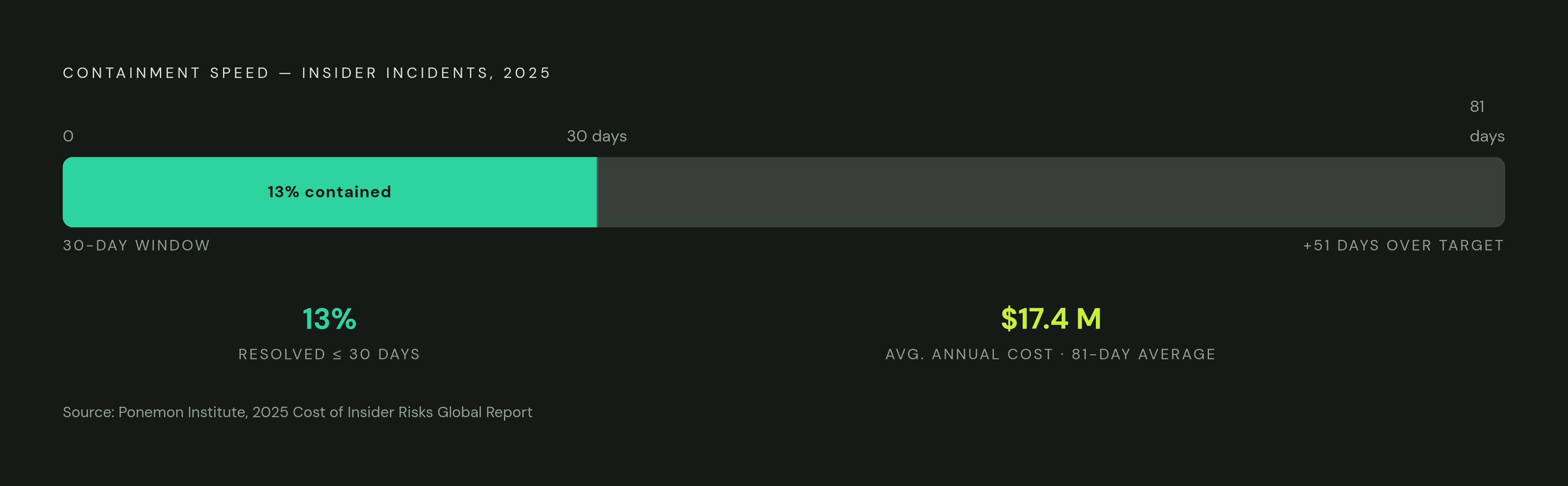
Getting this wrong carries a real cost, well beyond mere annoyance for the analyst team. Ponemon's 2025 figures put average time to detect and contain an insider incident at 81 days, a window long enough to compound exposure and remediation costs considerably, and the global average total annual cost of resolving insider incidents reached $17.4 million per organization that year. Only 13% of incidents were contained within 30 days, and the detection method in place is a major variable behind that gap between the fast cases and the slow ones.
Evaluating an ML approach for behavioral detection comes down to a short set of concrete questions. Does the system model individuals over a long enough history to catch slow drift, or only a short rolling window that erases it? Does it account for sequence and timing, or only volume? Does it layer peer comparison against individual baseline, or rely on just one? Does it combine multiple models so a single false signal cannot trigger escalation on its own? Does it produce outputs an analyst can actually interrogate, or a score that has to be taken on faith?
The answers to those five questions, more than headcount or alert volume, decide whether a security team is looking at signal or just staring at more noise.