AI Security Tool Deployment in Isolated Tenant Infrastructure
Vendors obscure whether their isolation actually protects tenant data from cross-tenant access.
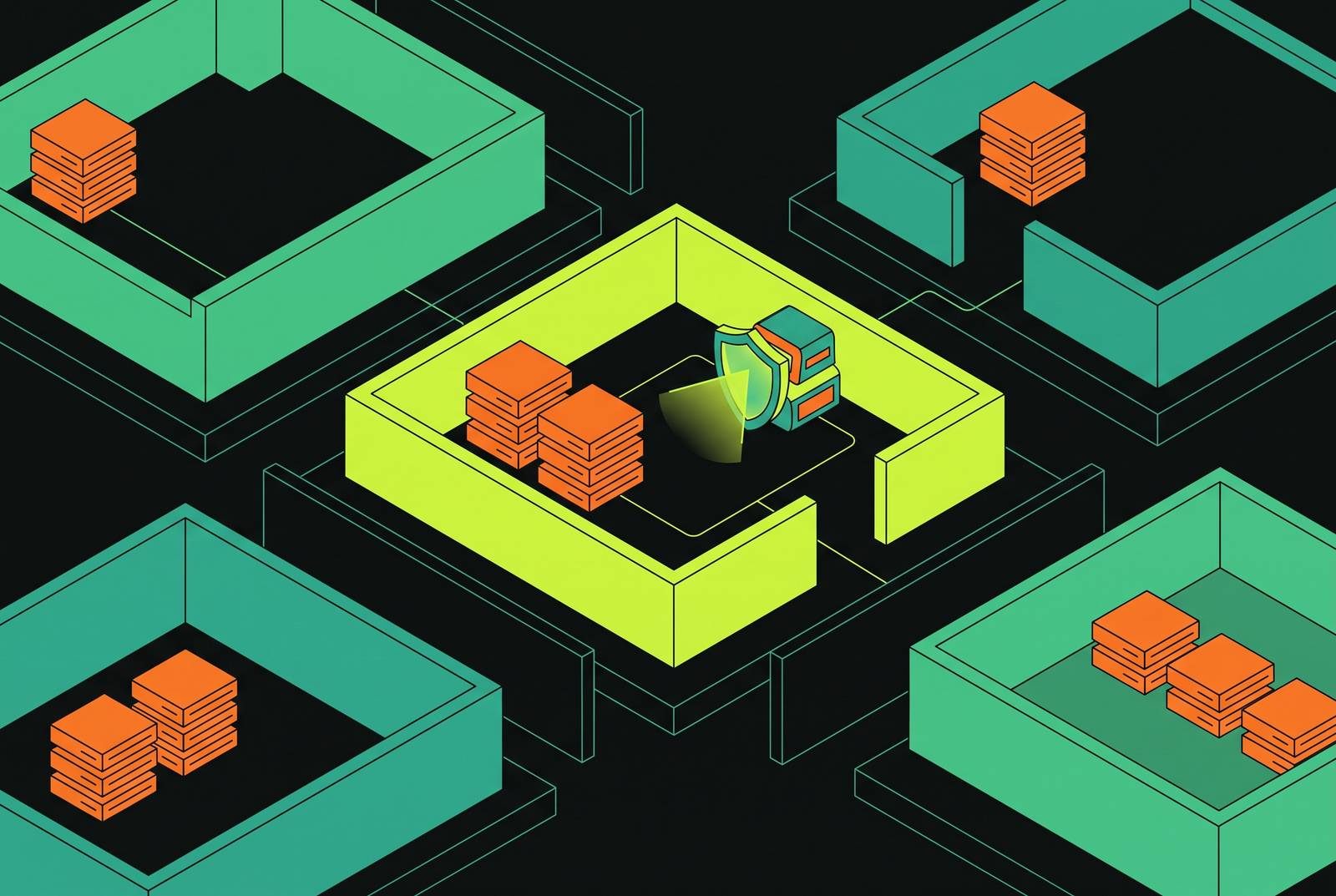
Multi-tenant AI infrastructure lets organizations share compute, but it cannot let them share data, models, inference results, or execution context. That distinction is the entire subject of this piece: how isolation works inside AI security tools, why it matters more for security workloads than for almost any other kind of enterprise software, and what practitioners should demand before they hand a vendor behavioral and identity data. Isolation architecture that lags behind agent adoption sits inside production systems today as a live exposure, and most vendors are not being straight about which side of that gap their product falls on.
What isolation actually means (and where shared infrastructure quietly fails)
Access control and isolation get used interchangeably in vendor conversations, and that habit is worth breaking early. Access control governs who can read data once it has landed in a shared space. Isolation stops the data from reaching that shared space in the first place. Most vendors sell you the lock and call it the room, and buyers who don't know the difference pay for a guarantee they never actually got.
Shared infrastructure fails in a few specific, well-documented ways. Standard containers share the host operating system's kernel, which is fine for a SaaS billing dashboard and not fine when tenants are running LLM-generated code or calling external tools through an agent. Co-located workloads also run into the noisy neighbor problem: one tenant's runaway inference job can slow down every other workload sharing that hardware. Then there's credential scope. Agents deployed with near-admin access represent a serious supply chain risk in AI systems; a single compromised tool server, or one successful prompt injection, escalates straight to full-environment access. In a shared execution environment, any one of these failure modes stops being an internal problem and becomes a cross-tenant incident.
Documented container runtime vulnerabilities in recent years are worth sitting with here. Even widely trusted container runtimes have exposed multi-tenant environments in cases where users controlled their own images. That's a close match for enterprise AI deployment today, where tenants configure their own agents and tool calls. Vendor marketing tends to flatten all of this into the single word "isolated," but network segmentation, encryption at rest, and role-based access each close a different gap, and none of them closes the others. A tool can encrypt data thoroughly at rest and still run inference for two different customers on the same kernel. That single fact should end most sales calls, not open them.
The three isolation technologies enterprises are actually deploying in 2026
Three isolation approaches dominate real deployments right now, and they are not interchangeable, whatever the pitch deck implies.
Firecracker microVMs give each tenant a dedicated kernel, a hardware-level boundary that offers strong isolation for regulated and sensitive workloads. This is the right baseline for regulated data and for behavioral or identity signals, and it belongs in deployments of every size, not just the largest contracts. gVisor works differently, operating between the tenant workload and the host kernel with a lighter approach; it trades some isolation depth for lower overhead, which suits compute-heavy multi-tenant inference where the resource cost of stronger isolation becomes a practical constraint. V8 Isolates, the lightest of the three, isolate at the JavaScript runtime level. They fit narrow, latency-sensitive tasks, but nothing that runs arbitrary code or touches a sensitive data store.
For security detection specifically, where the underlying data is behavioral logs, identity events, and HR signals, Firecracker-class isolation is the floor, not the ceiling. Anyone pitching gVisor or something lighter for that workload is optimizing for their own margins, not the tenant's exposure, and that distinction should be said plainly rather than buried in a technical appendix nobody reads.
One control that is frequently overlooked and whose absence creates real exposure is service mesh, meaning mutual TLS between internal services. It's the boring, unglamorous layer that never shows up in a sales deck, and its absence deserves to be treated as a real gap, not something to shrug off in exchange for a faster rollout. On the standards side, the Model Context Protocol, or MCP, is emerging as a structured way AI agents communicate with external systems, incorporating authentication and authorization into agent-to-tool interactions. For multi-tenant security tools, MCP matters because it introduces structured controls over which tools an agent can access, rather than relying solely on a setting someone configured once and forgot about. A permission enforced structurally at the protocol layer is harder to circumvent than one that only lives in a config panel.
Practitioners evaluating a vendor should ask plainly which of these technologies sits under inference, how tenant data and models are kept separate, and whether tool permissions get enforced at runtime or only in a configuration panel nobody checks.
How data sovereignty law is turning architectural preference into compliance requirement
Two legal frameworks now sit in direct tension, and together they define the compliance map for AI security tools. The EU AI Act is moving into broad enforcement, with penalties reaching 35 million euros or 7% of global turnover for high-risk systems. Its data residency requirements push high-risk deployments toward EEA cloud regions, with expectations that data handling remain within that jurisdiction. Meanwhile, US jurisdiction over US-headquartered cloud providers does not stop at physical borders. Put those two together and a plain fact emerges: data stored in Frankfurt may remain reachable under US legal process if the company running the servers is American.
That conflict has an architectural answer, not just a compliance checklist. Inference that runs inside a tenant's own environment, or inside a legally distinct sovereign cloud, sidesteps the jurisdictional overlap entirely. Certain highly regulated sectors face the strictest requirements, where the combination of sovereignty obligations and sensitivity of workloads pushes strongly toward air-gapped or fully self-hosted deployment regardless of how the encryption looks on paper.
The practical evaluation question has shifted. Encrypting data is table stakes; the harder question is whether inference ever leaves the organization's environment, and whose legal jurisdiction it falls under the moment it does. This isn't hypothetical. Coder's 2026 AI Maturity Assessment of 100 engineering organizations found 78% already running AI agents in some form, while 69% had no security protections in place, or only ad-hoc ones, against data exposure. Most enterprises are already past the point where waiting to sort out the architecture counts as a defensible position.
Why insider threat detection is the workload where isolation failures are most damaging
Insider threat detection handles the most sensitive data category any enterprise security tool touches: behavioral baselines, identity signals, HR context, financial stress indicators, access patterns, communication metadata. This is a record of named people's behavior over time, and it's exactly the record a shared-tenant failure would expose worst.
In a shared inference environment, a model trained or fine-tuned on one organization's employee behavior could, under the wrong failure conditions, leak signals about specific individuals into a different tenant's context. That's a reputational and legal exposure, not a compliance checkbox. The Ponemon Institute's 2025 Cost of Insider Risks report put the average annual cost of insider-related incidents at tens of millions of dollars. A detection tool that becomes its own exposure vector does not offset that number; it adds to it, on top of the very incident the tool was bought to prevent.
Most organizations don't even fully understand the data feeding these models in the first place. Legal and technical review of the isolation question hits an audit gap before it even gets started, because the organization can't fully trace how employees interact with sensitive data to begin with. That partial understanding makes containment inside an isolated environment more important, not less. The most predictive behavioral signals, meanwhile, are also the most sensitive: HR flags, psychosocial indicators, financial stress markers. Few organizations fold these signals into detection at all, which means the ones that do carry genuinely unique legal exposure. Detection accuracy depends on the integrity of each tenant's behavioral baseline, and if inference runs in a shared environment, nothing in the architecture guarantees that one tenant's baseline stays uncontaminated by another's data patterns.
What legacy DLP architecture misses and why the gap is widening
Legacy data loss prevention was built around a specific threat model: file transfers, email attachments, clipboard copies. Discrete, observable movements of data that could be matched against known patterns. That model has three structural blind spots today, and fixing one doesn't touch the other two.
First, AI prompts. When an employee pastes a client list into a generative AI chat window, no file moves and no email gets sent. The data leaves in a form legacy DLP was never built to see. Second, agent tool calls: legacy DLP has no concept of the Model Context Protocol, or of an autonomous agent's execution plan, so it can't observe what an agent touches on a user's behalf. Third, Widely cited industry analysis has identified encrypted traffic, intent blindness, and shadow AI as categories where conventional DLP simply can't manage GenAI data loss risk.
The shadow AI surface keeps growing, too, and most of what's running is unsanctioned by IT. AI agent adoption at the endpoint level has grown rapidly, expanding the shadow AI surface well beyond what IT-sanctioned SaaS tools account for. Static rule matching can't keep up with a surface shifting that fast, and pretending otherwise is how a DLP deployment quietly turns into shelfware.
There's an operational consequence here that gets underappreciated: false positives at volume wear down analyst trust in the tool until people quietly start ignoring it. A detection system too inaccurate to act on carries little practical value, whatever the pitch deck says. Compounding the problem, most legacy DLP tools sit in silos, without native integration to SIEM, UEBA, or identity platforms, which produces incomplete pictures and forces analysts into redundant triage work across systems that don't talk to each other.
What behavioral detection requires from the infrastructure it runs on
Behavioral detection works by building a baseline of what's normal for each user over time, then flagging what breaks from it. That takes continuous, longitudinal access to identity signals, access logs, endpoint activity, and HR context, held together over weeks and months, not processed once and thrown away. This runs directly against a stateless, throwaway processing model, and the mismatch matters, because plenty of infrastructure built for other AI workloads assumes exactly the opposite pattern.
Isolated tenant infrastructure is the prerequisite that makes this safe: each tenant's behavioral models, training data, and inference output need to stay fully contained, so that one organization's employee baselines can't influence, contaminate, or leak into another's. Detection quality also depends on how deep the integrations run. A tool that only sees endpoint activity misses the pattern entirely, because the real signal lives across identity providers like Okta, endpoint tools like CrowdStrike, collaboration platforms like Google Workspace or Microsoft 365, HR systems like Workday, and SIEM platforms like Splunk. Every one of those integration points needs the same isolation guarantees as the core platform itself, or the whole chain is only as strong as its weakest connector.
Explainability belongs in this same infrastructure conversation, not off in a separate UX discussion. When an alert flags a behavioral pattern, the analyst needs the assembled timeline: which signals, from which sources, over what period. That audit trail has to live inside the tenant's isolated environment, not in some shared logging layer sitting outside the boundary the rest of the architecture just spent so much effort building. Deployment speed matters here too. Most organizations are still in the early stages of insider risk maturity, per Fortinet's 2025 report, and a platform that takes a quarter to stand up delays the behavioral baselines that make the whole system useful in the first place.
The alert volume problem that isolation alone does not solve
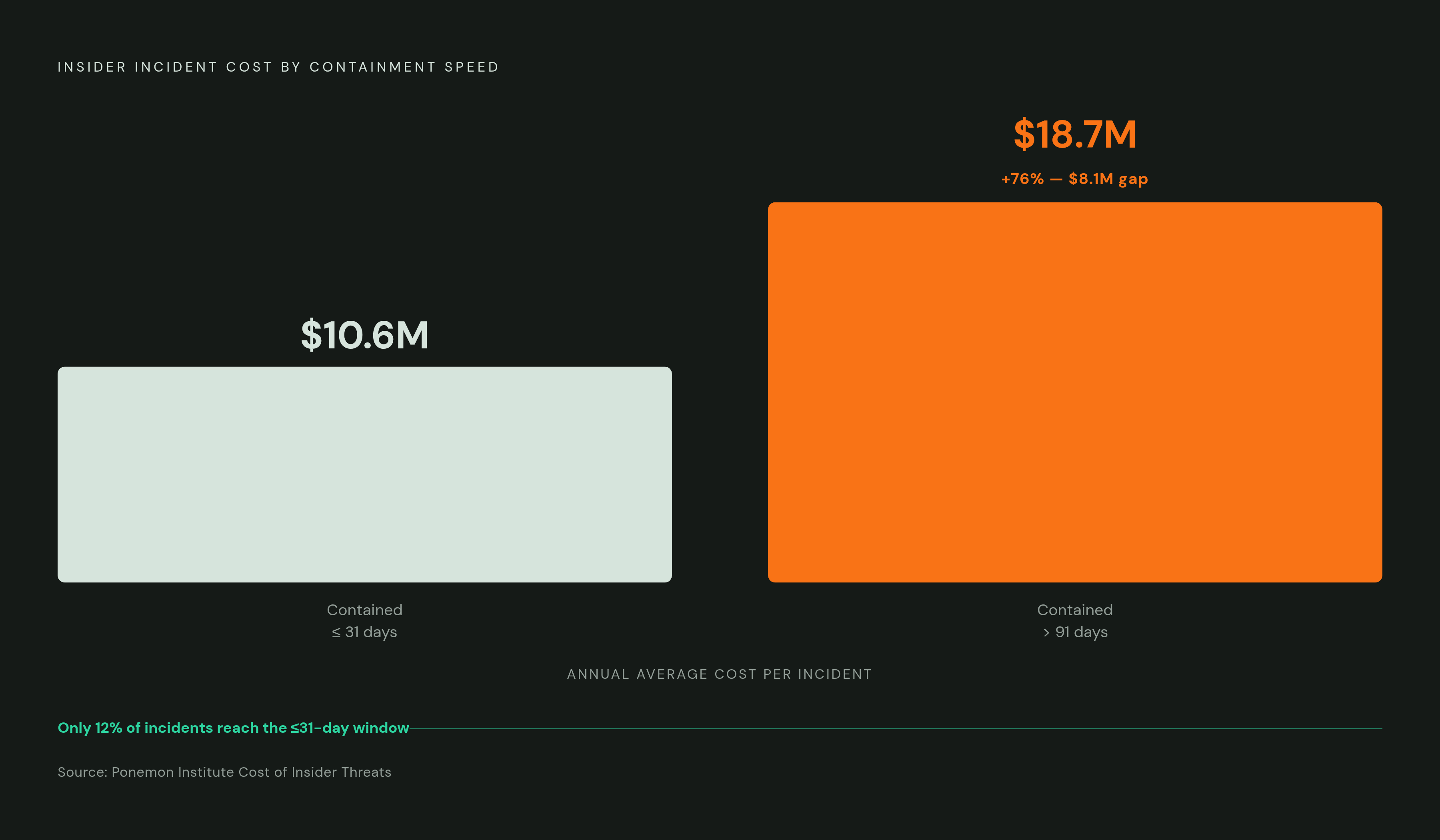
Isolation solves a containment problem. It does nothing for the speed problem, and the data on speed is stark. Incidents contained within 31 days cost organizations $10.6 million a year on average; incidents that take longer than 91 days cost $18.7 million, 76% more, according to Ponemon and DTEX research. Only 12% of insider incidents get contained inside that 31-day window. The bottleneck sits in the gap between signal and analyst action, more than in detection architecture by itself.
Spending reflects that imbalance directly: organizations put roughly $211,021 into containment per insider incident, against just $37,756 spent on monitoring. That ratio says plainly how underinvested the detection layer is relative to the cleanup that follows a miss. Alert floods from legacy tools are a big part of why. Once analysts stop trusting alerts, every single one needs manual digging to verify, and that digging is where the 91-day cases come from. Candor Security, a behavioral DLP platform for modern enterprises, is built specifically around this problem, surfacing pre-assembled cases rather than raw alerts.
The real promise of behavioral AI, stated plainly, is this: surface only the cases that actually warrant attention, with the context already put together around them. The analyst's job shifts from sorting through noise to deciding what to do about a case that's already built. That takes a pre-assembled timeline, the relevant signals stitched together, and the anomaly explained in terms of what changed from baseline, delivered as a finished case rather than a raw ping on a dashboard.
What a mature evaluation looks like when assessing AI security tools on these criteria
Ponemon's 2026 research found organizations with formal insider risk programs save $8.2 million a year and avoid roughly 7 incidents annually. The return on the right tooling isn't in dispute. What's actually in question is which tools deliver the architectural groundwork laid out above, and which ones just claim to. The only way to tell the difference is to ask directly, and refuse the answer that comes back vague.
On isolation, ask whether inference runs inside the organization's own environment or whether data has to leave for shared cloud processing. Ask which isolation technology sits under the agent runtime: container, microVM, or something else entirely. Ask whether model weights and behavioral baselines get stored per tenant or shared across customers, and whether tool whitelisting is enforced at runtime or only sits in a configuration file that a clever prompt could route around.
On data sovereignty, ask which legal jurisdiction the inference data falls under, and whether that answer changes when the provider is US-headquartered regardless of where its servers physically sit. Ask whether audit logs are written and kept inside the organization's own region, and whether air-gapped or fully on-premise deployment exists as an option if a regulator eventually demands it.
On detection quality, ask whether the platform ties together identity, endpoint, HR, and collaboration systems, or only a narrow slice of them. Ask whether behavioral baselines get built per user over time or whether detection is purely event-based, a far weaker signal. Ask whether the platform can tell the difference between negligence and malicious intent in how it routes a response. Ask whether the alert landing on an analyst's screen is an assembled case with a timeline, or a raw signal that still needs hours of manual digging behind it.
Deployment timeline deserves a place on this list too, as a genuine detection quality signal rather than a mere convenience factor: a platform that takes months to deploy is a platform that delays the behavioral baselines it needs to be useful at all. One answer overrides every other consideration in this evaluation, though. Customer data must never leave the tenant's environment, and it must never train a shared model across customers. Any vendor that hedges on that question, rather than answering it plainly, has already answered it.