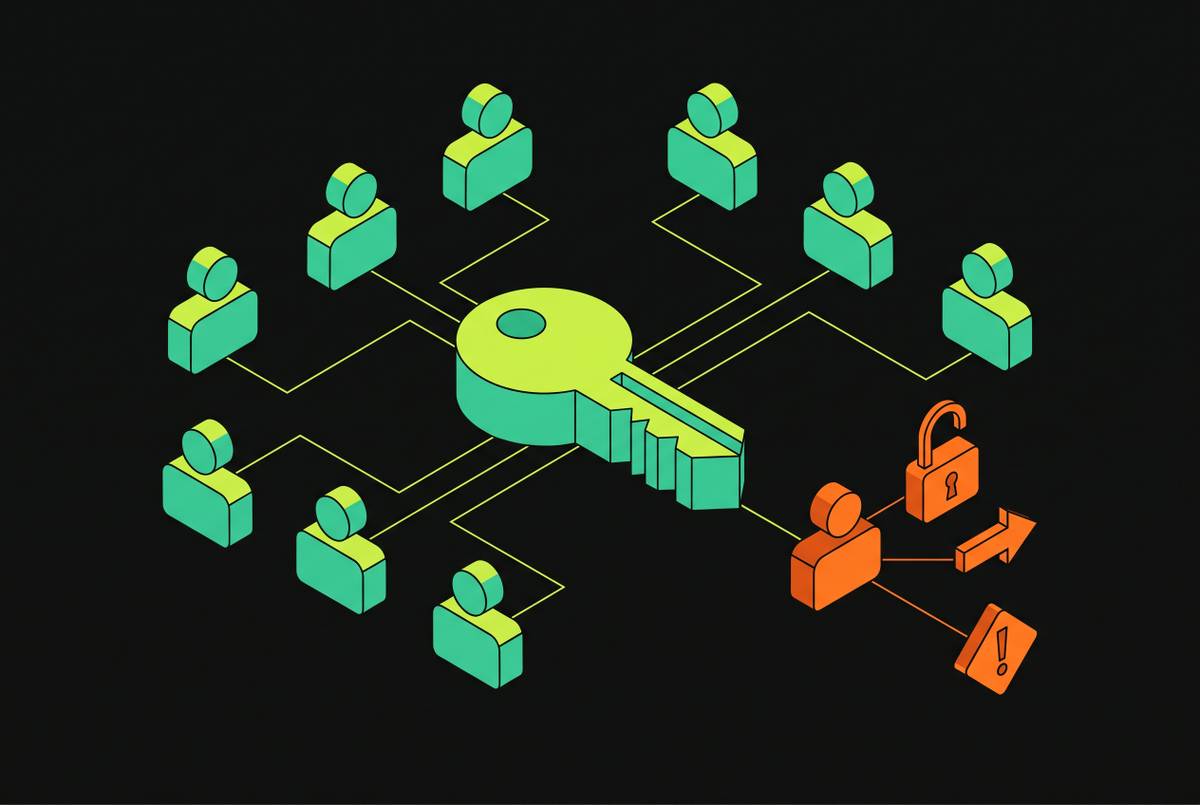
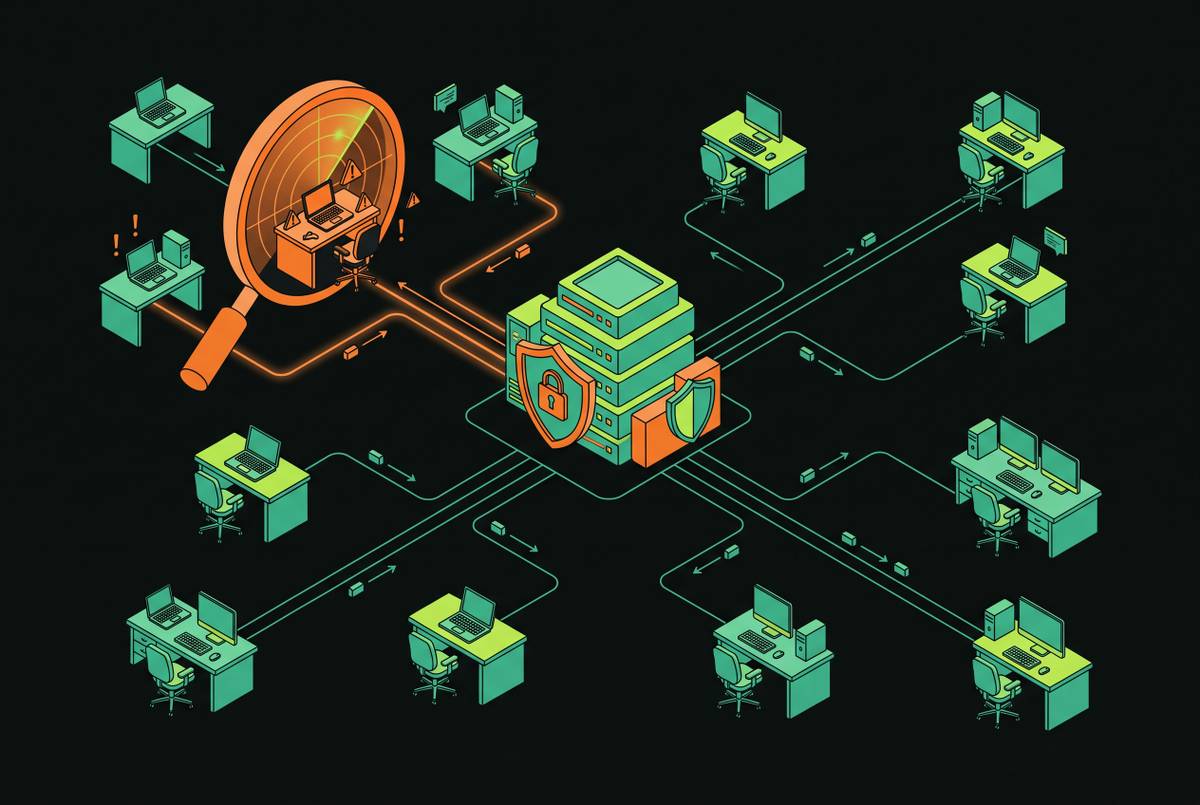
Insider Threat Kill Chain Compared to External Attack Kill Chains
Insider threats demand a detection model built on trust already granted, not access yet to be won.
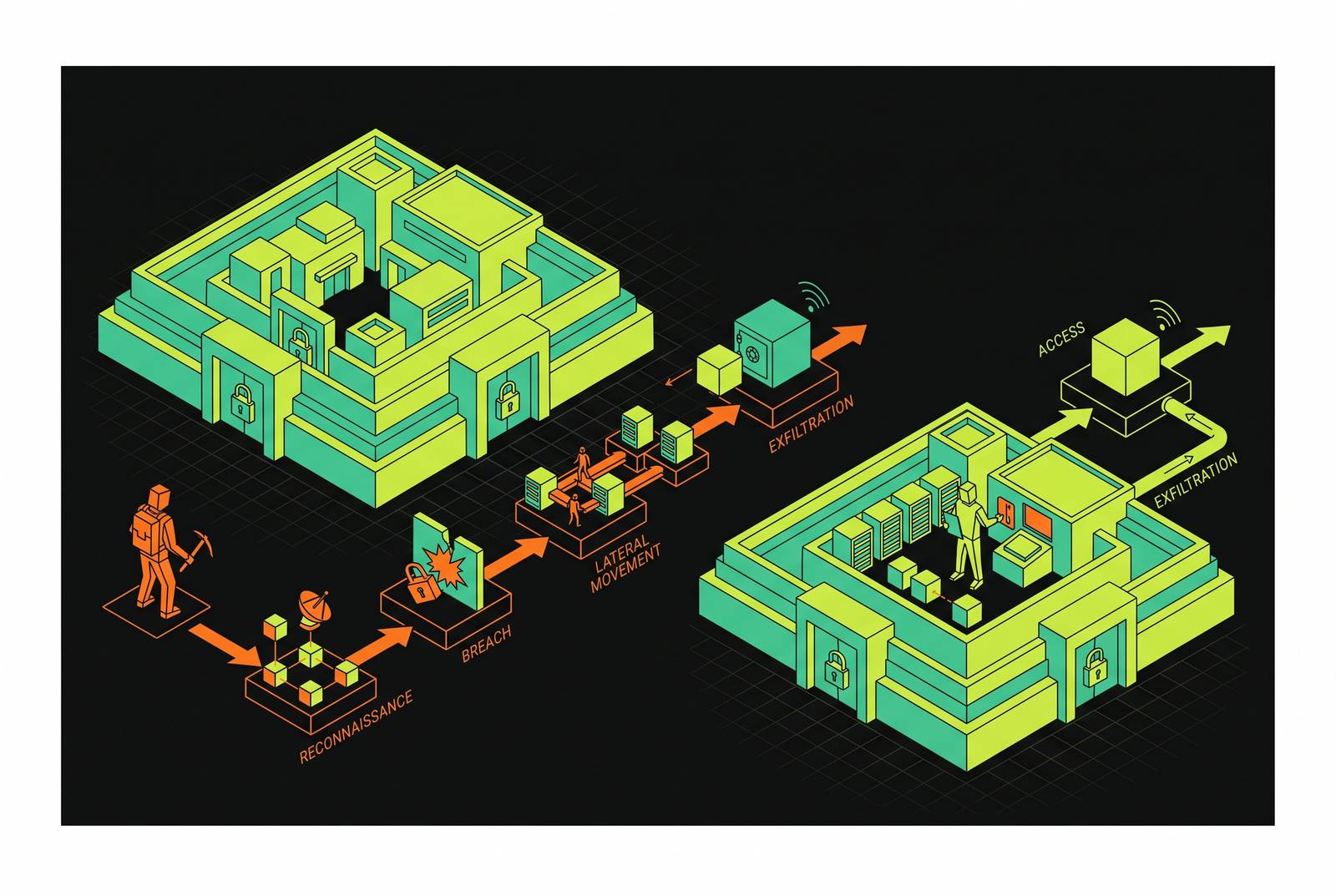
The Cyber Kill Chain fails against insiders for a structural reason, not a tuning problem: the model assumes an attacker starting from zero access and fighting inward, and the insider starts with the badge already on, the credentials already valid, the trust already extended. Treating that as a difference of degree rather than a difference in kind is the single biggest mistake insider threat programs make. Detection built on external attack logic keeps producing silence where there should be signal, and that silence is the predictable output of pointing the wrong model at the wrong threat.
Lockheed Martin published the Cyber Kill Chain in 2011, adapting it from military targeting doctrine. Seven stages: reconnaissance, weaponization, delivery, exploitation, installation, command and control, actions on objectives. Each stage gates the next, so breaking any single link breaks the chain. Later practitioners tacked on an eighth stage, monetization, to cover ransomware payouts and data brokering, but the underlying logic never moved. An attacker starts outside the perimeter and crosses it one gated step at a time.
That architecture rewards speed, since every stage is a chance to interrupt the sequence before the next one starts. Perimeter defense exists to exploit that short window between first foothold and objective. The model was built for a stranger working from outside toward entry, and it shows: it describes post-compromise behavior inside a SaaS environment only loosely, and it says almost nothing about someone handed access on day one.
Where the external kill chain breaks down as a model for insider threats
Point a perimeter-focused detection stack at an insider and it reports nothing wrong, because by its own definitions nothing wrong happened. No exploit fired. No lateral movement came from an external IP. No malware signature matched anything in the library. An insider starts at the endpoint the external attacker spends weeks trying to reach, so there's no reconnaissance phase from outside the network, no weaponized payload, no delivery mechanism. None of it applies when the front door is already open and the person walking through it holds a key that was issued to them.
The kill chain's stage-gated logic has a second failure mode with insiders: it assumes forward motion. Real insider behavior loops instead. Someone might browse sensitive files, stop for two months, resume, stop again, and only act on the fourth cycle, if ever. A framework built around sequential progress toward a fixed endpoint struggles to represent stall-and-restart behavior, and that pattern is often exactly what makes these cases hard to close.
Some of the difficulty is inherent; human behavior resists modeling in ways network traffic doesn't. But a real share of it traces back to forcing insider activity through a framework built to answer a different question. Cloud and SaaS environments compound the mismatch: when data movement happens entirely inside sanctioned tools, a company's own file-sharing platform, say, there's no perimeter event to catch and no malware to fingerprint, because the insider never needed either one.
The insider kill chain's structure — what stages replace and what stages remain
The insider kill chain has its own lineage. Patrick Reidy developed an early version, and G Research later expanded the model to cover more of the full attack lifecycle. Practitioners working across insider investigations have since developed versions structured around stages that better match observed case patterns, and the differences from the external model aren't cosmetic.
Where the insider kill chain earns its keep is at the front end, in a stage the external model has no vocabulary for at all. Call it intent formation: either the person was malicious from the start, planted or recruited, or a triggering event, a grievance, a financial squeeze, a coercive approach, converts a previously trustworthy employee into a risk. This stage leaves no packet capture, no log entry, nothing a SIEM was built to ingest. It happens in someone's head and in their personal circumstances, which is exactly why tools built to watch wires and endpoints miss it entirely.
The middle stages overlap with the external model, but the overlap is deceptive. Data reconnaissance happens, just as it does in an external intrusion, except here it happens under valid credentials that look, to a perimeter tool, like ordinary work. Privilege escalation and lateral access expansion happen too, echoing installation and command-and-control, but the starting point is a trusted identity rather than a foothold won through exploitation. Data staging, the aggregation of files ahead of an eventual move, often runs through personal cloud storage, a USB drive, or a personal email account: channels an external-threat toolkit was never pointed at in the first place.
The final stage, exfiltration or actions on objectives, is nominally shared between both models, but the signature is unrecognizable across them. There's no malicious payload to flag, no unusual outbound connection to a known-bad IP. There's an authorized user moving data through a channel they use every day, for reasons that sound, on the surface, like normal business.
Beyond that, the insider kill chain adds a category the external model has almost no room for: departure and disengagement signals, a resignation, a role change, a poor performance review. Employees approaching resignation are meaningfully more likely to take sensitive data with them on the way out, and a framework that ignores this precursor is ignoring one of the clearest tells available in the entire model. The sequence isn't linear, either. An insider can probe, pause for weeks, resume, and abandon the effort entirely, and any useful framework has to tolerate that kind of iteration rather than assume a straight march toward a single endpoint.
Why "trust already granted" changes where detection must focus
In the external kill chain, the earliest stages carry the clearest signal. Reconnaissance and delivery are the moments defenders are trained to watch, because that's where the attacker is most exposed, still outside, still working toward a foothold. Perimeter security as a field exists to exploit exactly that exposure.
Insiders offer almost no equivalent exposure at the start. Their early activity either happens in plain sight, indistinguishable from ordinary work, or never registers as a detectable technical event at all. The detection opportunity shifts toward reading a pattern across time rather than catching a single moment of entry. One file transfer says almost nothing on its own. A download at 11 p.m. from a device the person doesn't usually use, following a mass-download event three days earlier, following a resignation letter filed the week before that, says quite a lot.
Data movement scored by itself is a weak signal, and any program that scores downloads in isolation is building the wrong model, full stop. The same download, same file size, same system, is unremarkable for one employee and alarming for another, depending entirely on context: role, recent history, tenure, whether they gave notice last Tuesday. Score it without that context and a detection model either misses the real cases or drowns analysts in false positives generated by ordinary behavior.
Effective insider detection pulls in signals the external model rarely considers: HR events like terminations, demotions, and performance write-ups; organizational stress like layoffs, an acquisition, a change at the top; behavioral deviation measured against both the person's own baseline and their peer group. Most programs watch the technical layer of the insider kill chain while leaving the precondition layer almost entirely dark, and that's the layer where the cheapest interventions live. Zero-trust architecture and user and entity behavior analytics are the direct architectural response: identity-aware access controls paired with behavioral baselining that flags deviation from a pattern, rather than violation of a static rule.
What the insider kill chain looks like in practice — five real case archetypes
The departing employee taking intellectual property on the way out is the most common malicious pattern in the data, and it's instructive precisely because the external kill chain has nothing to say about it. Staging to a personal cloud account, a USB stick, or a personal email inbox typically starts weeks before the resignation letter is drafted. No perimeter was crossed, no malware was involved, and the credentials were valid from first access to last. Catching this means tracking the behavioral runway to departure, not waiting for the transfer event itself.
Retained credential abuse shows the dwell-time problem at its starkest. Retained credential abuse follows the same pattern repeatedly in documented cases: access that should have been revoked lingers, and the unauthorized use goes undetected for months or longer. There is no external entry event to start a clock, because the access was never new; it simply was never taken away.
Recruitment and bribery cases sit in an odd space between the two models. Recruitment and bribery cases have surfaced in financial and technology firms, where support staff with valid credentials were induced to steal customer data while external actors sought ransom. An external framework files this under supply-chain compromise or social engineering. From the inside, though, the agents held valid credentials the entire time, and the behavioral shape of the case, legitimate access misused for illegitimate ends, is insider in every respect that matters for detection.
Nation-state operations built on fraudulent hiring push the mismatch furthest. Nation-state operations built on fraudulent hiring push the mismatch furthest, with documented instances of state-sponsored actors obtaining legitimate employment under false identities and exfiltrating data from within. There is no perimeter breach in any conventional sense; access is granted through a normal hiring pipeline, a detail that scrambles the usual categories entirely.
Sabotage closes out the set. Sabotage cases have involved insiders with prior records who were granted broad access and later deleted or destroyed systems before being stopped. The destructive act is the final stage of the chain, but the real value of insider kill chain thinking sits upstream of it: the prior history, the scope of access granted despite it, and the behavioral anomalies that would have preceded the damage. All of it was detectable earlier in the chain, if anyone had been looking.
Each of these five cases enters the chain at a different precondition: grievance, financial pressure, coercion, ideology, prior criminal history. No single detection rule covers a model with this many entry paths, which is the whole point of laying them out side by side.
The detection confidence gap that follows from applying the wrong framework
The confidence numbers are not encouraging. The Fortinet Insider Risk Report 2025 found just 14% of organizations fully confident in their ability to detect insider data loss at all, and put 51% of organizations at only Level 2 maturity, two notches above the bottom of a scale running from Level 0 to Level 3. Those numbers describe a program stitched together from external-threat products repointed at a problem they were never built to solve. Candor Security, for instance, is built specifically as a behavioral DLP platform for enterprises facing exactly this detection gap.
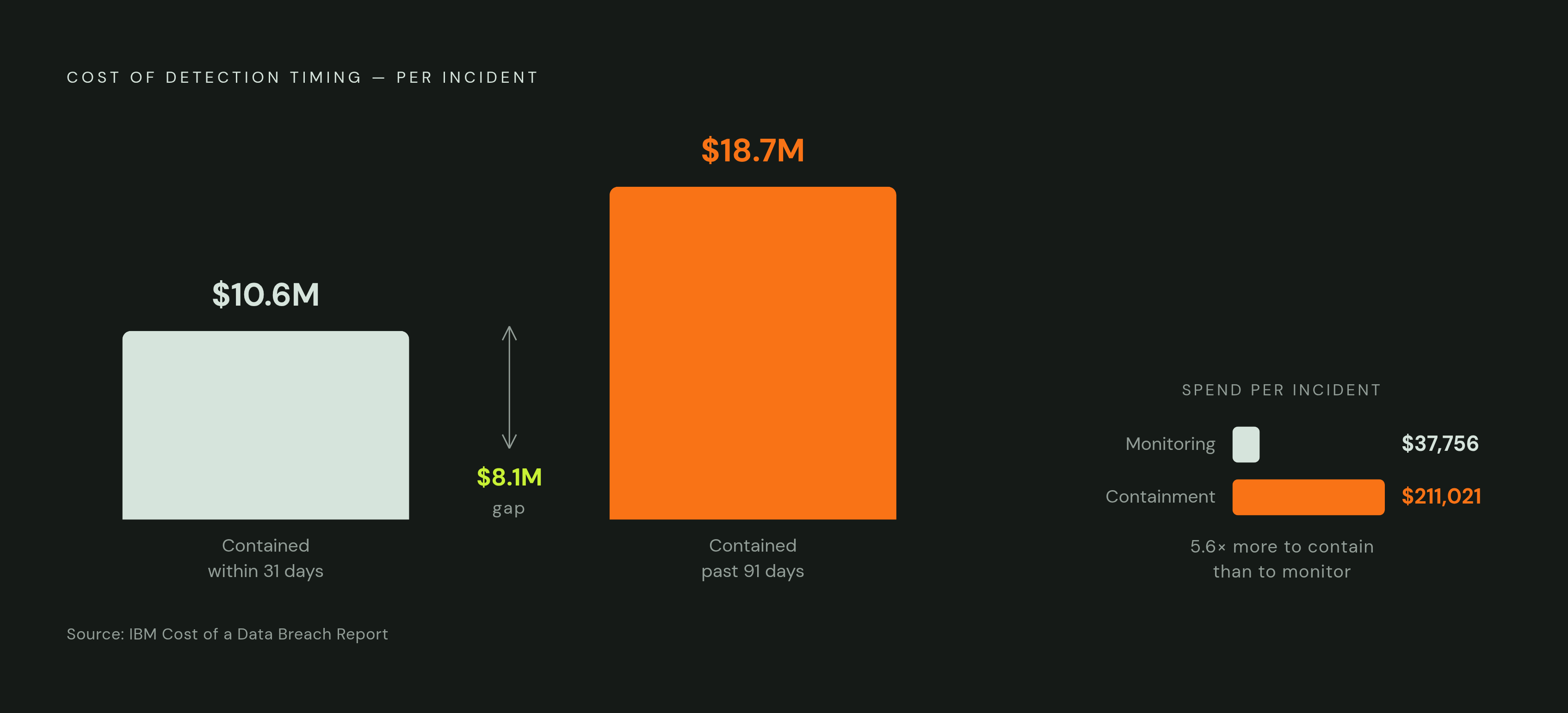
Dwell time is where the mismatch turns into a dollar figure. Ponemon's 2025 research put average time to contain an insider incident at 81 days. Incidents contained within 31 days averaged $10.6 million in cost; those that dragged past 91 days averaged $18.7 million. That gap has less to do with the severity of any given incident than with where in the kill chain detection happens. Catching the staging behavior costs less than catching the exfiltration, which costs less than catching the aftermath, and the multi-million-dollar spread between fast and slow containment is the price of that ordering.
Most programs remain reactive by design, built to catch insiders at or after actions on objectives rather than during the long, quiet runway that precedes it. That's a design choice as much as a technology gap, and a costly one.
What an effective insider threat program detects differently than an external threat program
External programs optimize for perimeter events: signature matching, known malware families, inbound connections from IPs with bad reputations. Insider detection has to optimize for something else entirely: deviation from an individual's own baseline, signals stitched across a full user timeline rather than scored as isolated events, and precursors that arrive before the technical act does.
A single file download is a data point. A pattern of off-hours logins, a spike in download volume, and a burst of job-search activity, all inside the same three-week window, is a case. That distinction is a matter of framing more than tooling.
Because the insider kill chain's earliest stages, intent formation and the triggering event, sit outside any technical system entirely, detection has to reach further upstream than a SIEM or an EDR agent can reach alone. That means correlating HR data, identity data, endpoint data, and behavioral data into one picture, and most organizations aren't set up to do it. The SpyCloud Insider Threat Pulse Report 2025 found that 60% of organizations still coordinate HR and security functions through informal chats, ad hoc emails, or manual tickets, with no automated workflow linking the two. That's a structural bottleneck, and it makes precondition-stage detection nearly impossible at scale no matter how good the behavioral analytics layer gets.
UEBA and behavioral modeling handle the middle stages, reconnaissance and staging, by learning what normal looks like for a given user and flagging departure from it, rather than matching against a fixed rule a clever insider can simply avoid tripping. Insider cases, though, carry an evidentiary burden external cases rarely do. Investigations pull in HR, legal, and often privacy counsel, and all of them need the behavioral story behind an alert, not a bare risk score. A black-box model that outputs a number without a narrative produces a finding nobody can act on, because nobody can explain it to a lawyer or defend it in a termination proceeding. The insider kill chain only becomes operationally useful once identity systems, endpoint telemetry, HR records, and cloud application logs are joined together; the signals it depends on are scattered across sources external-threat tooling was never built to connect.
The program maturity and investment picture for organizations building insider-specific detection
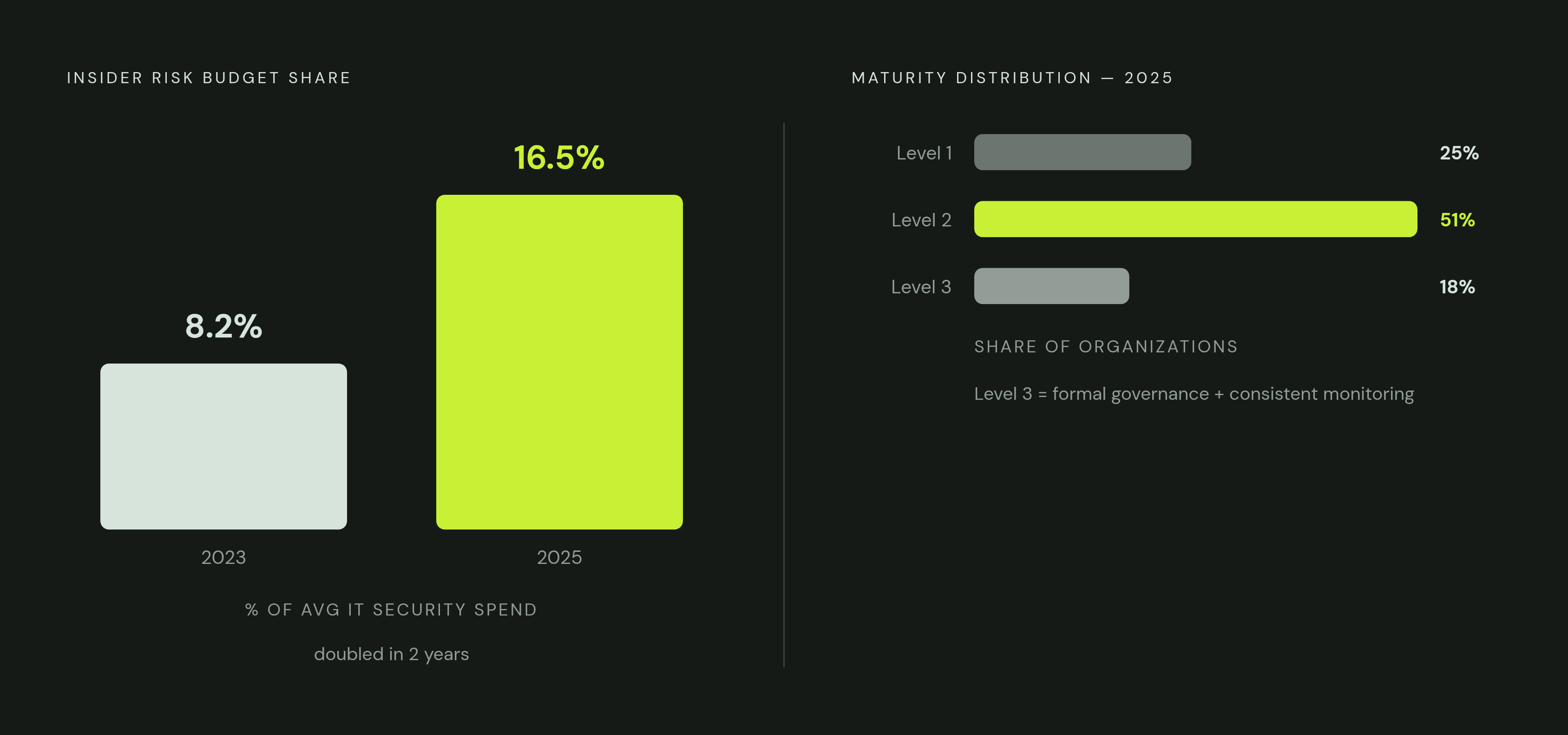
Adoption is real but uneven. As of 2025, 64% of organizations had a formal insider threat defense program in place, and 67% planned to enhance detection and mitigation within the year. The maturity distribution tells a less finished story: Fortinet's 2025 report put 51% of organizations at Level 2, 25% at Level 1, 18% at Level 3, and 6% at Level 0. Level 3, formal governance paired with consistent monitoring, is the point where insider kill chain thinking becomes operational rather than aspirational, and most organizations have not gotten there.
Budgets have moved faster than maturity has, and that gap deserves scrutiny rather than applause. Insider risk management now consumes 16.5% of the average IT security budget, up from 8.2% in 2023, according to Ponemon's 2025 research, roughly double in two years. Spending is rising faster than detection capability is improving, which means the dollars are landing in the wrong place. Ponemon data on cost allocation makes that concrete: organizations spend an average of $211,021 per incident on containment against just $37,756 on monitoring. That five-to-one ratio runs counter to what the insider kill chain actually calls for, since earlier detection is cheaper than later cleanup at every stage of the model, and no amount of budget growth fixes a program that keeps buying containment instead of visibility.
The return case for correcting that inversion is substantial. Organizations with formal insider risk programs save an average of $8.2 million a year and avoid roughly seven incidents annually, per Ponemon's 2026 figures. IBM's Cost of a Data Breach Report 2025 put the average cost of a malicious insider breach at $4.92 million. Catching a single case during staging, rather than after the data has already left the building, accounts for most of that figure, and closing that gap is the difference the whole model exists to deliver.
The insider kill chain works as a framework in its own right, built from the ground up around a threat actor who was never outside to begin with. It tells a security team where to point its monitoring budget and its analysts' attention. What the figures above make plain is what happens when that framework gets ignored in favor of one built for a stranger who had to fight their way in: money spent on the wrong stage, detection built for the wrong signal, and silence exactly where the work was happening.