Insider Threat Indicators in Privileged User Accounts
Privileged accounts demand behavioral detection, not access rules, to catch insider abuse.
Privileged accounts draw the most attention from insider threat actors because they shrink the distance between access and damage to almost nothing. Spacelift's Insider Threat Statistics put the figure directly: 80% of breaches involve a compromised privileged credential of some kind. A single trusted identity with broad permissions can do in one session what an outside attacker would need months and several stages of exploitation to pull off. That compression of effort is the entire logic behind why privileged accounts sit at the center of insider risk, not a side effect of it.
Flashpoint's 2025 intelligence shows the same logic from the attacker's side. Threat actors recorded a large volume of insider recruiting and solicitation activity that year, and the reason is straightforward: it costs far less to recruit or buy access to an insider than to build a complex exploit chain against a security stack that costs millions of dollars to defend. The insider population behind that activity is not one type of person. It includes employees who make careless mistakes, people who act with deliberate intent to cause harm, and victims whose credentials were stolen without their knowledge. All three groups gain outsized leverage the moment the account they touch carries elevated permissions, regardless of what drove them into that position.
The shift to cloud and SaaS has made the privileged account an even sharper point of failure. The 2026 Insider Threat Report found that most incidents now involve cloud and SaaS resources. Privileged console access has displaced the endpoint as the main stage where abuse plays out. An administrator's console session, not a laptop or a file server, is now where the highest-value damage tends to happen. The console is built for broad reach by design, and that same broad reach is what makes the account worth attacking, so detection has to work differently now.
What makes detecting abuse on privileged accounts structurally harder
The same properties that make privileged accounts valuable to attackers make abuse on those accounts hard to catch. Broad, legitimate access means that almost any single action an administrator takes looks authorized on its face, because it usually is. Omada's analysis frames the problem well: insiders have authorized access to sensitive information, so accessing internal data is not itself a red flag. A thorough read of behavioral indicators tells threat from normal activity, not a rule that flags the access itself.
Compromised-credential abuse makes the problem worse. When an outside attacker logs in using credentials stolen through infostealer malware, security tools record a legitimate authentication, because it is one. The Snowflake and UNC5537 campaign is the clearest recent example of this pattern: attackers used infostealer-obtained credentials to pull data from roughly 165 customer organizations, including Ticketmaster and Live Nation, Santander Bank, AT&T, Advance Auto Parts, Pure Storage, and Neiman Marcus. No malware ran on the target systems. No exploit was needed. A valid credential walked in the front door. Session token theft deepens this further: infostealers pull saved browser session tokens that can bypass multi-factor authentication entirely, so even a well-configured MFA setup does not reliably stop a privileged session once the token itself has been stolen.
The Coinbase breach, reported in May 2025, shows a different variant of the same structural weakness: access that is authorized but abused. Overseas support agents contracted through TaskUs took bribes so they could use their privileged access to pull sensitive user data. Standard endpoint protection, network monitoring, and data classification tools all missed it, because the people doing the pulling were authorized users working inside their normal permission scope. At the level of any single event, the abuse looked exactly like ordinary work. That is the detection problem in its purest form: a security model built to catch unauthorized action has nothing to catch when the action is, by every technical measure, authorized.
The behavioral signals that privileged account abuse produces
Privileged account abuse still leaves a trail, and you can recognize its shape. The signals only mean something, though, when read against the account's normal role and the activity around it. But none of them, taken alone, reliably separates a threat from legitimate administrative work.
Access pattern anomalies are one of the clearest starting points: an account reaching into data or systems that sit outside the scope of its job function. An employee or account touching files or databases unrelated to their role may be mapping out a path for exfiltration later. The signal is not the access itself but the mismatch between what got touched and what the role actually requires. SafeAeon's indicator framework points to exactly this kind of case: an accountant with no reason to open design files, a developer querying financial records. The anomaly lives in the mismatch between person and data.
Privilege escalation attempts beyond an account's established scope work the same way. When a privileged account tries to expand its own access, it is working to increase its own blast radius, something legitimate administrators rarely need to do for themselves once their role is set. SafeAeon flags unauthorized escalation as a preparatory signal, because more access makes theft easier to carry out and easier to hide once it happens.
Lateral movement is the same kind of signal: an account starts touching systems it has never touched before. An administrator who has worked for years inside one defined set of systems and suddenly starts querying adjacent environments has moved into territory that deserves a second look, since lateral movement is the mechanism by which a contained compromise turns into an enterprise-wide one.
Off-hours and unusual-location access add another layer. Omada identifies logins from unrecognized devices and access outside normal working hours as key indicators because off-hours work narrows the range of innocent explanations and raises the cost of ignoring whatever else is happening at the same time. Geographic impossibility, the same account active in two distant locations within a window of time that makes travel impossible, is close to a certain sign of credential compromise.
Bulk data staging follows a related pattern: irregular or mass downloads, data moving toward uncharacteristic destinations like personal cloud storage, external email, or removable media, and the use of unauthorized storage devices all point toward exfiltration being prepared or already underway. If a file gets renamed or its extension changed, say from a recognizable internal format into something generic or misleading, that is a technical evasion signal that points to deliberate concealment rather than carelessness.
Security tool manipulation ranks among the highest-confidence signals available on its own. Legitimate privileged users have no reason to disable the controls that monitor their own work. When that happens, it almost always means the person doing it knows they are doing something that would otherwise get caught.
Generative AI has added a newer, more ambient channel for data to leave without anyone meaning to steal it. When users paste content into generative AI tools, more than half of those pastes include sensitive corporate data on average. Copy-paste into unsanctioned GenAI tools has become a fast-growing way for data to slip past enterprise controls, and it carries extra weight on privileged accounts, where the content being pasted is more likely to be the kind of material an organization can least afford to lose.
Pre-attack behavioral and non-technical signals ahead of technical indicators
Technical signals on privileged accounts rarely appear without warning signs preceding them. Non-technical, human behavior tends to come first, so catching insider threats early means you treat that behavior as part of the detection surface rather than as a soft observation handed off to HR and forgotten.
Flashpoint's analysis names several of these early markers directly: erratic or impulsive behavior, noncompliance with policy, withdrawal from colleagues, and communication with competitors. None of these are technical events, and none would show up in a log file, but they often arrive well before anything a security tool would flag.
Financial strain is another consistent early marker. Significant debt, visible financial distress, or sudden unexplained financial gain correlate with both insider recruitment and self-motivated theft. Flashpoint notes that extortion groups target employees facing financial pressure, because that pressure makes them easier to recruit.
Departing employees sit inside a specific window of elevated risk. Spacelift's Insider Threat Statistics found that 56% of former employees who retained access after leaving admit they used that lingering access with the specific intent of harming their previous employer. If employees copy data or forward emails before they resign or get terminated, they are working on a compressed timeline, one that is often watched less closely than it should be, even while their access is still live.
The DPRK IT worker scheme shows these signals can appear even earlier, during onboarding, before any work has started. Detection signatures tied to this scheme include productivity-masking tools such as caffeine.exe and mouse jigglers, several remote-management tools installed right after a company laptop ships, and use of Astrill VPN from a corporate endpoint. Every one of these signals is visible before any data has been touched, let alone exfiltrated. SafeAeon's framework makes the point that neither layer, human or technical, gives you enough signal on its own. Combined, they narrow the field of genuinely risky activity to something a security team can act on with confidence.
False positives and missed threats from reading signals in isolation
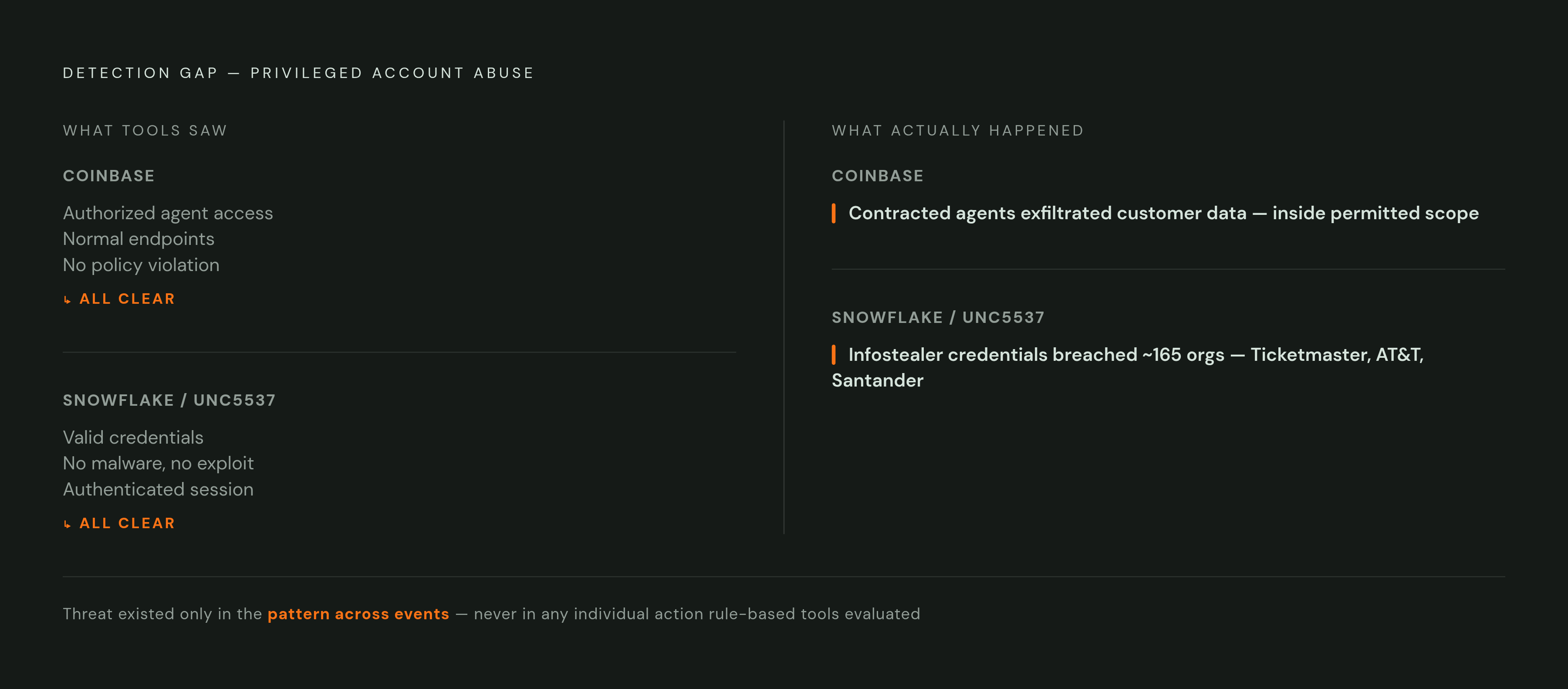
The core failure in detecting abuse on privileged accounts has little to do with a shortage of signals. It comes from treating each signal as a verdict on its own, instead of as one data point inside a pattern that has to be read across time, role, and context at once.
Consider an administrator working a time-sensitive project who logs in off-hours, pulls a large batch of files, and touches systems adjacent to their usual scope, all in the same week and all legitimate. Now consider a malicious actor running a slow exfiltration campaign who never trips any of those thresholds individually, because each action is small and spread out over weeks or months. A detection model built on single-event thresholds treats the first case as suspicious and the second as invisible, which is the opposite of what it should do.
Legacy DLP and SIEM tools, built on static rules, are poorly suited to this problem by design. They ask whether one specific action violated a predefined policy. They do not ask whether a sequence of actions across a user's timeline adds up to an emerging risk. The result runs in both directions at once: high false-positive rates on legitimate privileged work, and low detection rates on slow, quiet abuse that never crosses any single rule's threshold.
The Coinbase case makes this concrete. Bribed contractors accessed customer data within the bounds of their authorized permissions, so each access event looked normal on its own. The risk lived in the pattern: who was accessing what, how often, and whether that behavior matched what the role should look like. No single event in that case would have justified an alert. The pattern across many events would have.
What separates threat from normal work is whether a given sequence of actions is normal for that specific person, in that role, at that time, given what came before. Answering that question needs the full timeline of a user's behavior rather than a rule engine evaluating one event at a time. That shift, from single-event rules to full-timeline pattern analysis, is what the next generation of detection architecture has to be built around.
The expanded insider definition and privileged-access threats indistinguishable from legitimate use
The population holding privileged access today includes compromised identities, fraudulent hires, and contracted third parties, not just a known employee who went rogue, and the behavioral pattern framework has to cover all of them.
Compromised credentials are the clearest case. The Snowflake and UNC5537 campaign showed at scale how stolen infostealer credentials, used against customer accounts that had not enforced MFA, gave outside attackers fully authenticated sessions across a large number of organizations. The "insider" in that campaign was the credential itself, not any employee. The only available signal was the pattern of activity: bulk data pulls from authenticated sessions that had no history of making those kinds of queries before.
Fraudulent employment is a newer and stranger category. The DPRK IT worker scheme, tracked as FAMOUS CHOLLIMA by CrowdStrike, UNC5267 by Mandiant, and Jasper Sleet by Microsoft, generated close to $800 million in 2024 according to the U.S. Treasury's estimate. This category carries risk from the very first day of employment, before any behavioral baseline even exists, and the actor's entire goal is to blend into ordinary administrative work indefinitely rather than stand out.
Third-party contractors round out the picture. Flashpoint's 2025 case data includes an incident in which a contractor working for a cryptocurrency firm sold customer data to threat actors and recruited colleagues into the scheme, leading to a large number of terminations and the compromise of tens of thousands of customers. The contractor's privileged access was the entry point, and recruiting colleagues extended the damage well past what monitoring any single account would have caught.
AnySecura's 2026 analysis places this inside a broader pattern of supply chain exploitation, where vendors and contractors extend an organization's privileged-access footprint well past its own employee roster. The practical conclusion is unavoidable: any detection approach built around the question "is this a trusted employee or not" has already missed the point. Whether the pattern of behavior on a privileged account matches what that account's role, history, and context should produce is the real question, regardless of who or what sits behind the login.
Sources
- 59 Insider Threat Statistics You Need to Know in 2026
- Insider Threat Statistics 2026 (Verified Data)
- Insider Threats: Turning 2025 Intelligence into a 2026 Defense Strategy
- Potential Insider Threat Indicators & Security Risks
- Potential Insider Threat Indicators
- Insider Threats in 2026: Key Trends, Real Cases, and How to Prevent Them
- 2026 Insider Threat Report: 5 Critical Reality Checks