Integrating Insider Threat Tools With Microsoft 365 and Entra ID
Correlating Microsoft 365 logs reveals hidden threat patterns that native monitoring tools miss.
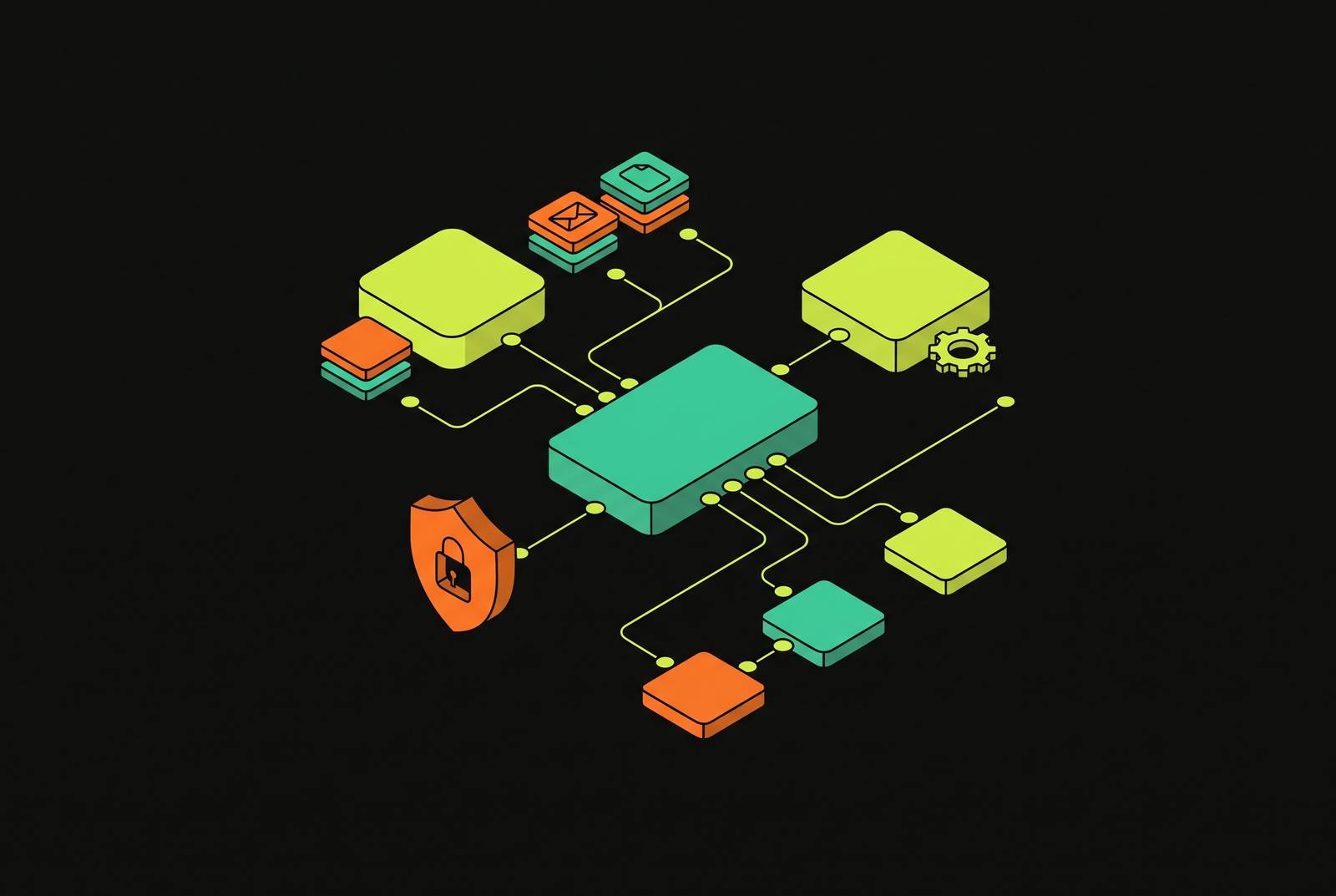
Insider threat programs looking for better data don't need a new source. The richest behavioral and identity signal available to most enterprises already sits inside Microsoft 365 and Entra ID, and the real work is extracting and correlating what's already there.
Microsoft 365 and Entra ID as the foundation for insider threat signal collection
Identity has taken over as the primary attack and risk surface, replacing the network perimeter that security programs were built around for two decades. The Netwrix 2025 Cybersecurity Trends Report found that account compromise roughly tripled between 2020 and 2025, a pace that tracks how quickly attackers and, by extension, malicious or careless insiders have moved their activity onto identity-proxied surfaces. Entra ID logs almost every action that matters, each sign-in, each role change, each consent grant, so missing data is rarely the constraint. Missing data rarely limits an insider threat program built on this foundation. The limit is knowing which of those logged events deserve an alert and whether anyone can connect them once they've landed in separate systems.
Copilot has changed the shape of that problem. Data access that once took an analyst or a curious employee an hour of manual navigation through SharePoint folders now takes a 30-second natural-language prompt, and the record it leaves behind is a prompt-and-response log rather than a file access entry. Traditional file-monitoring approaches were not built to read that kind of trail, and they can't be retrofitted to do so without deliberate architecture.
None of this diminishes the value of the Microsoft stack as a signal source. It expands it. Identity, role, file activity, email, Teams sharing, endpoint action, and HR events all flow through the same ecosystem, and all of it can be correlated into a coherent picture of user risk when the integration connecting these pieces is built correctly. Building on Microsoft 365 and Entra ID is a given for practitioners, and the real work is routing the signal already flowing through them into something an analyst can act on.
Entra ID logging and the limits of native monitoring
Entra ID produces three log sources that, together, cover most of the evidence trail insider risk investigations need: sign-in logs, audit logs, and Privileged Identity Management logs. Sign-in logs record who authenticated, from where, and at what assessed risk level. Audit logs record what changed in the tenant, including role assignments, permission grants, and edits to Conditional Access policies. PIM logs record how a privilege became active, down to the just-in-time activation record. Taken as a set, these three sources answer most of the who, what, and when questions an investigator needs.
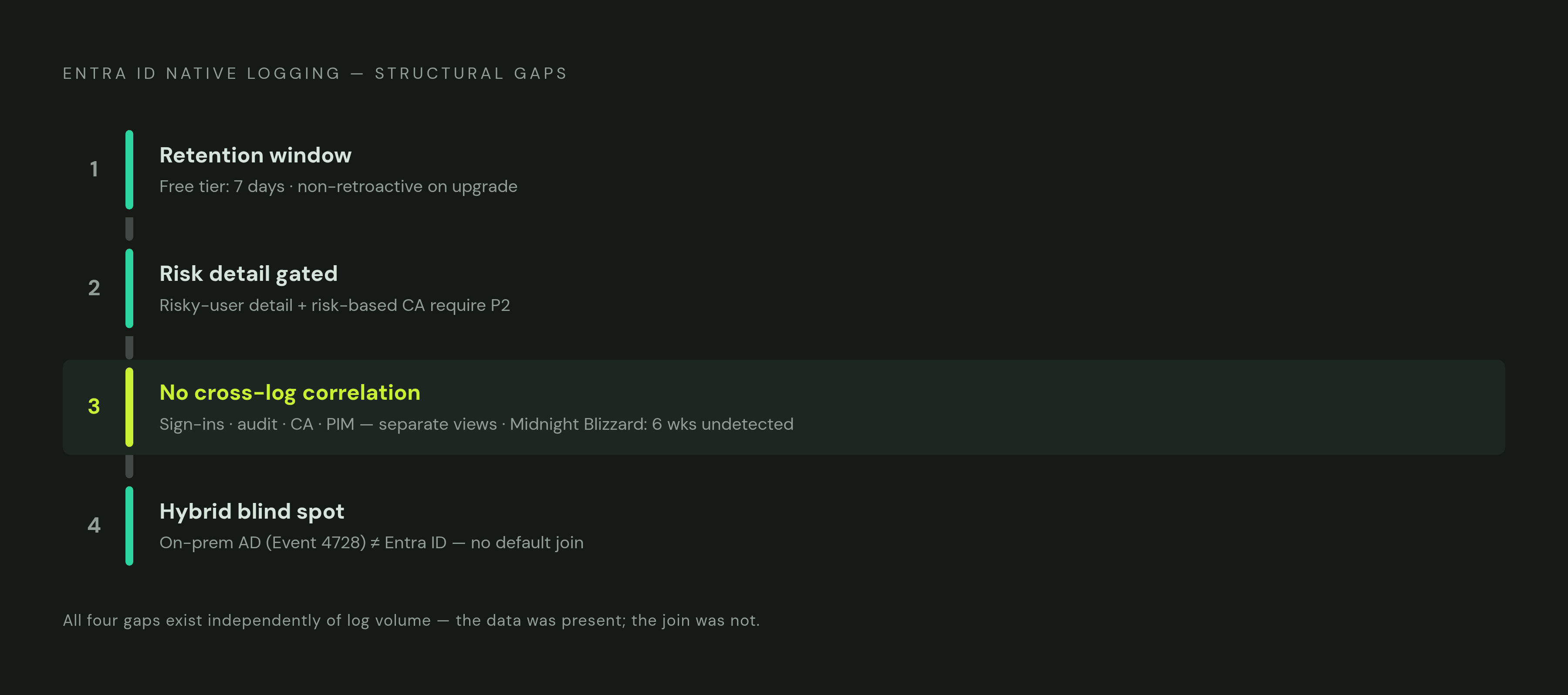
They don't answer those questions automatically, and four structural gaps determine how much work is left after the logs are collected. Retention windows: audit and sign-in logs persist longer on P1 and P2 than on the free tier, which keeps them for only seven days; retention upgrades are non-retroactive, so moving from Free to P1 does not recover expired logs. Risk detail is gated behind licensing as well. Risk policies, full risky-user detail, and risk-based Conditional Access all require Entra ID P2, so free and P1 tenants monitor with a reduced data set. There is no built-in cross-log correlation: sign-ins, audit events, Conditional Access changes, and PIM activity each live in their own view, so a Conditional Access exclusion added at 2:14 and a role assignment at 2:31 never appear side by side unless someone builds that connection deliberately. And hybrid environments carry a directory blind spot, because on-premises Active Directory and Entra ID use different identifiers. A group membership change logged as Windows Event ID 4728 on a domain controller and a role assignment in the Entra audit log don't join by default, which leaves a cross-directory attack path invisible to anyone relying on native views alone.
The Midnight Blizzard intrusion shows what these gaps cost in practice. The attack began with a password spray that compromised a legacy, non-production test tenant account that lacked multifactor authentication. From there, the actor used a legacy test OAuth application with elevated privileges to create additional malicious OAuth applications and grant them the Office 365 Exchange Online full_access_as_app role. Each step, examined on its own, resembled ordinary administrative activity. The intrusion ran for roughly six weeks, from late November 2023 to its detection on January 12, 2024, because no single view connected the sequence of events into a recognizable pattern. The logs existed. The correlation didn't, and that gap between logging and correlation is what any serious integration architecture has to close.
The signals that carry real weight for insider threat detection inside Entra ID
The set of Entra ID events worth actively monitoring for insider threat purposes is narrower than the full catalog of what Entra ID logs, and narrowing to that set is the first real integration decision a practitioner makes, drawing on Netwrix's monitoring guidance on high-weight signals. Risky sign-ins flagged by Identity Protection cover leaked credentials, password spray attempts, anonymous IP logins, and token replay. "Add member to role" events that occur outside PIM matter because they represent direct role assignments that bypass just-in-time controls entirely. OAuth consent grants, logged as "Add delegated permission grant," are a common lateral-movement step after initial compromise. And Conditional Access policy edits that quietly loosen an existing policy deserve scrutiny because a small configuration change can open a large window of exposure.
Entra ID Protection itself processes trillions of signals daily through AI and machine learning models to flag risky users and risky sign-ins as they happen, and its detections cover the same categories: password spray, leaked credentials, anonymous IP logins. It can also enforce automated, adaptive access controls tied to the assessed risk level, as Microsoft's Entra ID Protection documentation describes.
Two newer categories deserve attention precisely because most programs haven't built for them yet. As of November 2025, Entra expanded its identity coverage with the public preview of Microsoft Entra Agent ID, extending risk-based policies to AI agents and introducing a non-human identity layer that most insider threat programs have not yet incorporated into their monitoring. And the Copilot-specific forensic trail, the prompt-and-response log rather than a file access record, is its own signal category. It is absent from standard SharePoint or OneDrive activity logs, so collecting it requires a deliberate decision to include it.
How Purview Insider Risk Management correlates M365 signal
It reaches that capability only through deliberate configuration, particularly around HR data feeds and Entra ID integration.
Purview IRM ingests and correlates file activity in SharePoint and OneDrive, email patterns and Teams sharing behavior, endpoint actions via Microsoft Defender, and HR events, resignation dates and role changes, ingested through the HR data connector. That hierarchy data is required for cumulative exfiltration detection, the kind of policy that tracks gradual data movement over time rather than a single large transfer, and detection accuracy drops if Entra ID doesn't maintain it. Purview runs all of this through machine learning models and more than 100 built-in indicators to surface risky users and behavioral sequences, with policies aimed at scenarios like departing-employee data theft, data leaks, and security policy violations.
Pseudonymization is built into the workflow by default, so investigators see anonymized users until an escalation justifies unmasking, a design choice that matters for organizations operating under works council rules or other legal constraints on employee monitoring.
Adaptive Protection closes a loop that many configurations otherwise leave open. When a user's Purview risk score climbs, Adaptive Protection dynamically applies stricter DLP controls to that user, connecting behavioral detection back to Microsoft's enforcement stack without requiring manual intervention from an analyst. That link between detection and enforcement is what turns a risk score into an actual control.
The HR connector is the single most consequential configuration decision in the entire Purview IRM setup. Without resignation data flowing in, the departing-employee detection template has no trigger at all, and the most common exfiltration pattern, the departing employee who takes data on the way out, goes undetected by that template. Organizations that skip this connector are not running a slightly weaker version of departing-employee detection. They are running none.
Sentinel and Purview's combined investigation surface
Microsoft Sentinel and Purview IRM are integrated into a single investigation experience, giving SOC and data security teams a shared, contextual view of the potential blast radius of a given incident. The integration combines Sentinel's threat-centric graph analytics with Purview's data-centric content analysis in one workflow, and that combination reflects a division of labor that existed before the integration and still shapes what each tool contributes. Sentinel's UEBA capability performs behavior-based anomaly detection across identities, endpoints, and cloud workloads. Purview IRM performs policy-driven detection, investigation, and governance of risky user actions tied to data and compliance.
What the integration adds is the ability to identify sensitive or risky data, trace how it was accessed, moved, or exposed, and take action, all from one experience. An investigation no longer requires pivoting between a SIEM interface and a separate compliance portal to assemble a full picture of what happened. That pivot, which analysts previously had to make manually every time a data-related alert touched on identity or behavioral anomalies, is exactly the kind of friction that stretches investigation time without adding investigative value.
The integration also extends into automated response. Playbooks in Sentinel can respond instantly to identity risks that Entra ID Protection detects, cutting down on manual intervention and shrinking the gap between detection and containment. Entra ID Protection exports its risk events into Sentinel for further correlation, and that connection is native rather than something a team has to build as a custom connector project. The plumbing between identity risk detection and SIEM correlation already exists inside the Microsoft stack, reducing the build effort a practitioner needs to spend.
Analyst workflow and alert quality in realizing the integration's value
A better-integrated Microsoft stack produces more alerts than a poorly integrated one, simply because more signal is being surfaced and correlated in the first place. That only pays off if alert quality and investigation speed keep pace with the added volume. Absent that, richer integration just produces more noise for the same-sized analyst team to sort through.
Mean-time-to-investigation, not the raw count of alerts generated, is the metric that reflects whether an integration is working. A thorough insider risk investigation involves querying the SIEM, checking identity logs, pulling endpoint telemetry, and correlating timelines across all of it, which is substantial hands-on work even in the best case where an analyst starts the moment the alert fires. In practice, queue depth means analysts rarely start immediately, and that delay compounds whatever time the investigation itself requires.
The Midnight Blizzard case makes the point again from a different angle. The intrusion stretched across weeks because each individual signal looked, in isolation, like ordinary administrative activity, even though the necessary data existed. The integration architecture that could have connected those signals existed. The correlation and investigation work that would have connected them in time did not happen, which is a capacity problem rather than a data availability problem.
Pre-assembled context, so the timeline is already correlated when the alert surfaces, AI-assisted triage that investigates and closes benign alerts autonomously before they consume analyst time, and a single investigation surface rather than multiple pivots across tools are what actually change MTTI. The Sentinel-Purview integration covered in the previous section addresses the third piece directly. But the volume of low-fidelity alerts that turn triage into a queue management exercise rather than a security exercise requires logic sitting above what the native stack provides on its own.
What a purpose-built insider threat platform adds
Purview IRM, Sentinel UEBA, Entra ID Protection, and Adaptive Protection together form a capable detection and enforcement foundation. Practitioners who rely on that native stack alone will still run into a consistent set of structural limits, and those limits show whether an insider threat program built on Microsoft 365 closes the gaps this article has traced or simply inherits them.
Behavioral baselines inside Purview IRM are anchored to policy templates. Risk that is statistically normal for a given user, risk that has existed since day one of their access, or risk conducted entirely through channels the user is authorized to use may never trigger a template built around a different pattern. The HR connector, despite being the most consequential configuration decision in the platform, covers resignation events specifically and doesn't ingest the fuller range of off-system context that changes how risky a user actually is, things like performance issues, access change requests, or manager escalations. Copilot's prompt and response logs require deliberate collection, and sensitivity labels interact with Copilot at the model layer in ways traditional DLP tools were not built to observe, leaving a coverage gap around shadow AI use. Retention limits mean that a pattern unfolding over more than a few weeks becomes invisible in native logs unless an export architecture was already in place before that window closed. And perhaps most fundamentally, the native stack classifies data by label or pattern match. It has no way to recognize that a piece of intellectual property is sensitive because of what it represents to the business rather than how it happens to be tagged, which leaves that category of data invisible to policy-based detection.
A purpose-built insider threat platform is built to close exactly these gaps. It evaluates content, destination, identity, role, and surrounding behavioral pattern together, in a single decision, rather than running behavioral analytics as a separate module bolted onto a DLP policy engine after the fact. It pre-assembles investigation context so that when a candidate event surfaces, the analyst already sees a correlated timeline rather than a bare starting point for manual work. It extends coverage to unlabeled, high-value intellectual property by assessing what data means to the business rather than only checking whether it matches a predefined rule. It applies shadow AI controls that depend on the data itself, its destination, the account behind it, and surrounding context, rather than settling for a visibility dashboard or a blanket ban that does little more than register that AI tools are in use.
The case of Sohaib Akhter illustrates what's at stake when these gaps go unaddressed. Akhter was convicted on May 8, 2026, for conspiring to delete roughly 96 government databases in the hours following his firing in February 2025. The same deprovisioning gap that allowed earlier data theft to go unnoticed also allowed the sabotage that followed his termination, and catching it required immutable log retention and immediate access termination at the moment of firing, since the policy template was waiting for a resignation date that, in this case, never came. That is the category of failure a purpose-built platform is designed to prevent: the moment when a native, template-driven system runs out of the specific trigger it was built to watch for, and nothing else is watching in its place.