AI Model Drift Risks in Enterprise Security Behavioral Analytics
Model drift silently erodes insider threat detection until damage occurs.
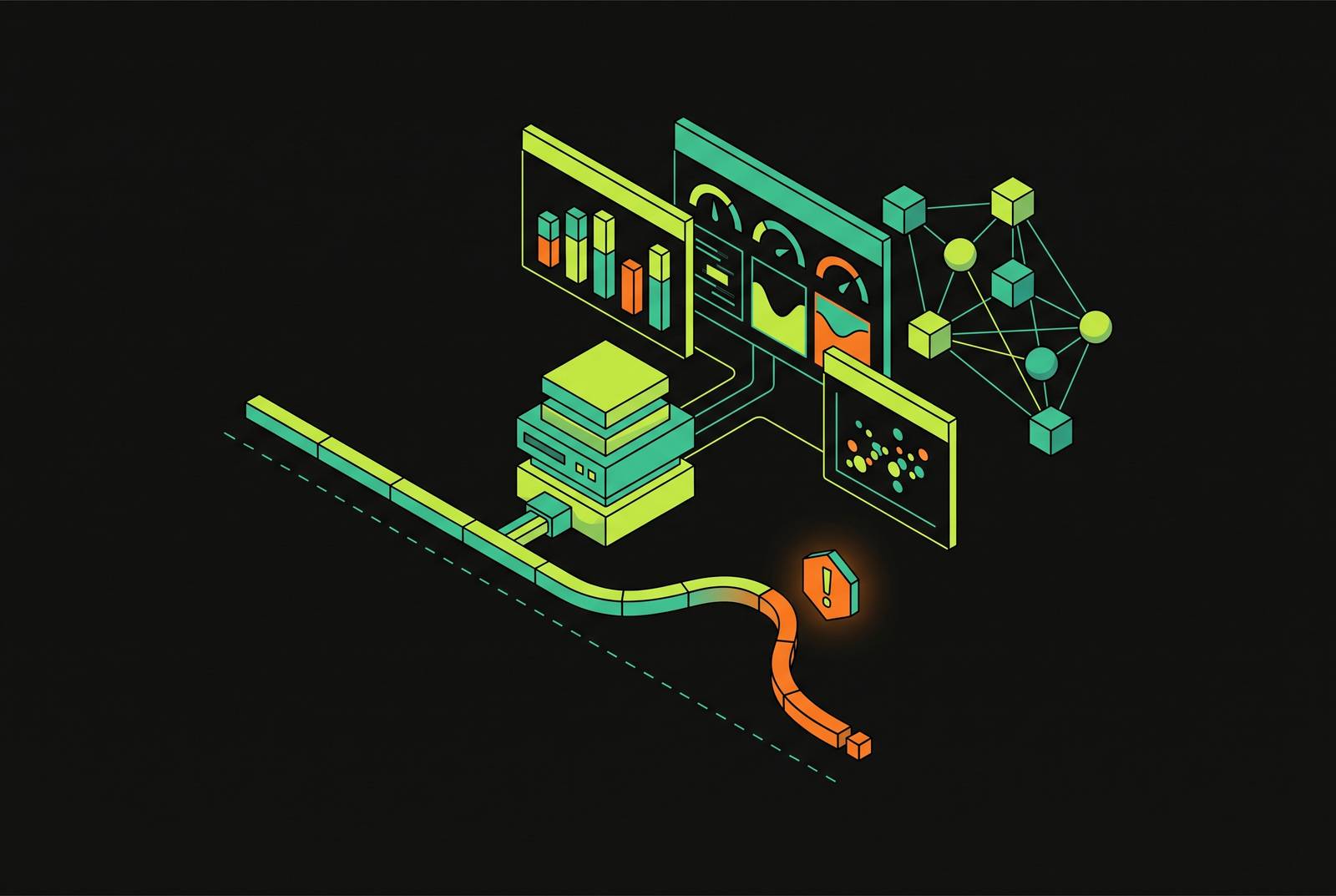
Insider threat models don't fail with a bang. They fail with a slow, quiet slide, where the gap between what a model learned during training and what's actually happening on the network widens until someone notices the noise, or worse, notices what the noise missed. That gap has a name: model drift, and it comes in two flavors security teams need to tell apart. Concept drift is when the meaning of a behavior changes, so a pattern that once signaled exfiltration becomes routine, or the reverse. Data drift is when the inputs themselves shift: file sizes, access volumes, and communication channels move at the org level even though the underlying risk relationship hasn't changed at all. Knowing exactly how drift shows up in behavioral analytics is the first step toward managing it on purpose, instead of finding out the hard way after the damage is done.
What the insider threat landscape looks like as the baseline models were trained on
Insider risk cost organizations an average of $17.4 million a year in 2025, up from $16.2 million in 2023, according to Ponemon research. That's the baseline before anyone accounts for what happens when the detection model watching for it starts to slip, and the shape of these incidents matters as much as the cost. Ponemon's 2025 data puts negligence, not malice, behind 55% of incidents, which means a model built mainly to catch deliberate bad actors already has a hole in it on day one.
That hole compounds fast. Ponemon found only 25% of organizations run an insider risk program mature enough to have defined metrics and executive oversight, and 2024 industry research put the share running full proactive monitoring at just 36%. Without that instrumentation, drift can run for months before anyone spots it, and most programs are structurally set up to miss it.
Layer on top of that the AI tooling shift, which happened faster than most training pipelines could track. Research tracked by insiderisk.io found the share of sensitive data flowing into AI tools jumped from 10.7% to 27% between March 2023 and March 2024, and that 39.7% of what employees hand to AI tools counts as sensitive. Any model trained on 2022 or 2023 data learned a world that, in a meaningful sense, doesn't exist anymore. The population these models now have to watch is majority-negligent, increasingly AI-mediated, and changing its tool habits faster than most vendors update their training sets. That's a genuinely different target than the one most training data captured, and treating it as the same problem is the first mistake most programs make.
The five ways drift surfaces in behavioral detection models, and what each looks like in practice
Falling accuracy, precision, and recall are the most obvious signs something's wrong, and they're also the slowest to show up. By the time those numbers move enough to notice, per VentureBeat's reporting from April 2026, real detections have usually already slipped through. Waiting on aggregate accuracy to signal trouble is, functionally, waiting too long.
A shift in the prediction rate is a better early flag. If a model that historically flagged 1% of events as suspicious suddenly starts flagging several times that rate, or drops to 0.1%, something changed, either the inputs or the model's grip on what it's looking at. Confidence erosion is subtler still, and most teams simply aren't looking at it: a model's confidence on individual calls tends to soften before its overall accuracy does, which makes it one of the better leading indicators available and one of the least monitored.
Feature distribution shift has a clean illustration from VentureBeat's reporting: a phishing model trained on emails averaging 2MB attachments can fail outright against a new malware-delivery method that ships 10MB attachments. The insider threat version is a model whose training data predates the AI-tool adoption wave that has since reshaped how and where employees move data. The most dangerous mechanism, though, is adversarial, because someone's doing it on purpose. In 2024, attackers used echo-spoofing to slip past email protection systems by exploiting blind spots created by real shifts in the underlying data distribution. The insider parallel is direct: a user who understands where the thresholds sit can pace their activity to stay under them.
For behavioral analytics specifically, concept drift does the most damage over time, and it's the one most programs are least equipped to catch. What counts as "normal" for a person or peer group shifts constantly with role changes, reorgs, project cycles, and new tools, and the model has no built-in way to know its reference point has moved. All five problems get worse because insider threat data is thin to begin with: real events are rare, hard to label cleanly, and many models train on limited or synthetic data. A systematic review on arXiv synthesizing 48 peer-reviewed studies from 2021 to 2025 quantified how badly static models collapse when real-world behavior shifts away from their training distribution.
Why organizational change is a primary but underappreciated drift driver
Most conversations about drift jump straight to attackers adapting their tactics. That's the wrong place to start. The bigger day-to-day driver is a lot less dramatic: ordinary organizational change, and it accounts for more silent model decay than any adversary does.
A reorg changes a person's peer group, their access rights, and their normal data-handling pattern all at once, so their historical baseline stops being a useful reference the moment the org chart updates. New hires build a pattern fast, and departures, especially of long-tenured people, pull baseline anchors out from under the model. Someone deep in a quarterly close, a product launch, or a merger integration will look, to a static model, uncomfortably close to a person prepping an exfiltration, even though nothing abnormal is happening. Moving file storage from on-prem to a cloud SaaS platform resets the feature space entirely, so a model trained on the old environment starts flagging routine activity in the new one. Hybrid work made this worse across the board, since access times, endpoint types, and VPN-versus-direct patterns changed for most of the workforce, and models that weren't updated to match keep throwing false positives long after the shift settled in.
AI tooling adds its own wrinkle. As coding assistants, LLM interfaces, and autonomous agents become normal parts of the day, data moves in ways older behavioral models were never built to read. A model trained to flag large file transfers to cloud storage may now flag a routine AI-assisted document workflow, simply because it looks similar on paper.
What makes organizational change different from attacker adaptation is that it's predictable. Reorgs, departures, and platform migrations show up in HR systems and IT calendars well before they show up in behavioral data. A mature insider risk program treats those signals as a trigger for model review, rather than waiting for accuracy metrics to slide first, and any program that isn't doing this is managing drift on a lag it didn't need to accept.
How static DLP rules and behavioral models share the same decay problem
Drift isn't new, and it isn't unique to machine learning. Legacy DLP has been fighting the same fight with static rules, keyword lists, and regex patterns that judge data at a single moment with no behavioral context around it.
Writing DLP policy that accurately reflects a company's current data environment takes real time, and the policies that were accurate at launch drift out of date the moment the environment changes underneath them. That's the same decay curve an ML model rides, just with a different mechanism. Either way, the result looks the same: stale rules throw false positives, new behavior slips past because it falls outside what the rule was written to catch, and security staff spend their hours on upkeep instead of on actual risk.
The two failure modes aren't identical, though, and the difference matters for how fast anyone notices. A bad static rule fails loudly, it matches the wrong thing and someone notices right away. A drifted model fails quietly, its predictions get worse bit by bit with no obvious trigger to point to. Legacy DLP also carries a blind spot ML-based tools were built to address: it can't see AI-mediated data movement at all. It was built to watch file transfers, email attachments, and clipboard activity, and when someone drafts a document with generative AI or pulls information out through a chat interface, that data moves through channels the old tool was never designed to look inside.
None of this means behavioral AI solves the decay problem. It changes what the problem looks like, and the discipline required shifts from writing and maintaining policy to monitoring and recalibrating a model, which is a different skill set entirely. Worth flagging for anyone shopping vendors: some "next-gen DLP" products, per analysis from Orionsec, just bolt an AI layer onto an existing rule engine to sort alerts faster. The detection model underneath, and the decay that comes with it, stays exactly the same. Buying the label without checking what sits underneath it is a mistake worth naming plainly.
How adversarial actors deliberately accelerate drift to evade detection
A sophisticated insider, or an external actor who's done the homework, knows a behavioral model runs on thresholds and baselines, and knows those thresholds can be walked around slowly rather than tripped all at once.
Data poisoning is the most deliberate version of this. An adversary with access to a training pipeline or a continuous-learning system can feed it corrupted data on purpose, and the model learns the wrong thing and stays wrong until someone finds it, because the corruption becomes part of what the model treats as normal. In insider risk terms, that plays out as a person establishing a slow, low-volume pattern of data movement over weeks or months to normalize their own behavior before making a larger move. It can also mean routing data through legitimate AI tools that a pre-AI-era model was never trained to flag, or timing sensitive activity to land during a known noisy period, like a quarterly close, when everyone's anomaly score is elevated and one more spike doesn't stand out.
The 2024 echo-spoofing incident VentureBeat covered is a real-world version of this same dynamic. Attackers exploited misconfigurations and let millions of spoofed emails through, because the classifiers' reference point for "normal traffic" had already drifted away from what current traffic actually looked like.
There's a supply chain angle too. Research flagged by obsidiansecurity.com points to risks introduced through third-party vendors or shared data pipelines, where corrupted inputs can compromise a model before it ever goes live. Underneath all of this sits a governance gap: most organizations don't monitor model behavior or training data integrity closely enough to catch any of it, and these are dynamic, learning systems that need a different kind of oversight than a traditional IT asset gets. A model nobody's watching for drift isn't just decaying on its own. It may be getting help, and treating those two failure modes as the same problem is how they both go unnoticed.
What current research on insider threat detection models reveals about drift management
UEBA systems pull from logs, relationship graphs, peer comparisons, and long-run behavioral trends, clustering activity with machine learning to find what doesn't fit. That multi-source design is also a weak point: a distribution shift in any one feed propagates straight into the model's output.
Supervised approaches built on LSTM networks pick up temporal patterns in activity sequences well and perform strongly on benchmark data, but they lean hard on labeled training examples, and those are genuinely hard to get for insider threats, since real events are rare and often subtle enough to mislabel. That dependency limits how well these models recalibrate once they're live and facing real traffic.
A 2025 deep evidential clustering framework, described in that same arXiv paper by Anas Ali, was tested against the CERT and TWOS benchmark datasets and hit 94.7% average detection accuracy with a 38% cut in false positives, by folding uncertainty modeling directly into the architecture. Teaching a model to flag its own uncertainty is, on its own, a form of drift detection, and it's a more useful design principle than chasing higher raw accuracy.
Separate research on the Vectoredge IRM system (arXiv 2505.03796) documents a move away from a static PRISM scoring model toward an adaptive model built on an autoencoder neural network with iterative feedback loops. The results were substantial: a 59% drop in false positives, a 30% gain in true positive detection, and a 47% cut in incident response time after deployment, while processing up to 10 million log events a day at sub-300ms query latency. The mechanism doing the real work is the feedback loop itself: human analyst decisions get fed back into the model over time, which is a practical, working answer to drift rather than a theoretical one.
A systematic review pulling together 48 peer-reviewed studies from 2021 to 2025 quantified just how badly static models collapse once concept drift sets in. The research community treats this as solved in principle. Enterprise practice tells a different story, because very few production systems build in the uncertainty estimation the research keeps pointing to, even though it's the clearest way to cut alert fatigue and give analysts a leading indicator instead of a lagging one. Explainability work matters here too: the AIB-ITD framework, which uses SHAP values and appears in MDPI research, was built specifically to address detection systems that lack both explainability and automated mitigation. Without that explainability layer, drift becomes hard to diagnose for a simple reason: analysts have no way to see why a model's predictions changed, only that they did.
The monitoring infrastructure that catches drift before detection degrades
The root problem across most of this is visibility. Enterprises tend to deploy AI systems without any real monitoring of how the model itself behaves over time, and the monitoring tools built for static applications, per aren't built to catch the subtle behavioral shifts that signal drift in a learning system.
A few signals are worth instrumenting directly, rather than waiting for accuracy metrics to move. Prediction rate tracking means setting a baseline alert rate for the model and watching for sustained deviation from it, since a jump from 1% to 5% flagged, or a drop to 0.1%, is diagnostic information, not an operational quirk to shrug off. Confidence score distributions, logged per prediction over time, give analysts a genuine early warning: a downward drift in average confidence tends to show up before accuracy visibly drops. Feature distribution monitoring, tracking the statistical shape of key behavioral inputs like access volumes over time, catches the kind of quiet input shift a model can't flag about itself.
None of these signals replace an analyst's judgment, and none of them substitute for treating organizational change, reorgs, migrations, new AI tooling, as a scheduled trigger for model review rather than something to notice after the fact. The research is fairly consistent on this point: detection models that build in uncertainty estimates and feedback loops from human review consistently outperform static ones, because they were designed to keep learning rather than treated as finished the day they shipped.
Sources
- AI-Driven IRM: Transforming insider risk management with adaptive scoring and LLM-based threat detection
- Five signs data drift is already undermining your security models | VentureBeat
- Artificial Intelligence-Based Insider-Threat Detection: A Hybrid Explainable Framework with Automated Response and Privilege Containment
- arxiv.org
- arxiv.org
- obsidiansecurity.com