Building an Insider Threat Program From Scratch in Large Enterprises
Start with governance and cross-team coordination, not technology tools.
Insider threat programs are structural problems disguised as technology purchases. The organizations getting this right in 2026 spend most of their early effort on governance, scoping, and data plumbing, and only then start evaluating detection platforms. The ones getting it wrong buy a tool first and spend the next eighteen months trying to retrofit the org chart, the data feeds, and the legal review around it. This piece lays out the sequence that actually works, in the order the decisions need to happen.
Why insider threat programs have fallen behind
The cost curve alone should worry any security leader still running an insider threat program built five years ago. Average annual cost of insider-related incidents hit $19.5 million, up from $17.4 million in 2025 and $16.2 million in 2023. That's not a one-time jump but a compounding line, and compounding lines don't fix themselves with a bigger budget line item next year.
Volume tells the same story from a different angle. Insider incidents studied rose from 3,269 in 2018 to 7,868 in 2025, more than doubling in under a decade. The share of organizations reporting insider attacks climbed from 66% in 2019 to 76% in 2024. So more companies are getting hit, and each one is getting hit more often.
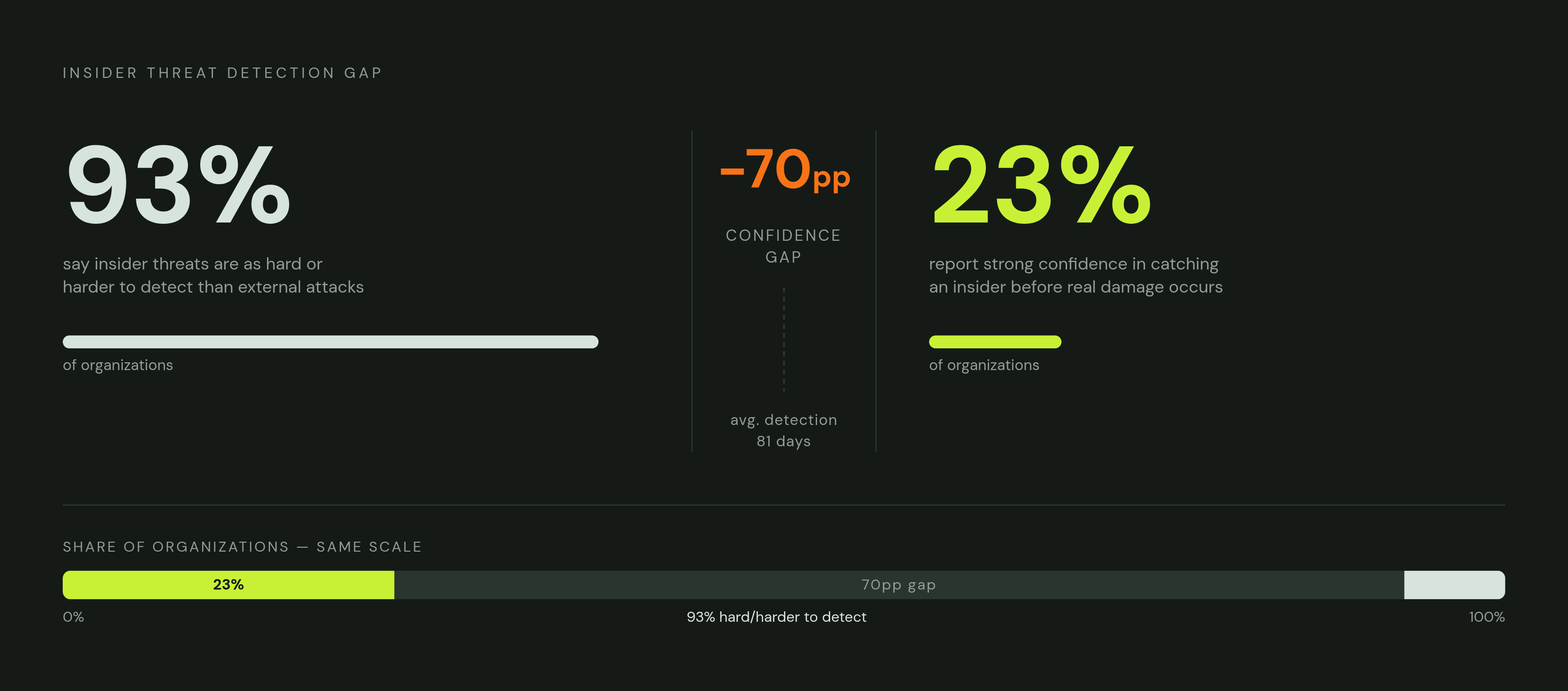
Detection hasn't kept pace, and boards should be more concerned about this than about the cost figures. 93% of organizations say insider threats are as hard or harder to detect than external attacks. Only 23% report strong confidence in catching an insider threat before it does real damage. That gap, between near-universal difficulty and near-universal low confidence, is the actual insider threat crisis.
And the clock keeps running the whole time. Average time to detect and contain an insider-driven incident is 81 days. Almost three months. Whatever damage a malicious or careless insider does, it's mostly already done by the time most programs even open a case file.
The structural reasons most enterprise insider threat programs fail before they catch anything
Most existing programs are built backward: policy-heavy, investigation-triggered, reactive by design. They wait for a formal complaint or a DLP alert to open a case. The early behavioral signals, the ones that would have let a team intervene weeks earlier, go unread. By the time an investigation formally opens, the damage window is already measured in weeks or months, not hours.
Ownership is scattered across departments that don't talk to each other on a regular cadence. HR sees a resignation and a performance improvement plan. IT sees an unusual file transfer. Legal sees a contract dispute. Corporate security sees a badge swipe at an odd hour. Each group holds a fragment of the picture, and early indicators routinely appear in one silo long before anyone else notices. The visibility gap this creates, an over-reliance on internal telemetry without cross-team correlation, is a critical and widely documented structural weakness in enterprise insider threat programs today. Fragmented reporting slows response far more than any technology limitation ever could.
Then there's the tools-first trap. A widely cited industry framework from PwC notes that insider risk programs frequently focus on implementing tools and technology while skipping the organizational, risk management, and cultural work that has to come first. Without that groundwork, the tool has no way to tell relevant data from noise. It just collects everything and hands the manual sorting work to an analyst who now has to sort it by hand, undercutting the reason for buying the tool.
There's also a taxonomy problem baked into how most programs are designed. Roughly 55% of insider incidents stem from negligence, not malicious intent, yet most detection logic is built to catch a saboteur. A careless employee who mishandles a file needs a coaching conversation and a policy reminder. A departing employee who exfiltrates a client list needs legal involvement and possibly law enforcement. Running both cases through the same workflow produces two failure modes at once: false positives on the negligent majority, and missed signals on the malicious minority, because the model was never built to distinguish between them.
Establishing governance and cross-functional ownership before any tool is deployed
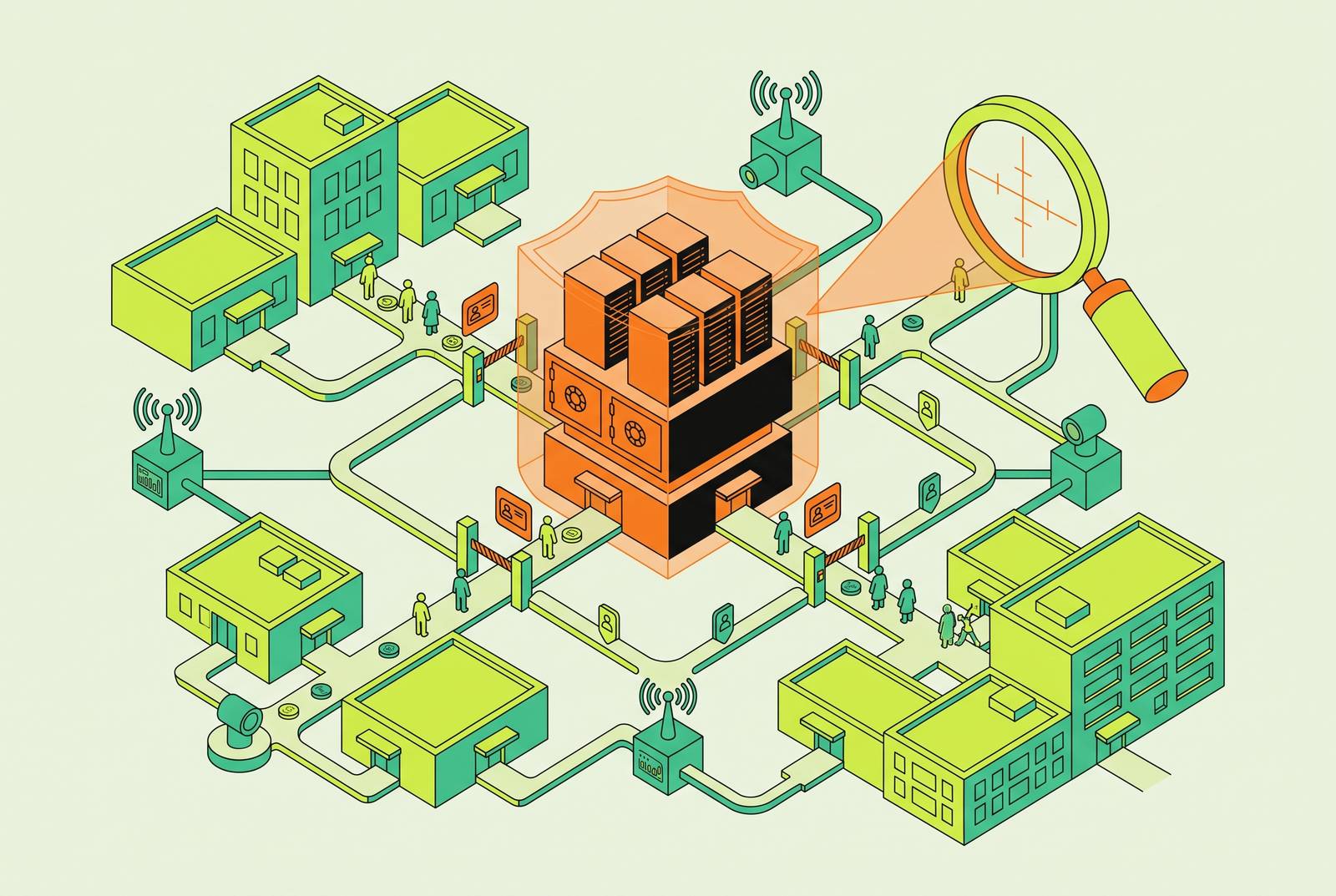
Cross-functional ownership has to exist on day one, as a working group with named liaisons in IT security, HR, legal and compliance, and physical security. Each of those functions sees signals the others structurally cannot. Ad hoc coordination, the "call someone when something looks weird" model, is exactly the pattern that produces the 81-day detection lag described above.
Government guidance is catching up to this reality. CISA published guidance on January 28, 2026 for assembling a multi-disciplinary insider threat management team, aimed at critical infrastructure entities and state, local, tribal, and territorial governments. The guidance frames the team as a combination of physical security, cybersecurity, personnel awareness, and community partnerships, which is a useful starting template even for private-sector enterprises well outside critical infrastructure.
None of this works without governance decided in advance. Acceptable use policy, escalation paths, disciplinary procedures, data privacy constraints: these need to be locked down before monitoring goes live, not drafted in response to the first employee grievance filed after someone gets flagged. A program that starts monitoring before it has answered these questions is one legal challenge away from getting shut down, and it'll happen at the worst possible time, in the middle of an active investigation.
Culture is not a soft add-on here but a design input. PwC's framing is direct on this point: the program has to protect the organization, its people, and its critical assets without turning into an overbearing authority that employees route around. A program perceived as surveillance for its own sake loses cooperation from the very people whose tips and reports make it work.
Scoping the program around critical assets and priority use cases rather than covering everything at once
Trying to monitor everything on day one is a resourcing mistake and a credibility mistake at the same time. A program that floods its analysts with noise in month one loses internal trust fast, and once leadership stops believing the alerts matter, funding and headcount dry up before the program has a chance to prove anything.
Threat and risk analysis, one of PwC's core program elements, exists to force prioritization: what matters most, ranked, not catalogued exhaustively. The output should be a short list of material business risks. Most of what a company owns doesn't need this level of scrutiny.
Crown-jewel identification is harder than it sounds, because the most valuable data in most companies has no label attached to it. A spreadsheet becomes sensitive because of what it represents to the business, a pricing model, an unfiled patent concept, a customer list about to close, not because it matches a regex pattern or carries a classification tag. Scoping work has to identify that unlabeled value directly, rather than relying on a sweep for tagged files that misses most of what actually matters.
From there, a small set of use cases should anchor the launch: departing employees, especially in the period surrounding a resignation or termination notice, where risk peaks sharply. Contractor offboarding, where access frequently lingers past the end of an engagement and the population is large enough that nobody's watching closely. Privileged access abuse among system administrators, DevOps engineers, and finance staff who sit on top of crown-jewel systems by default. Large-scale data exports, bulk downloads, archive creation, mass forwarding, anything that breaks from a person's normal role behavior. Sensitive-record snooping, where someone accesses HR files or legal documents outside their functional lane. SaaS oversharing through collaboration tools, where a file meant for three people ends up visible to three hundred. And GenAI data leakage, employees pasting proprietary content into AI tools nobody sanctioned, a failure mode that has drawn significant industry attention and that legacy DLP struggles to address.
Assembling the telemetry foundation: which data sources to connect and in what order
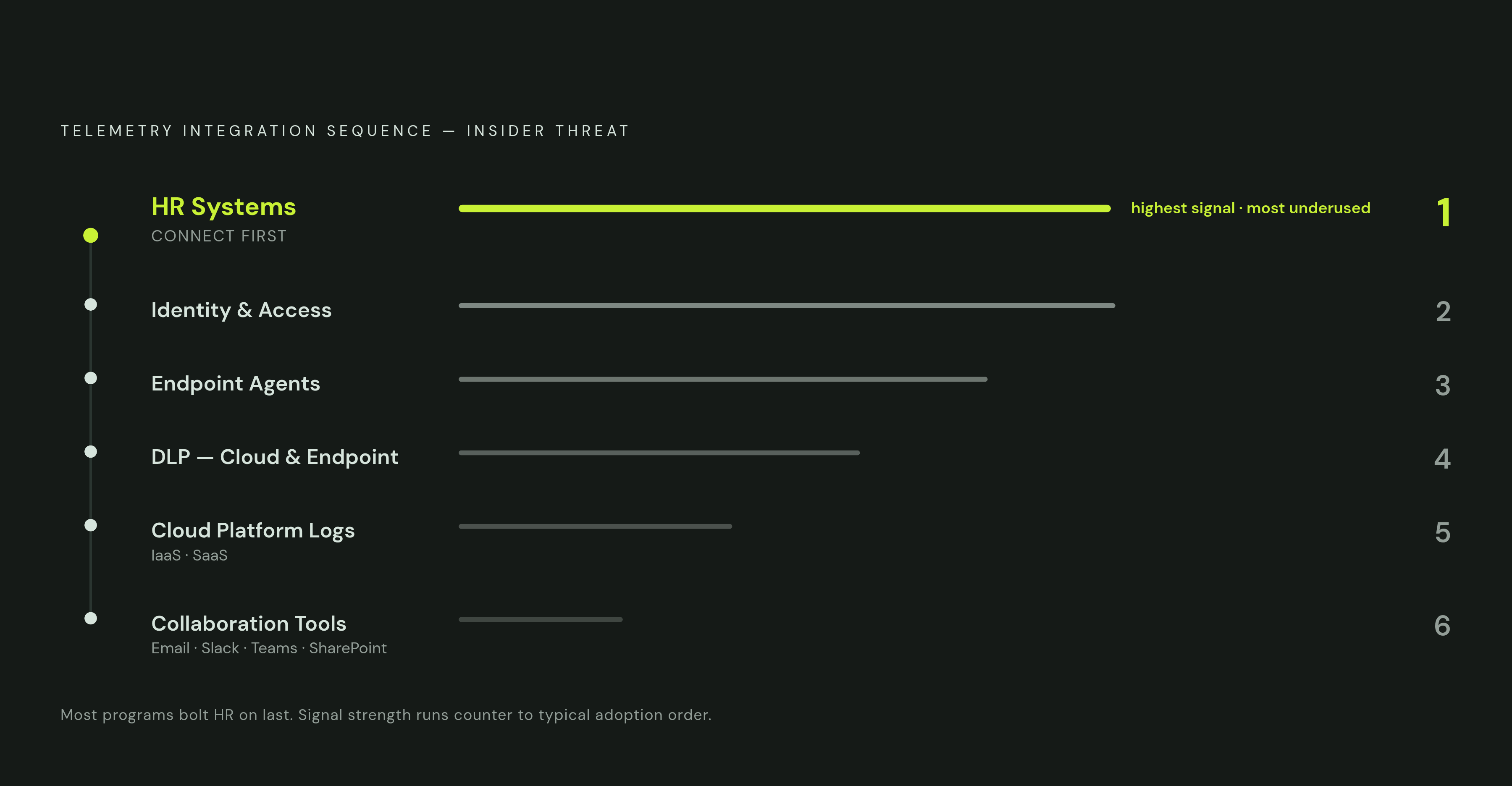
Six categories of data cover those priority use cases, and each one sees something the others miss: identity and access management systems, endpoint agents, DLP across cloud and endpoint, cloud platform logs from IaaS and SaaS providers, collaboration tools like email, Slack, Teams, and SharePoint, and HR systems.
HR is the most underused, highest-signal feed of the six, and most programs bolt it on last instead of first. A resignation date, a performance improvement plan, a role change: these are the structured facts that turn a merely suspicious file download into a confirmed high-risk event. Without that context, every anomaly starts from zero, and an analyst has to manually reconstruct facts that HR already has sitting in a database.
Identity integration matters for a different reason: it catches the compromised-insider scenario, where a credential gets stolen or a session cookie gets lifted weeks or months before any behavior looks unusual. Connecting identity intelligence, including monitoring for exposed credentials outside the company's own walls, gives a program a detection layer that sits ahead of behavior. Pure internal telemetry can't do that on its own, because by definition it only sees what happens after the credential is already in use.
GenAI makes cloud and SaaS telemetry non-negotiable if leakage through AI tools is one of the priority use cases. 61% of organizations report employees using unsanctioned AI tools. Gartner estimates 69% of organizations suspect prohibited GenAI usage somewhere in their workforce. Netskope tracked over 1,550 distinct GenAI SaaS applications in 2025, up from 317 at the start of that same year, a fivefold jump in twelve months. A program with no visibility into cloud and SaaS traffic is flying blind on the fastest-growing leakage vector in the enterprise right now.
Detection logic: why behavioral context must be built into the model from the start, not added later
Legacy DLP was built for a world of structured data and static rules, regex for Social Security numbers, keyword lists for confidential markings, and that world has mostly moved on. Modern data flows are unstructured, fast-moving, and full of exceptions that legacy systems can't reason about, so someone has to manually manage the exception list, forever, and the list only grows.
Gartner's assessment is blunt about the scope of this failure: conventional DLP cannot effectively manage GenAI data loss risks, including exposure through encrypted traffic, blindness to user intent, and shadow AI usage the security team never approved. That's a mismatch between what the architecture was built to do and what the risk actually looks like today, not a configuration problem a patch fixes. It's a mismatch between what the architecture was built to do and what the risk actually looks like today.
User and entity behavior analytics fills that gap by building a baseline for each person and each system, then flagging deviations from that baseline instead of matching against a fixed rule. An unauthorized file transfer, a privilege escalation, access outside normal working hours or outside someone's normal scope: none of these need a predefined rule to catch, they just need a baseline to compare against.
That baseline changes what a single event means. A system that knows a given employee only touches finance files from a managed laptop, and only through one approved workflow, can immediately distinguish routine access from a departure-driven grab. If the baseline is stripped out, every action gets judged in isolation against a static rule, which is exactly the blind spot that lets both false positives and real incidents slip through the same door.
Investigation workflows and alert triage: designing so analysts can act, not just receive notifications
Detection accuracy gets most of the attention in vendor pitches, but mean-time-to-investigation matters just as much, and most programs underbuild it. A platform that surfaces exactly the right alert but then buries the analyst in manual triage work hasn't solved anything. The 81-day detect-and-contain average isn't purely a detection failure, part of it is an investigation throughput failure, and those two problems need different fixes.
A survey found that 65% of organizations with an established insider threat program report that it pre-empted a breach before damage occurred. That pre-emption comes from investigation speed as much as detection coverage. A program that detects a risk correctly but takes three weeks to investigate it hasn't pre-empted anything; it has just documented a loss after the fact.
The fix is to pre-assemble the case before a human ever sees it. Automated investigation work should run on candidate events before they reach an analyst's queue, so the alert that lands already carries the user's role, recent access history, HR context like departure flags or PIP status, a peer comparison, and the full sequence of events that led up to the trigger. An analyst opening a bare alert with none of that context is starting the investigation from zero, every single time, which is the same throughput problem as the 81-day average in a different disguise.
A single flagged event is almost never the actual risk. The risk lives in the pattern across a person's full timeline, including the file download last Tuesday, the login from a new device Thursday, and the resignation letter filed Friday. Investigation workflows built around individual incidents miss that pattern. Built around the full timeline instead, they give analysts something they can act on quickly, rather than another notification to file away and hope was nothing.