Insider Threat Program Maturity Models for Security Teams
Insider threat program maturity models and their origins
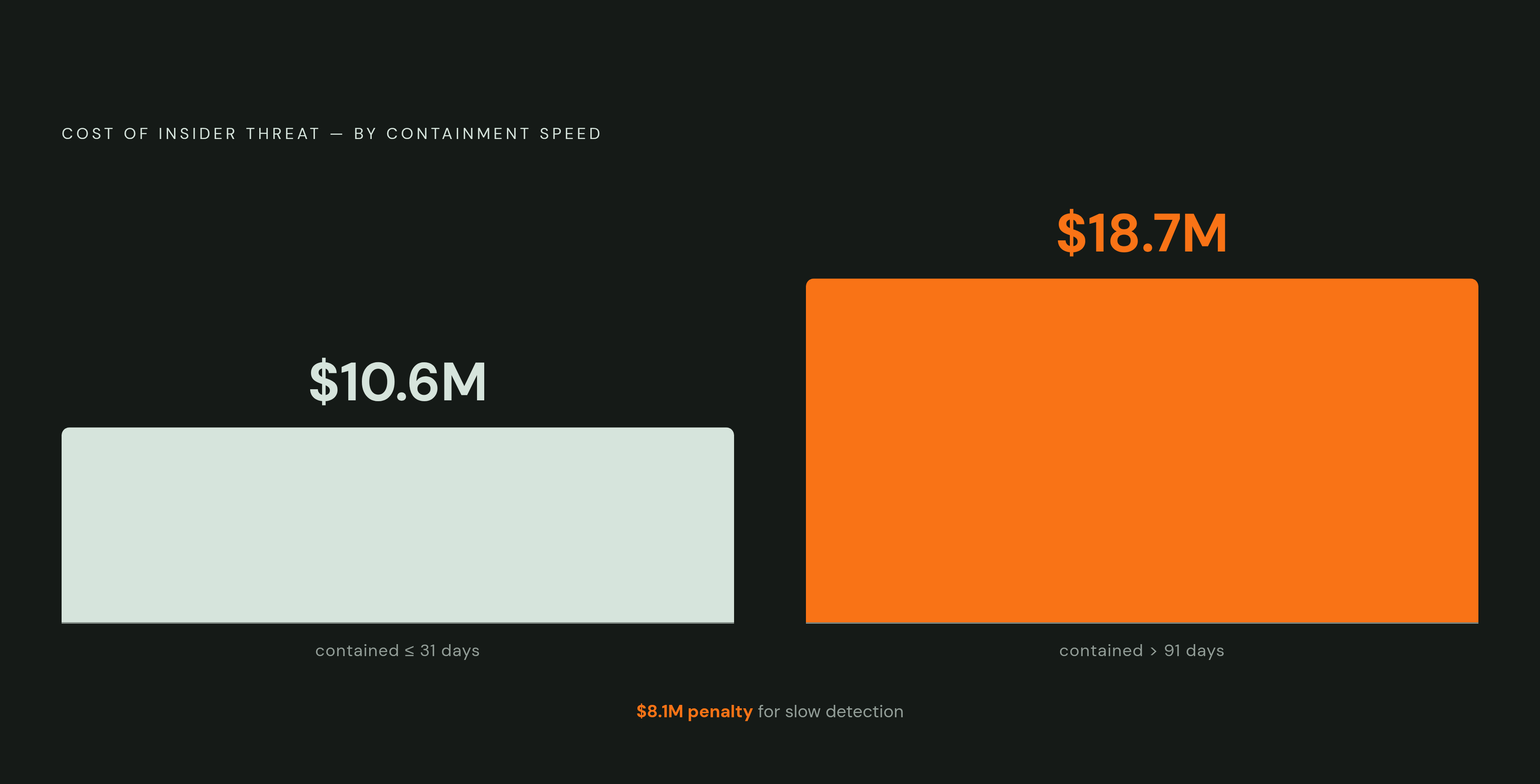
Incidents contained within 31 days cost an average of $10.6 million. Pushing past 91 days raises that number to $18.7 million. That gap is the price of slow detection, scattered ownership, and tools bought before anyone wrote down what risk the program was actually supposed to catch. This piece walks through the five-level maturity curve for insider threat programs, what separates each stage in practice, and why the 2026 threat surface raises the coverage bar at every level, not just the top one.
Insider attacks hit 83% of organizations in 2024. Despite that, a market guide from a research firm found that 54% of insider risk programs still qualify as "less than effective." Budgets have moved: average insider-risk allocation rose from 8.2% of total cyber spend in 2023 to 16.5% in 2024. Doubling a budget does nothing for a program that was never built around a defined risk appetite, data classification, or cross-functional governance. Money poured into a structurally immature program buys more tools, not more maturity, and that gap between spending and structure is the entire reason maturity models exist.
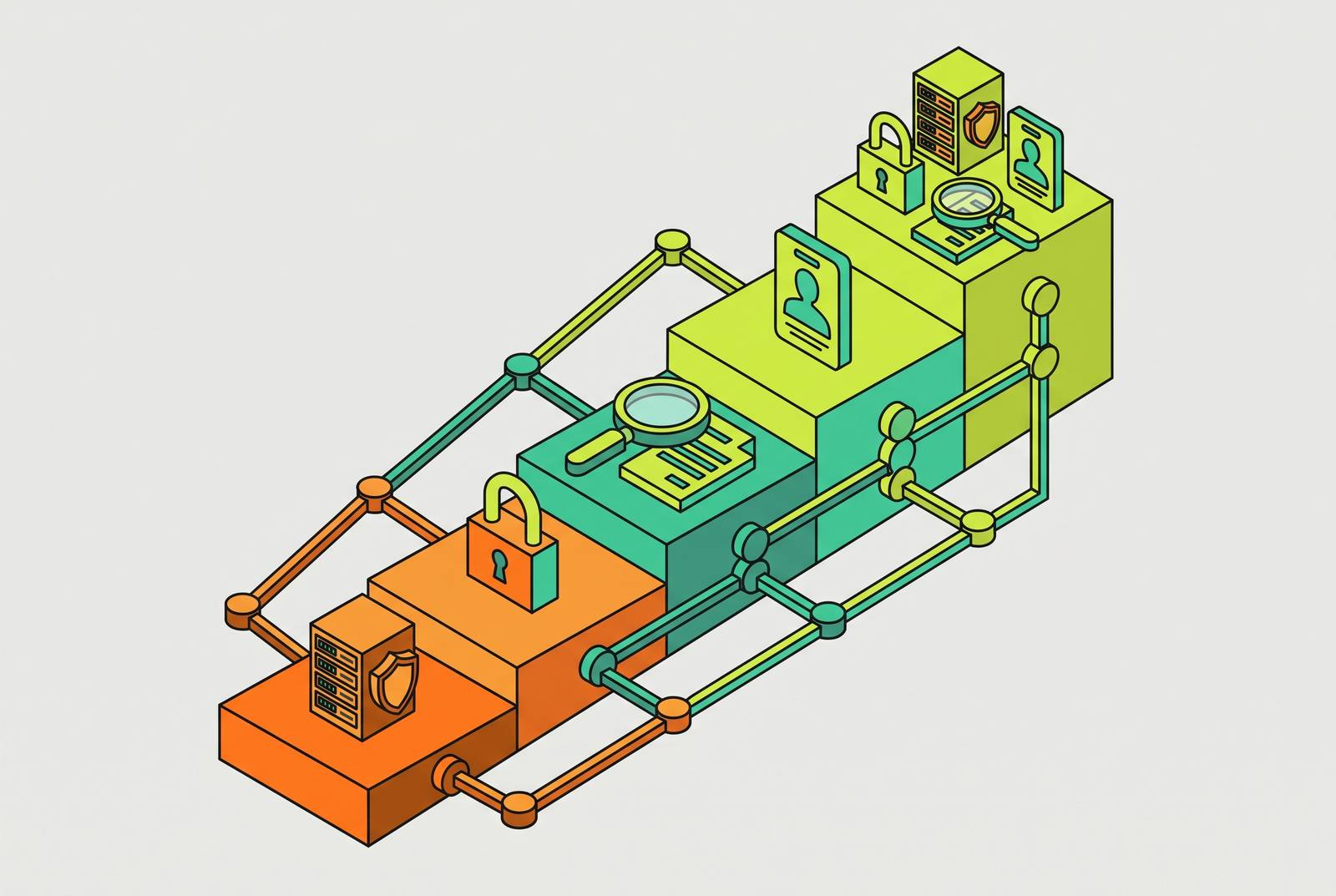
The reference document is a federal task force's Insider Threat Program Maturity Framework, released November 1, 2018. NITTF built it to move federal agencies past bare Minimum Standards compliance and toward something that actually deters, detects, and mitigates insider risk instead of just writing it up after the fact. Five levels: Ad Hoc, Initial, Repeatable, Managed, Optimized. The progression tracks measurable gains in cost and containment time. That's why the model outgrew its original federal audience.
Critical infrastructure adopted the same logic. ReliabilityFirst built an Entity Insider Threat Program (InTP) Maturity Assessment Tool for grid-security operators, and entities can work with CIP subject matter experts to review results and plan changes to policy or procedure. ReliabilityFirst has since stopped accepting new users for that tool, and anyone with existing assessment data needs to download it before December 15, 2025. What replaces the tool in 2026, if anything does, has not been announced, a real gap in the ecosystem.
The credibility of these models rests on where they come from. NITTF built the underlying logic, and that lineage matters: a maturity model built by the company selling the Level 5 tool is going to draw its lines wherever suits the sale. A model built by federal task forces and independent researchers doesn't carry that conflict.
Level 1 (Ad Hoc): what a program looks like when it isn't really a program
At Level 1, nobody owns the problem, no formal policy exists, and monitoring, when it happens at all, happens after the damage is done. Response is entirely reactive: something breaks, someone investigates, and the "program" turns out to be an incident response process wearing a different name tag.
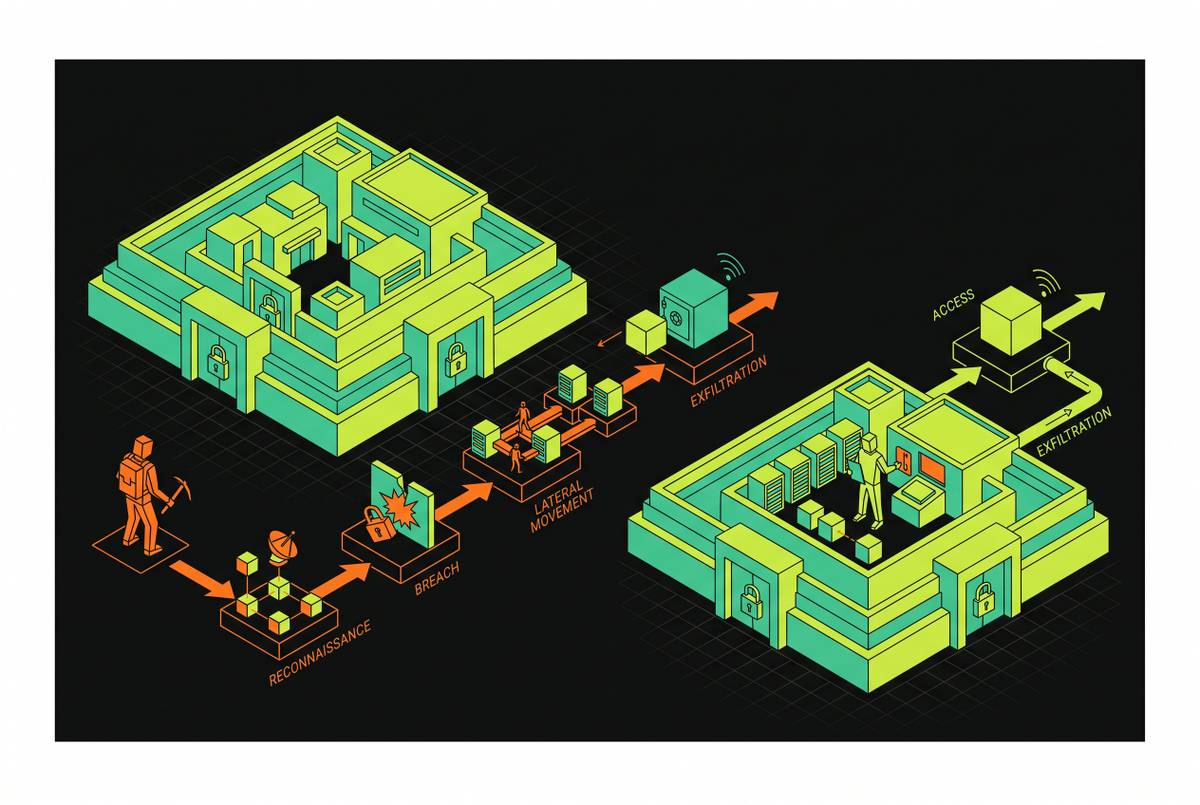
The deeper failure is the absence of shared visibility. Insider threat usually sits with one team, IT or security, while HR, legal, corporate security, and compliance each hold a different fragment of the same picture. A formal HR complaint, a resignation announced the same week as unusual file access, a compliance flag buried in a vendor contract: because insider threat usually sits with one team, each of these appears in one department long before it becomes visible anywhere else. Nobody is hiding anything on purpose. The information just sits in different filing cabinets, and that siloed reporting slows response more than any missing piece of monitoring software ever could.
Detection at this stage leans on endpoint anomalies and network logs, and even those get pulled up only once an incident is already suspected. That's a serious structural problem, because most insider incidents aren't plots. Research puts 55% of insider incidents down to negligence rather than malicious intent. A reactive posture catches neither the negligent majority nor the malicious minority before the damage lands. It just writes down what already happened.
Level 2 (Initial): first formal structures, persistent coverage gaps
Level 2 is where a program starts to resemble a program. A written policy exists now, someone has been named the owner, basic user activity monitoring runs on managed endpoints, and employees sit through annual training. Call it the skeleton stage: the bones are there, but there's no muscle around them yet.
The most visible technical gap at this level is legacy DLP. Most Level 2 data loss prevention systems rely on regular expressions and data fingerprinting matched against known patterns, an approach built for a world of email attachments and portable storage devices. That approach has no concept of an AI prompt. It can't inspect content moving through a chat interface, because the pattern it's hunting for was never built to recognize a paragraph of pasted source code inside a conversational window. The industry consensus is increasingly clear: conventional DLP cannot effectively manage GenAI data loss risks, including exposure through encrypted traffic, intent blindness, and shadow AI.
The gaps compound from there. Personal devices, home networks, and unsanctioned apps sit entirely outside the field of view of managed-endpoint DLP, and A substantial share of organizations report employees actively using AI tools that were never approved. A policy on paper and a monitoring agent on the office laptop don't accomplish much when the real risk activity happens on a phone or a home machine running an app IT has never heard of.
Level 3 (Repeatable): consistent process, behavioral context, and multi-source signal
Detection at Level 3 moves from event-based to pattern-based, because a single anomalous login or one large file transfer rarely tells the whole story by itself. Risk lives in the pattern across a timeline, not in any one moment on it.
User and entity behavior analytics (UEBA) is what makes that shift work in practice. Machine learning builds a baseline of normal behavior for each user, then watches for meaningful deviation from that established pattern. It catches the subtle, shifting techniques that static rule sets miss, because a static rule only catches what somebody already thought to write down in advance.
Behavioral baselines matter, but they aren't enough on their own, and treating them as the finish line is the mistake most Level 3 programs make. Risk can exist from day one and never register as a deviation, because it was normal from the start. A user who has always exported large datasets as part of the job isn't going to trip an anomaly detector by exporting one more dataset next week, even if that particular export is the one that matters. Deviation-based detection has a blind spot for risk hiding inside authorized, habitual behavior, and no amount of tuning the baseline fixes that.
That's why Level 3 also builds cross-functional structure: a centralized risk committee, or designated liaisons in HR and compliance, makes behavioral and contextual signals visible in places where a technical log never would. The fragmented reporting characteristic of earlier levels gets replaced by an actual escalation path. Someone in HR who hears about a bitter resignation now has somewhere specific to send that, and it lands next to the technical signal instead of sitting in a separate file.
Level 4 (Managed): integrating identity, data lineage, and behavioral context into a single risk picture
Three alerts land in a queue, unconnected: a privileged account exports a bulk set of records, logs in from an unfamiliar location an hour later, then uploads a file to a personal cloud account before the shift ends. At Levels 1 through 3, those are three separate tickets, reviewed by three different analysts, rarely connected. A managed program treats that sequence as one prioritized, contextualized signal, because identity, data lineage, and behavior finally sit in the same system instead of three different ones.
AI-native DLP is what makes that integration possible. Instead of relying on static rule libraries, it uses machine learning, behavioral analytics, and data lineage tracking to recognize unstructured, sensitive material, contracts, proprietary research, engineering IP, without a human having to pre-write a pattern for it. AI-native DLP has been associated with false-positive reductions as high as 90% compared to rule-based systems, alongside better detection overall. Fewer false positives means analysts spend their attention on signals that matter instead of chasing noise all day.
The Samsung episode from 2023 is the case study that made this failure mode concrete for the whole industry. Three separate incidents, all involving engineers pasting proprietary semiconductor source code and other confidential material into ChatGPT for various work purposes. The company's existing controls caught none of it, leaving the exfiltration undetected until it was reported externally. A managed-level program with AI-native controls would have had visibility into both the prompt content and where it was headed, and that visibility separates Level 4 from everything below it.
Shadow AI is what makes Level 4 non-negotiable rather than aspirational. Gartner estimates 69% of organizations suspect prohibited GenAI tool use inside their own walls, and Netskope tracked more than 1,550 distinct GenAI SaaS applications during 2025, up from 317 at the start of that same year. A monitoring architecture that wasn't built with AI destinations in mind has a structural hole in it, and that hole widens every quarter as the number of available tools climbs.
Level 5 (Optimized): AI-accelerated investigation, proactive threat intelligence, and program feedback loops
Even the best programs in the field aren't fast. The 2026 Ponemon/DTEX research recorded a record-low containment time of 67 days, down from 81 days in the prior year's edition, and that's still more than two months from detection to resolution. Level 5 is the architecture built to keep pushing that number down further.
What Level 5 adds is pre-emption. Among organizations with an established insider risk program, 65% reported that the program had actually pre-empted a breach before it happened, catching the pattern early enough to intervene instead of clean up afterward. That's the outcome the whole maturity curve has been building toward: fewer messes, not just faster mopping.
AI does the heaviest lifting here as an investigation force multiplier. Instead of an analyst manually stitching together a privileged export, a strange login, and a cloud upload into a coherent story, AI assembles that narrative before the case ever reaches a human reviewer. Mean-time-to-investigation shrinks because the alert arrives with context already attached, rather than as a raw queue entry demanding manual correlation from scratch.
The furthest edge of this is agentic AI inside the security operations center. What started as rule-based automation years ago has moved into ML-driven analytics, and by 2026, agentic systems can independently execute steps across the full detection-to-response lifecycle, closing the long gap that used to sit between spotting something and acting on it. That's a real leap from reactive to real-time, but it comes with a condition that can't be waived: autonomous detection has to stay auditable. A system making containment decisions on its own cannot also be a black box, because "the AI flagged it" doesn't survive a legal or compliance review. Explainability is the precondition built into agentic AI from the start. It's the precondition for trusting agentic AI with any real authority.
How the 2026 threat surface changes maturity level coverage
Two shifts have redrawn what "coverage" means going into 2026. The first: employees pasting sensitive material into public large language models through personal accounts, often on devices the company issued. The second, newer and less understood: autonomous AI agents holding standing privilege inside corporate systems and acting without a human reviewing each step. Neither existed as a meaningful risk category five years ago, and neither fits the monitoring architecture built for the last decade's threat model.
Shadow AI isn't just a blind spot in visibility, though it's that too. Sixty-nine percent of organizations suspect prohibited GenAI tool use inside their own environment, yet a large share of organizations report having no AI-specific controls. The controls that actually work here track the data itself: where it's headed, who owns the account sending it, what the surrounding context looks like, with the ability to step in before sensitive information leaves the building rather than logging the fact that it already did.
Regulatory posture has caught up on one piece of this faster than most security teams have. US federal guidance now treats AI agents as privileged internal actors in their own right, requiring least-privilege access, a human override mechanism, and audit logging, the same governance vocabulary applied for years to human employees with elevated access. A program that hasn't updated its scope to include AI agents as a distinct actor class is missing a category of risk that regulators have already decided counts.
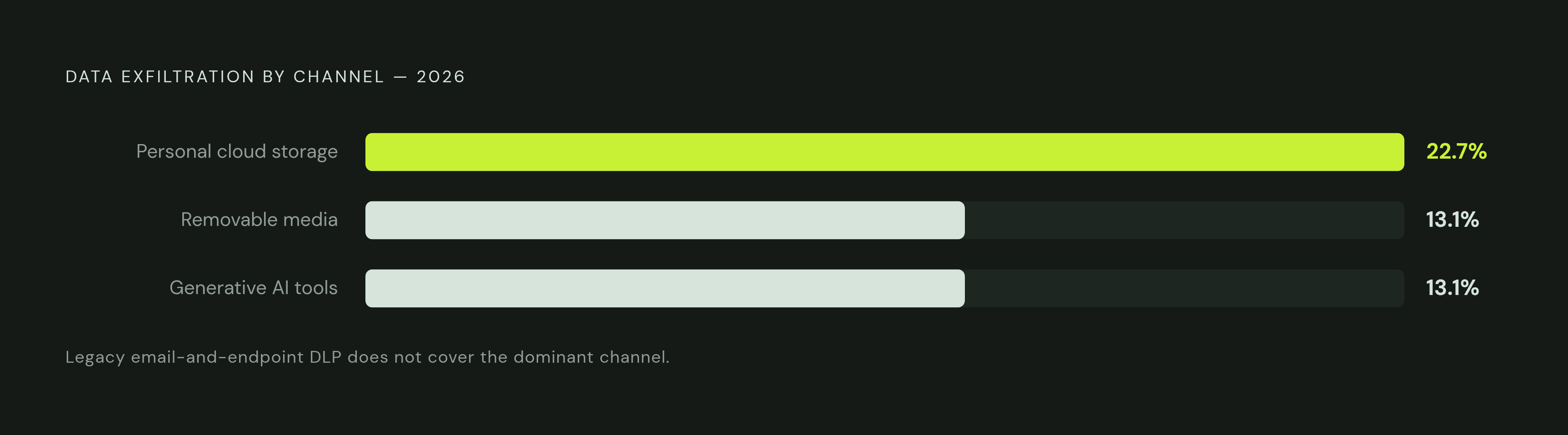
The exfiltration numbers back this up. Personal cloud storage now accounts for 22.7% of exfiltration paths, with removable media and generative AI tools at 13.1% also representing significant shares. A program still built primarily around email monitoring and endpoint DLP is structurally mismatched to where the traffic actually moves in 2026. What matters is whether a program's coverage map was drawn for the threat surface that exists now, or the one that existed five years ago, and that question decides how well it detects real risk regardless of what maturity level it claims on paper.