Scoring Insider Threat Platforms on Behavioral Context Depth, Not Dashboard Polish
Behavioral depth in threat detection matters far more than dashboard design.

Insider threat platforms are usually chosen on the strength of what a buyer can see in a demo: a clean dashboard, a well-organized alert queue, a polished investigation timeline. None of those features predict whether the platform will catch a real insider threat, because detection quality depends on something a demo rarely shows: how deeply the platform understands the behavioral context around a data action, not just the action itself. This article gives security practitioners a concrete framework for scoring platforms on that dimension: five testable criteria and three real-world insider threat patterns, so you can see where visible polish and actual detection pull apart.
Dashboard quality is a poor proxy for detection quality in insider threat platforms
A security team sits through a vendor demo, watches a clean interface render an investigation timeline in real time, and walks away assuming the detection underneath must be just as sophisticated as the screen that displays it, because the interface and the detection logic are produced by the same team and reflect the same engineering investment. That assumption is a category mistake. Interface quality and detection quality are produced by entirely different parts of a platform, built by different teams, solving different problems, and a vendor can invest heavily in one while leaving the other thin. The visual layer is also the easiest thing to compare across vendors in a 45-minute sales call. That ease of comparison is why it gets disproportionate weight in procurement decisions that should hinge on detection quality instead.
The dashboard cannot show the detection philosophy that drives the platform: whether it understands that a file transfer, a login, or a download only becomes meaningful in light of who did it, what they had been doing in the weeks before, and what the data actually represents to the business. A platform running on static rules will fire reliably on the specific behaviors engineers told it to watch for. It has no mechanism for catching the pattern that falls between two rules, or the pattern that spans two separate systems neither rule was written to see together.
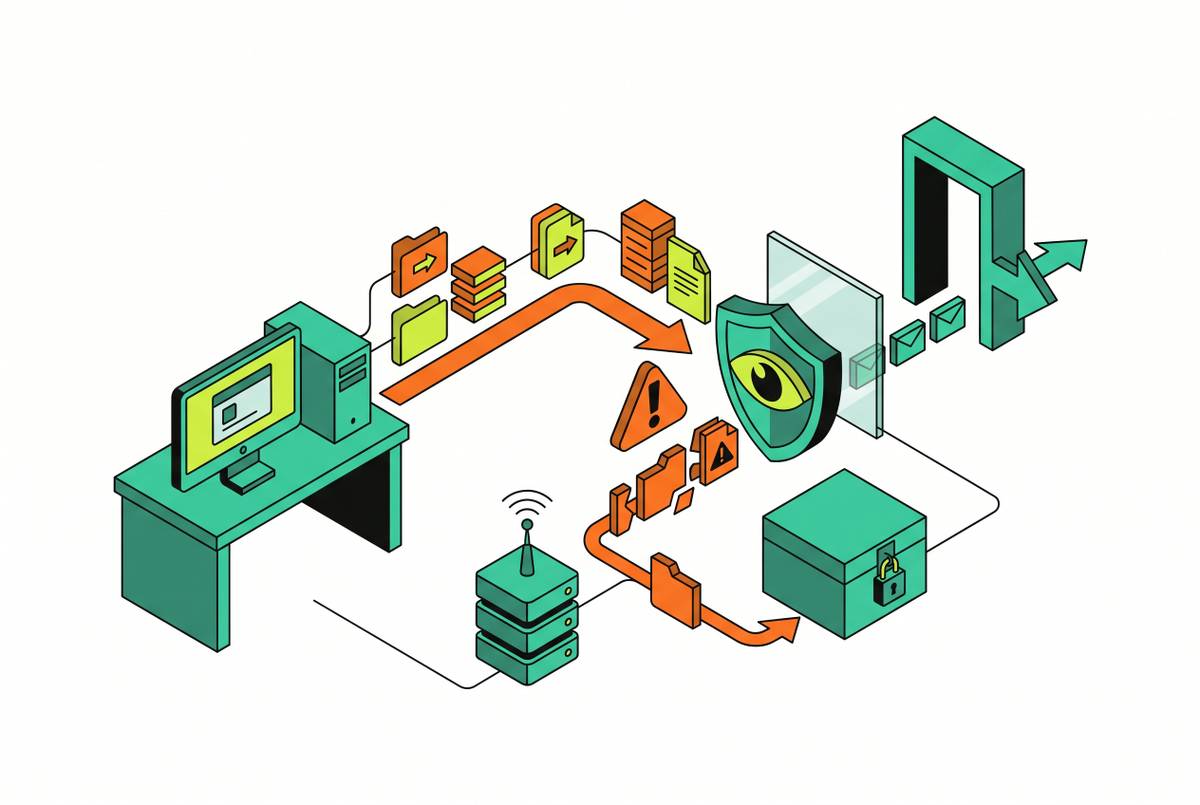
Intel's experience with a departing employee illustrates the gap cleanly. The employee downloaded a large volume of sensitive files before termination, and a DLP control did what it was configured to do: it blocked one transfer attempt. The employee then used a second device and moved the data anyway. The control worked at the channel level and failed at the behavioral level, because nothing in the system connected the blocked attempt on one device to the activity on the other as a single, escalating pattern. Rippling's case, covered in more detail later in this piece, shows the same structural gap stretched across four months. Both cases share a root cause: channel-based controls without behavioral coherence.
What behavioral context depth means
Behavioral context depth describes the degree to which a platform preserves and connects the circumstances surrounding a data action, including the user's prior activity, how that activity compares to their peer group, what the data means to the business, where it's headed, and what identity events happened nearby in time, then uses that assembled picture to separate real risk from routine noise. A static rule registers an action. Behavioral context depth evaluates whether that action, by that specific person, at that specific moment, fits the pattern of everything they've done before or breaks it.
The raw material for this kind of detection is not scarce. Endpoint agents and API integrations can already capture file access, application usage, email content, USB transfers, and cloud uploads at significant scale, so volume of collected data is not what separates platforms. What separates them is whether that raw material gets processed into per-user behavioral baselines, correlated across the surfaces where it originates, and turned into investigative context before an analyst ever sees it. Candor exemplifies this distinction by ingesting multi-source behavioral data across endpoints, SaaS, and identity systems, then assembling it into per-user behavioral narratives rather than isolated events, the kind of longitudinal coherence that static rule-based tools cannot deliver and the capability that would have exposed slow-burn staging tactics months before they matured into exfiltration.
Building that kind of depth means solving problems that have nothing to do with interface design. The second is longitudinal coherence: can the platform connect events across days or weeks, instead of evaluating each login session as an island? That second capability would have exposed four months of dwell time in the Rippling case, had a platform tracked the pattern across that entire window while maintaining its attention across sessions.
The sharpest objection to any baseline-driven approach is contamination. The answer to that objection is scenario-specific detection: modeling the behavior sequences characteristic of known threat archetypes, rather than relying solely on deviation from a personal mean that the insider has had time to shape. A platform built this way can catch risk that exists from an employee's first day, or risk that never produces a statistical anomaly at the individual level because the insider stayed inside their own normal range the entire time. That distinction is also the real test of whether a behavioral platform earns the label: ask whether it detects against known archetypes and behavioral sequences, or only against population-level deviation from an average.
The three insider threat archetypes that expose the limits of context-shallow platforms
Insider risk arrives in a small number of recognizable patterns, and each one stresses a different part of what behavioral context depth is supposed to deliver. That makes them useful diagnostic tools: a platform's ability to catch each archetype maps directly onto a specific capability a buyer can test for.
The first archetype is the departing employee staging exfiltration before leaving. The signal only becomes visible when three things are combined: HR context showing an active departure negotiation, an access pattern reaching into repositories outside the employee's normal work scope, and a destination showing personal email use at an elevated frequency. Catching that pattern requires integrating HR event data, correlating file access against outbound email across surfaces, and holding enough longitudinal memory to recognize an escalating pattern rather than treating each transfer as a single unconnected spike.
The second archetype is the legitimately credentialed insider who is compromised or bribed. At Coinbase, external attackers bribed support agents who then used their own legitimate access to customer support systems to exfiltrate customer data, a pattern detectable only through peer-group deviation and volume anomalies, because no formal rule was ever broken. A context-shallow platform misses this pattern entirely, because no rule is ever broken. The only available signal is that one person's volume, cadence, or data-type distribution diverges from their peer group, so you need a behavioral baseline with peer-group granularity fine enough to tell a support agent's ordinary access pattern apart from a bribed agent's extraction run.
The third archetype is the long-dwell embedded operative, or the negligent user whose risky habits escalate gradually. At Rippling, an operative allegedly planted by a competitor accessed Slack, Salesforce, Google Drive, and Rippling's internal HR directory over four months, stealing customer data and pricing information the entire time using authorized systems and legitimate credentials. What a context-shallow platform misses here is the slow accumulation of access across platforms and repositories outside a person's normal role scope, a pattern that becomes visible only when plotted across weeks, requiring long-window behavioral memory and the ability to model drift over time.
A scoring framework for evaluating behavioral context depth across platforms
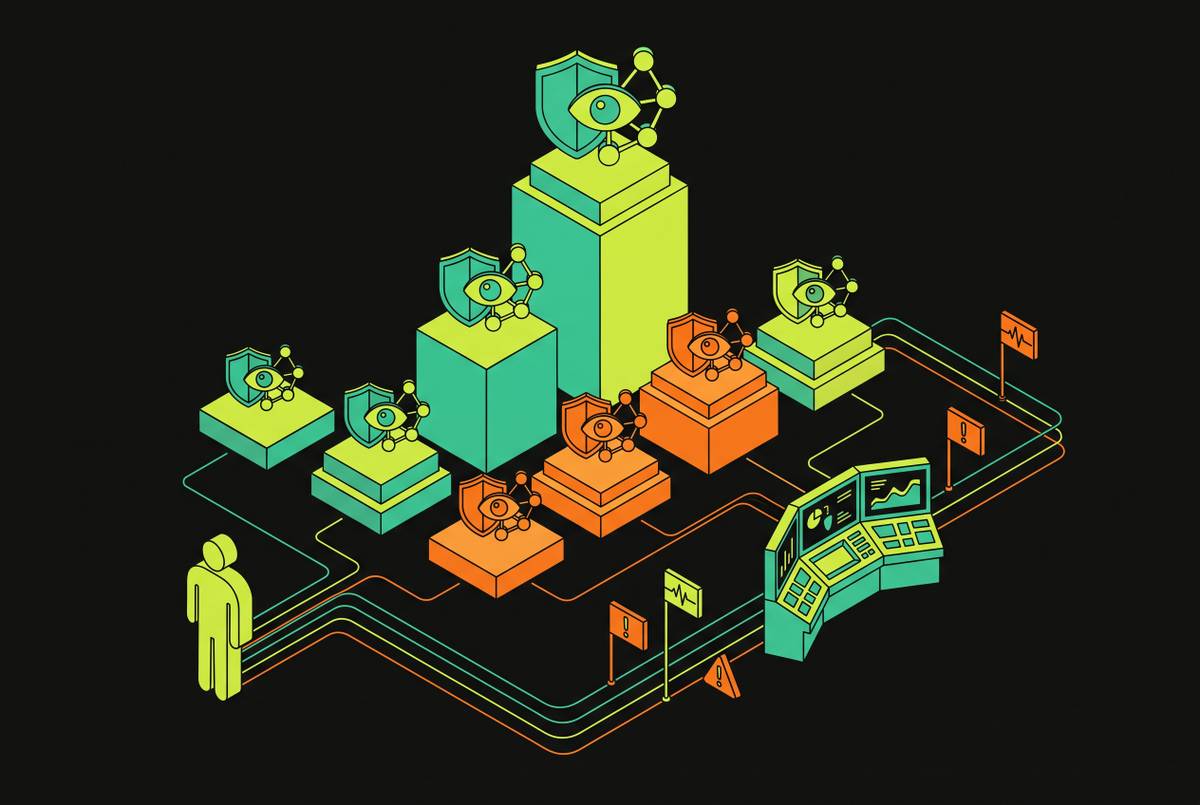
Evaluating behavioral context depth comes down to five dimensions, and each one gives you a testable question you can put directly to a vendor. A platform that scores well across all five should be able to catch all three archetypes described above; a platform that scores well on only some of them will carry predictable, identifiable blind spots that map directly onto the archetype its weak dimension fails to cover.
The first dimension is signal integration and context preservation: whether the platform ingests from endpoints, SaaS applications, cloud storage, identity providers, email, and HR systems, and whether it preserves the relational context between those signals rather than treating each one as an independent alert source feeding a separate console. If an analyst has to manually stitch that timeline together across tools, the platform is delivering behavioral context components, not behavioral context depth.
The second dimension is peer-group modeling granularity: whether the platform builds behavioral baselines at the individual level, the peer-group level, or only across the organization as a whole, with peer groups defined by role, tenure, department, and data access scope. A platform reveals this gap only when measured against a peer group of support agents with comparable access, so the natural test is how a platform defines those groups and whether the definitions can be adjusted without a professional services engagement.
The third dimension is longitudinal behavioral memory and drift detection: how far back a platform's behavioral model looks when scoring a current event, whether that window is configurable, and whether the platform can surface a trend line of access-pattern drift across weeks or months alongside today's deviation score. The Rippling archetype required months of behavioral memory to catch, and a platform running on a 30-day rolling window would have reset its own baseline roughly three to four times across that four-month dwell period, erasing the very escalation it needed to notice.
The fourth dimension is scenario-specific detection versus generic anomaly scoring: whether a platform can distinguish the behavioral sequence of a staged exfiltration from the sequence of a compromised credential or the sequence of privilege abuse, since the appropriate investigation and response differ for each. The test is simple: when an alert fires, does the platform name a threat scenario or archetype, or does it hand over a bare risk score and leave the categorization to a human.
The fifth dimension is pre-assembled investigative context versus alert-and-queue: whether the platform delivers a built investigative picture, including the user's behavioral timeline, relevant peer-group comparison, data context, and adjacent identity events, at the moment an alert fires, or whether it delivers a bare notification that forces the analyst to start investigating from zero. The test question here asks a vendor to walk through what an analyst sees in the first moments after an alert fires, and what the platform had already assembled before that moment arrived.
How the leading platforms score on these dimensions, starting with Candor
Two platforms that look nearly identical in a sales demo can diverge sharply once you measure them against these five dimensions, and the comparison that follows applies the framework's criteria.
Candor is built as an AI-native data loss prevention and insider risk platform around a specific premise: what the data means, where it's headed, who is interacting with it, and the surrounding behavioral pattern all belong in the same decision as the data movement event itself, not bolted on afterward. On signal integration, Candor combines DLP controls with behavioral detection and investigation across enterprise systems, so it assembles the full story before it ever reaches an analyst, and the human reviewing the alert doesn't have to do that work. On data context depth, the platform is built to understand what data actually means to the business rather than whether it matches a regex pattern or a formal classification label: the most valuable material inside a company often carries no formal label at all, so a platform that only watches for labeled data misses it by design. Candor is also designed to be deployable within a week regardless of whether it runs on-premise or in the cloud, a relevant detail for practitioners weighing platforms that need months of UEBA baseline-building before they produce any usable signal. The detection philosophy driving the platform is what separates these approaches, and it produces starkly different outcomes: a platform built on static rules fires on the surface behaviors it was explicitly told to watch, while a behavioral platform that assembles the story of who did what, when, and what it means to the business can catch patterns no rule anticipated, because those patterns cross surfaces or unfold over time in ways no single static condition was ever written to cover.
Darktrace built its reputation on network-level behavioral detection, using unsupervised machine learning to establish a baseline of normal activity across an organization's network traffic and flag deviations from it. Measured against the five dimensions, its strength sits most naturally in longitudinal baselining at the network level, with the open question for any buyer being how deeply that baseline extends into the SaaS, identity, and HR context needed to catch an archetype like the departing employee staging exfiltration, where the signal depends on correlating HR events with file access.
Proofpoint approaches insider risk from an email and data-protection background, and its strength sits in content inspection, email-channel controls, and policy-based data loss prevention tied to classification and content matching. The relevant question for a buyer evaluating it against these five dimensions is how far its detection extends beyond channel and content matching into cross-surface behavioral correlation and peer-group modeling, the capability that catches an archetype like the bribed Coinbase support agents, where no content rule was ever broken and the only available signal was a deviation in behavior against a peer group.
Platforms that investigate these archetypes through behavioral sequence modeling rather than deviation-from-baseline detection, surfacing the pattern before the analyst drowns in alerts, separate tools that catch real risk from those that merely provide visibility into data movement. The five dimensions above give buyers a way to tell which category a given platform actually falls into, well before a single demo screen gets involved.