The Security Analyst's Checklist for Evaluating Modern Insider Threat Platforms Against Aging UEBA Deployments
Legacy UEBA misses modern insider threats moving through cloud and SaaS environments.
Security teams are re-examining their UEBA deployments because the insider threat has moved to cloud and SaaS environments that most of these platforms were never built to see. Legacy UEBA was architected for an on-premises world, built around Active Directory logs, endpoint telemetry, and network traffic that stayed largely inside a corporate perimeter. The dominant execution path for insider incidents has since shifted: credential and session abuse, not malicious employees caught mid-act by a behavioral model, now drives most insider activity, with attackers operating through compromised identities rather than tripping the anomaly detectors UEBA was built to trigger.
The techniques behind that shift carry almost no footprint for endpoint-centric tools to catch. MFA helpdesk social engineering, legitimate admin console commands, and routine SaaS data pulls all succeed without deploying malware. They bypass the detection assumptions that most legacy UEBA deployments still carry. Many security organizations also carry years of accumulated tool sprawl: separate dashboards for insider risk, IAM anomalies, cloud audit logs, and HR signals that were purchased at different times for different reasons and never converged into a single architecture. Correlation across those signals remains the exception rather than the norm, and an organization evaluating its "legacy UEBA deployment" today may in practice be evaluating a platform that was already orphaned or mid-transition before the review started. Layered on top of all this is a newer category the original UEBA design never anticipated: AI agents operating with enterprise credentials, generating activity that looks like legitimate service access but carries none of the behavioral history a baseline model depends on.
Legacy UEBA's capabilities and structural limits
UEBA earned its place in the security stack, and you still get real value from how it works. The approach works by ingesting logs and telemetry, building behavioral profiles over time through machine learning and statistical modeling, then flagging deviations in login times, data access volumes, network connections, and resource usage, each one scored for severity and confidence. Peer-group comparison sharpens that scoring considerably: a finance analyst gets measured against other finance analysts with similar access in the same region, rather than against the organization as a whole, which cuts down on the noise that a flat, org-wide baseline would produce. The field's evolution from UBA to UEBA extended that same logic to entities, covering endpoints, servers, applications, and service accounts, because insider risk rarely confines itself to a single human session. A compromised service account can move as much data as a rogue employee, and a platform that only watches people misses it.
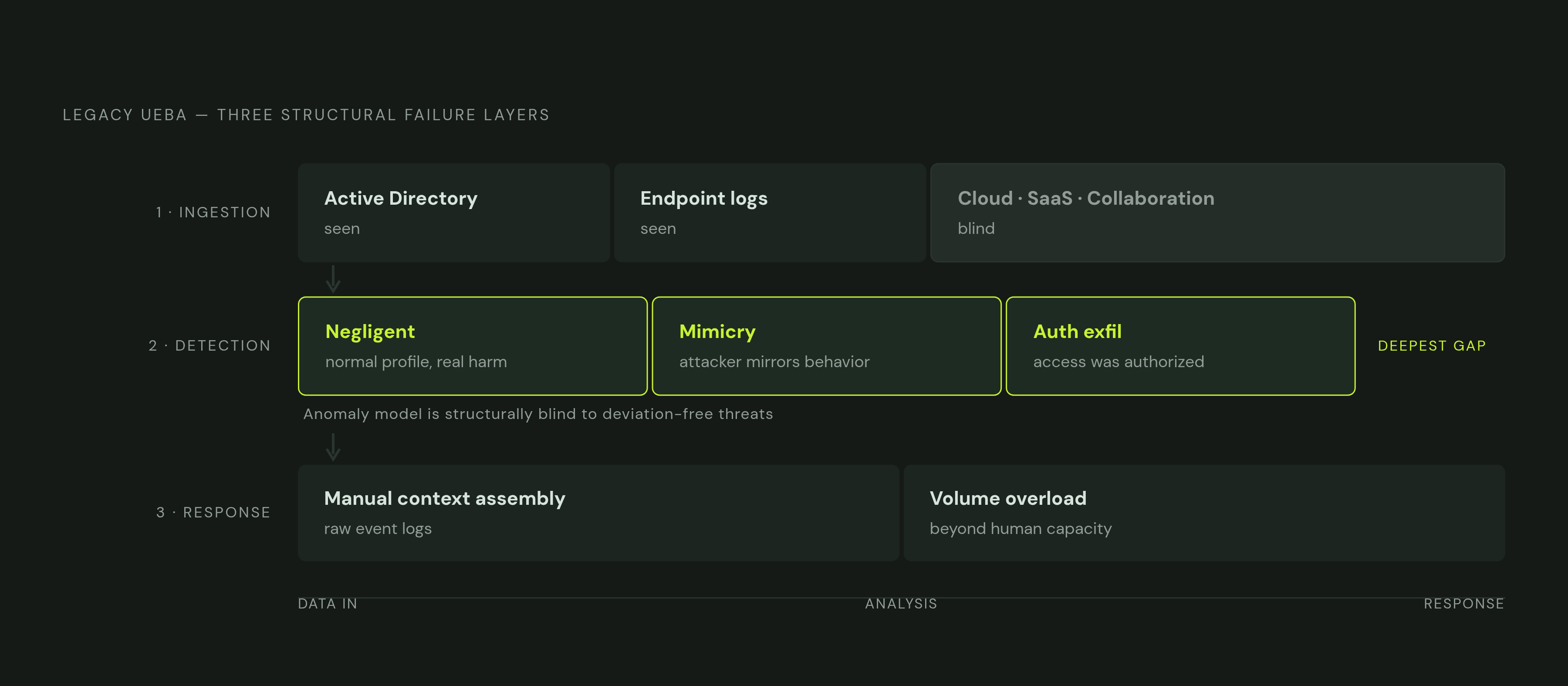
None of this is in question. What the checklist that follows tests is not whether these techniques work, but what they were tuned to find and where they were built to look. Three clusters of gaps emerge from that distinction, and each maps to a section of this checklist: coverage, meaning what data sources the platform actually sees; detection logic, meaning whether it can surface risk that never deviates from a baseline; and workflow, meaning whether it compresses investigation time or simply adds another dashboard to the pile. If a UEBA deployment is still built around Active Directory and endpoint logs, it misses most modern insider activity, which now runs through cloud consoles, SaaS applications, and collaboration platforms. Behavioral baselining, by design, is tuned to catch deviation, so a negligent employee acting carelessly within their normal profile, or an attacker using fully authorized access, can pass through undetected. And even where detection has improved, the investigation bottleneck has not closed: once an alert fires, a human analyst still has to assemble context and judge whether it signals a genuine threat, and alert volume at the average enterprise SOC runs far beyond what that human capacity can absorb.
Checklist criterion 1 (Data source coverage across cloud, SaaS, and collaboration platforms)
The first question to ask of any incumbent UEBA deployment has nothing to do with the sophistication of its models. It has to do with how many of the surfaces where insider activity now happens the platform can actually see. A model can be statistically elegant and still be irrelevant if it never ingests the telemetry where the activity occurs.
The concrete test for an analyst to run is specific: does the platform ingest telemetry from identity providers, endpoints, SaaS platforms, cloud infrastructure, email systems, data stores, and collaboration tools, rather than just Active Directory and on-premises logs? A related but separate question has become unavoidable: can the platform monitor AI agent activity? AI agents that operate with enterprise credentials form a new insider risk category, and traditional UEBA was never designed to address it, because there is no human behavioral history to baseline against and no login pattern in the traditional sense to compare. Vendor claims of "cloud coverage" vary enormously in practice, so the useful test is narrower than the marketing language: ask which named SaaS applications the platform ingests natively, which ones require a custom connector to be built, and which produce no behavioral signal. If you look at that gap between those three categories, you usually see the real coverage picture.
A second coverage question sits just behind the first: does the platform see contractor, third-party, and privileged users with the same fidelity it applies to full-time employees? Contractor and remote fraud-hire incidents, including nation-state IT worker schemes, have clearly gone up, so if a program treats only full-time employees as insider risk subjects, it has a coverage failure built into its design. Post-offboarding credential abuse adds another dimension to the same problem: former employees logging back in with their own or a colleague's shared credentials to pull sensitive material after resignation is a well-documented pattern, and catching it requires integration with offboarding workflows that many legacy UEBA deployments were never built to consume. An AI-driven insider threat platform is only as good as whether it can see the data sources where modern insider risk actually occurs. Legacy UEBA deployments built around Active Directory and endpoint logs miss the majority of activity that now runs through cloud consoles, SaaS applications, and collaboration tools, the places where both negligent and malicious insiders spend most of their working day.
Checklist criterion 2 (Detection logic that reaches beyond behavioral baselines)
Coverage answers what a platform can see. Detection logic answers what it can actually find in what it sees, and this is where the structural critique of legacy UEBA runs deepest. A platform that can only surface risk by detecting deviation from a user's own baseline will systematically miss the categories of insider risk that now account for most incident volume: negligent users acting entirely within their normal profile, compromised users whose attacker mimics their behavior closely enough to stay inside the baseline, and authorized-access exfiltration that never produces a statistical anomaly because nothing about it looks unusual on paper.
Negligence, not malice, dominates incident counts. A majority of insider incidents trace back to negligent or compromised users rather than confirmed malicious actors, and that fact exposes the core design tension in behavioral detection: it is built to find anomaly, but a careless employee working inside their established pattern generates no anomaly to find. The Charter Communications breach shows the compromised-user version of the same problem concretely. An attacker used voice phishing to obtain credentials for a Microsoft Entra account, then moved into a Salesforce environment and exfiltrated customer data, all while authenticated as the legitimate employee, and those actions may have appeared behaviorally consistent with that employee's normal patterns throughout. Sophisticated or patient insiders present a third version: rather than making one detectable move, they can shift their activity profile gradually enough that a baseline model simply redraws itself around the new behavior before raising any flag.
To close that gap, you need detection logic that reasons about content and sequence, not just statistical deviation. Understanding what data means requires knowing what kind of file it is, what it represents to the business, and whether its destination makes sense given the user's role, which calls for content intelligence operating alongside behavioral intelligence. A single download carries little signal on its own. That same download paired with a recent resignation, access to a repository the user has never previously touched, and an email sent to a personal account forms a pattern, and the risk lives in that sequence. Risk scoring needs identity context layered in as well: role, tenure, recent HR signals, and relationship to departing peers all carry information that a purely statistical deviation score cannot capture on its own. Where UEBA's baseline-driven detection falters, missing negligent or fully authorized activity that remains statistically normal throughout, modern platforms shift the frame from anomaly-hunting to pattern investigation, surfacing risk that exists from day one or occurs entirely through legitimate access. Platforms like Candor compress mean-time-to-investigation by assembling behavioral context upfront across the enterprise stack, so analysts spend less time reconstructing the story before they can even judge whether a real threat exists, and the practical test to put to any vendor is to demonstrate detection of a scenario where every individual action falls within the user's access rights and historical behavioral range and show how the platform surfaces that risk anyway.
Checklist criterion 3 (Prevention and intervention capability alongside detection)
Catching something only counts if you do it before the data is already gone. The window between initial access and exfiltration has compressed so much that a purely detection-centric architecture cannot close it through faster human response alone, no matter how good the underlying model is.
The Coinbase case makes the limits of detection-only architecture concrete. External attackers bribed support agents, who then used their own legitimate access to exfiltrate customer data, so behavioral detection might eventually flag the unusual access pattern, but only after the exfiltration had already run its course. That sequencing problem is built into legacy UEBA by design: it was architected to flag anomalies for human review, not to intercept data movement as it happens, so the response structurally arrives after the event rather than during it. Modern DLP controls take a different position in the stack, operating at the data layer itself, inspecting content inline and applying intervention proportionate to the risk: blocking, redacting, or alerting before sensitive data reaches its destination. Prevention is not a substitute for investigation in every case, and some insider scenarios will always require detection and response after the fact. But if a platform has no prevention capability, an organization depends entirely on response speed, and response speed alone is no longer fast enough against exfiltration that can complete in minutes.
Shadow AI usage illustrates a specific and current version of this prevention gap. When employees paste sensitive data into generative AI tools, traditional DLP tends to miss it, because the activity happens inside the browser over encrypted channels and the content itself is conversational and unstructured, matching no file-type or keyword rule. Prevention logic built for this problem works at the prompt layer instead, so it inspects and redacts content before it ever reaches the model. AI agents now operate with enterprise credentials under no behavioral baseline at all, so this new insider risk category exposes a blind spot that traditional UEBA cannot fill on its own. Modern insider threat platforms need to account for automated activity that behaves like legitimate service access but may represent a new vector for data movement and privilege abuse, which calls for behavioral profiling that understands both the data in motion and the actor moving it.
The checklist questions for this criterion follow directly from those gaps. Can the platform block or redirect data movement based on content, destination, user identity, and behavioral context together, rather than relying on a static rule keyed to a file type or keyword? Does its intervention logic tighten automatically for users who have already shown elevated risk signals, or does every user get the same static policy no matter their recent history? Does coverage extend to the SaaS and cloud exfiltration channels where most modern insider activity now occurs, or does it stop at endpoint and email? And can it address shadow AI specifically, through prompt inspection, output monitoring, and redaction before sensitive data leaves, instead of the blunter approach of blocking AI tools by domain, which tends to push usage underground?
Checklist criterion 4 (Investigation workflow efficiency and time-to-context)
If a platform fires the correct alert but hands the analyst a raw event log and nothing else, it has only solved half the problem. At the alert volumes most enterprise SOCs operate under, investigation efficiency is where insider threat programs succeed or fail in practice, regardless of how good the underlying detection is.
The throughput math is unforgiving. The average enterprise SOC receives far more alerts per day than its analysts can realistically review, and because each alert can take tens of minutes to investigate properly, most alerts end up queued for hours or never reviewed. Mean time to investigation is the metric where insider threat dwell time is won or lost: Prophet Security's SOC metrics research puts top organizations at an average between ten minutes and an hour depending on alert volume and automation, and hitting that range requires significant context to already be assembled before the analyst ever opens the case. Legacy UEBA typically hands over a risk score and a timeline of flagged events, and leaves the rest of the work, who this user is, what their role entails, what HR signals exist, what they touched before and after the flagged event, how sensitive the data in question actually is, to the human analyst to piece together manually.
An efficient investigation workflow looks structurally different. The platform pre-assembles the user's behavioral timeline, access history, peer-group comparison, HR context, and data context into a single investigation view, so the analyst arrives at a case rather than a raw alert that still needs to be built out. Risk scoring needs to be cumulative and explainable, so the analyst can see exactly which signals contributed to a given score and why, and triage becomes a judgment call backed by visible evidence rather than a fresh investigation from scratch every time. Explainability here is an operational requirement, not a compliance checkbox: analysts cannot act with confidence on a score they have no way to interrogate. AI-assisted triage, applied well, evaluates candidate events before they ever reach a human queue, surfacing only the cases that genuinely warrant analyst time rather than routing every statistical anomaly into the backlog. Integration with SIEM, SOAR, and case management tools matters here too, because it lets context travel with the alert into the response workflow, so analysts don't have to pivot into a separate console and rebuild what they already had.
How much context does the platform assemble before the analyst ever sees the alert, and is that context drawn from a single telemetry layer or pulled together across identity, HR, endpoint, cloud, and data signals at once? Can the analyst see why a given risk score was assigned, or does the scoring stay opaque? And as coverage scales up across more data sources, does the platform reduce the analyst's workload accordingly, or does more telemetry just stack more alerts in the same queue? The answers to those three questions, more than any vendor's description of its own machine learning, tend to reveal whether a platform was actually built for the investigation workload security teams carry today.