Insider Threat Case Management Workflows for Security Teams
Implement structured case workflows to turn insider threat alerts into defensible investigations.
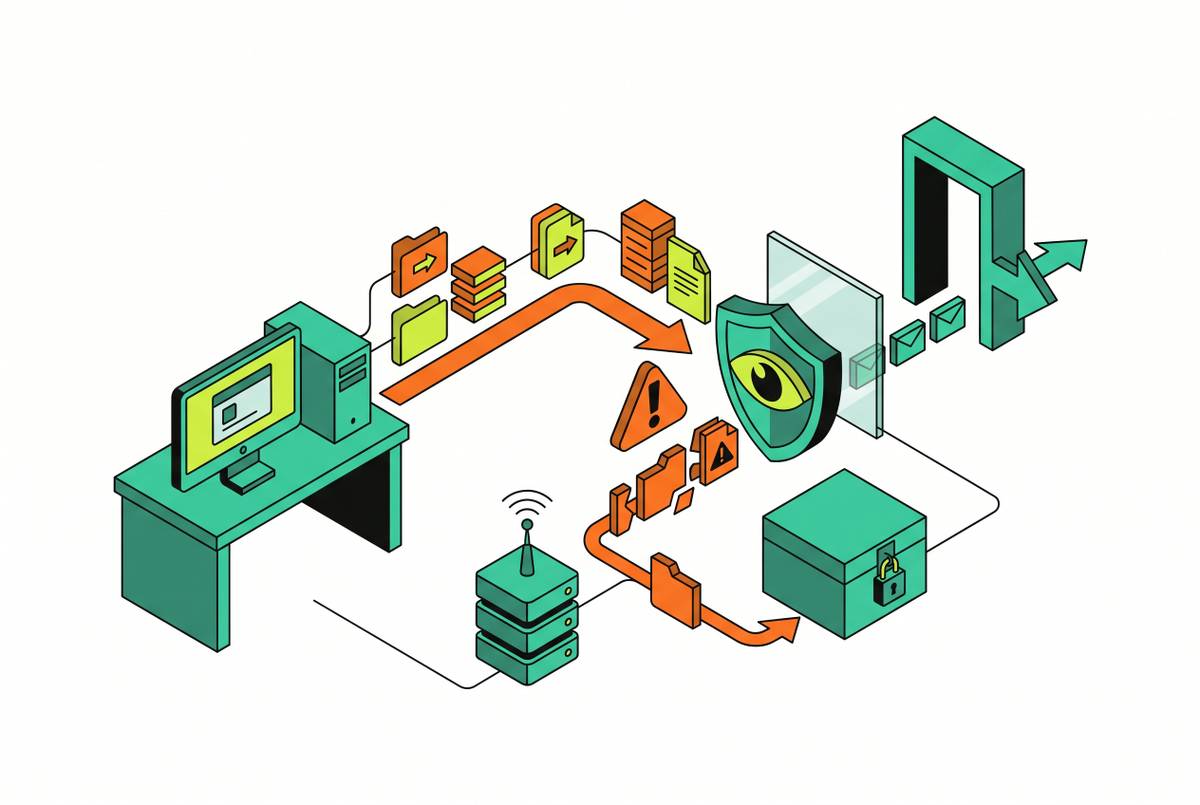
Most organizations already own the detection tools they need. What they lack is a case management discipline, and that gap, not the absence of technology, is where real risk gets buried. A security team can field DLP enforcement points, endpoint sensors, and identity analytics and still fail at insider threat, because detection only produces alerts. Alerts need a process that turns them into finished, defensible cases, and that process is where most programs quietly fall apart.
The failure appears first in a ticket factory. A SOC built this way turns into a service desk clearing a queue rather than a function that hunts for genuine exfiltration. Every alert, benign or dangerous, arrives in the same queue with no process to tell them apart.
The volume math makes the problem worse. Without a workflow built to split those categories apart early, both get mishandled: the negligent case gets treated like a federal case, and the malicious case gets closed like a training reminder.
CISA's January 2026 guidance on insider threat programs makes a point that deserves attention from any team still running a static rule set: insider threat management is an ongoing, dynamic process.
The confidence numbers track what the structural problem predicts. Industry reporting consistently shows that the large majority of organizations consider insider attacks as hard to detect as external attacks, or harder, while only a small fraction of security leaders say they feel confident they can stop one before serious damage occurs. That's not a knowledge gap. Security teams understand the threat. What they lack is a reliable process for acting on what they already know, and that's an execution failure.
Part of the execution gap starts with a definition that hasn't kept up. "Insider" used to mean a disgruntled employee with too much access. A workflow built only to catch the malicious-employee archetype will miss most of the caseload before it even opens a case.
The complete case lifecycle, before building its stages
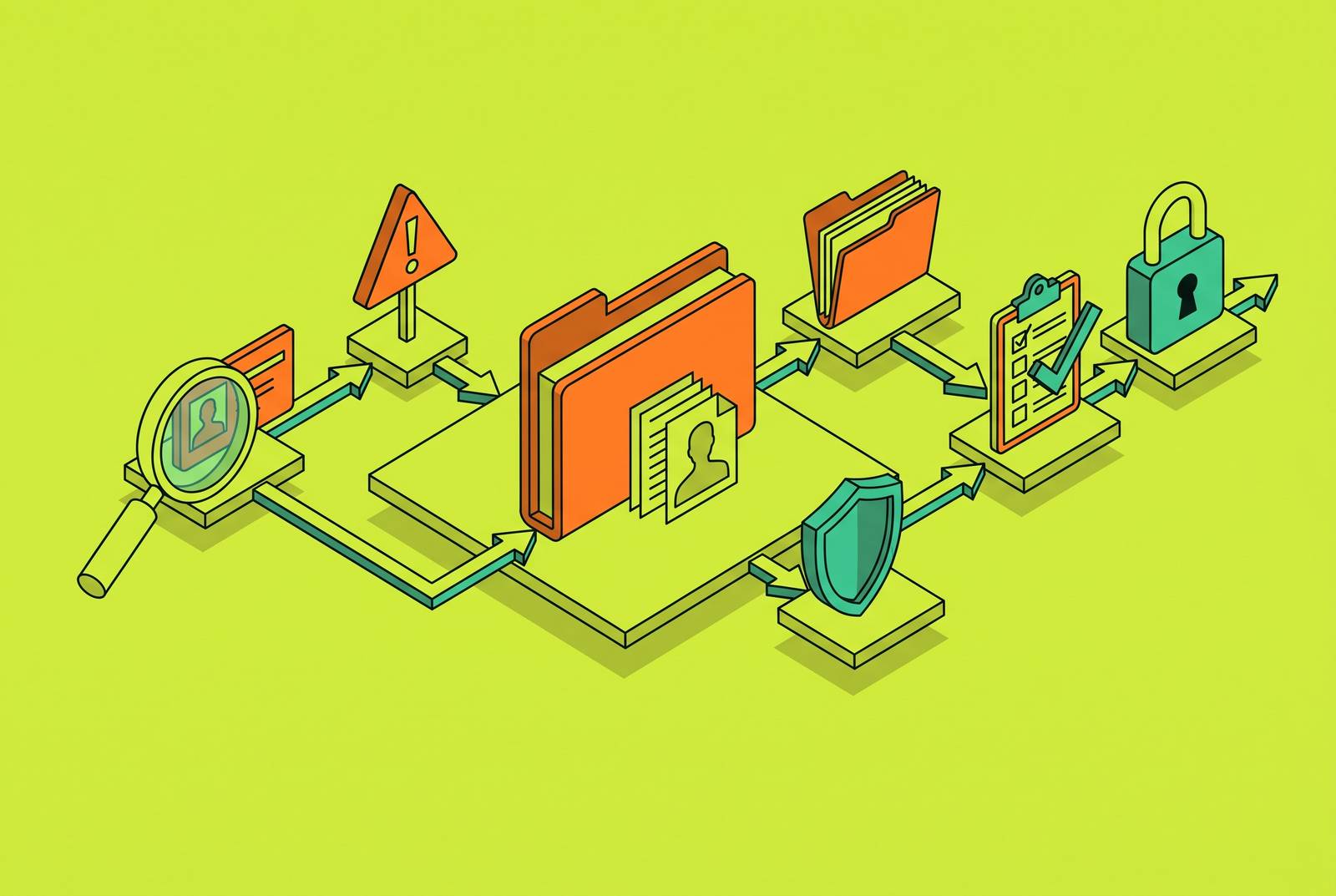
A defensible insider threat case does not happen by accident. It moves through a defined lifecycle, and understanding the full shape of that lifecycle before building out any single stage keeps a program from over-investing in detection while leaving investigation and closure as afterthoughts, which is exactly the mistake that produces a ticket factory.
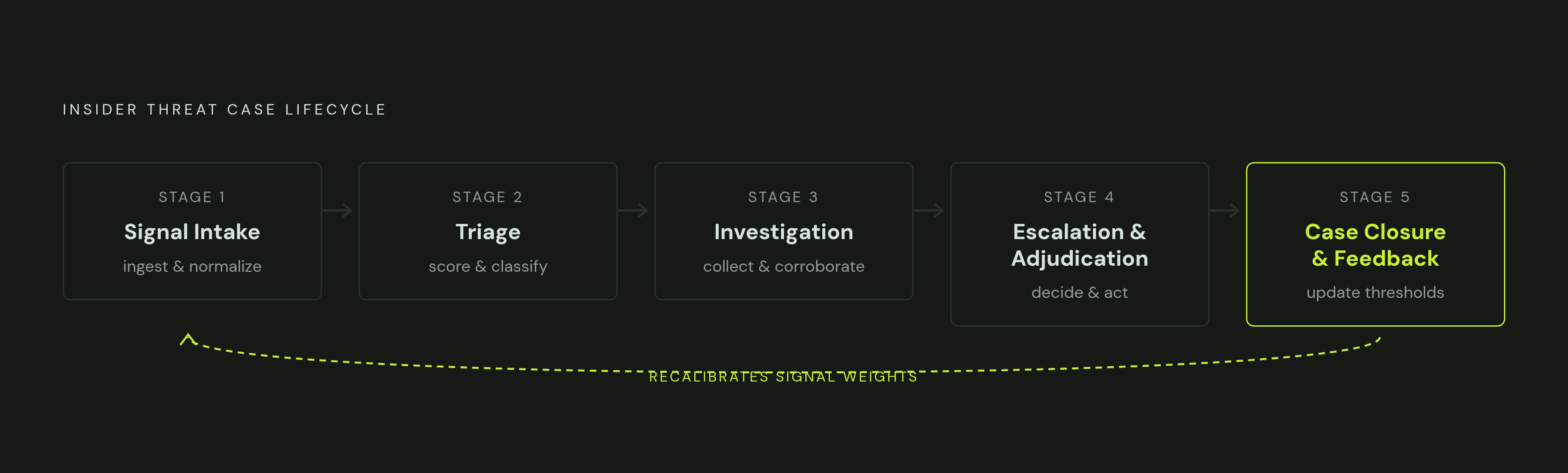
The lifecycle runs in five phases, and each one earns its own full treatment later in this piece. Fifth, closure and program feedback: the point where the outcome of the case gets fed back into the models and policies that shaped the first four stages.
CISA's POEM framework, standing for Plan, Organize, Execute, and Maintain, maps onto this arc at the program level rather than the case level. Maintenance closes the loop, feeding the outcomes of closed cases back into policy and detection model refinement, which is the same discipline Stage 5 depends on later in this piece.
None of this works under single-department ownership. No one department can carry a case from intake to closure alone, and a program that lets one department try will eventually either overstep legally or miss the organizational context that turns a raw signal into a real case.
That cross-functional structure needs a charter before it needs a single case. Without one, the handoffs between security, HR, and legal become the bottleneck where real risk gets buried, the same failure mode described at the start of this piece, just relocated from intake to the middle of the process.
The lifecycle also has to branch by archetype rather than run a single track for every case. Malicious, negligent, and compromised insiders call for different controls, different escalation rules, and different remedies. The lifecycle has to split early enough to treat each archetype on its own terms, a decision that gets made concretely at Stage 2.
Stage 1 (Signal intake: what enters the queue and how it gets there)
What gets allowed into the case queue, and what gets filtered out before it arrives, is the first decision in the entire lifecycle, and it shapes whether the rest of the workflow produces investigated cases or another pile of noise.
Signal intake has to pull from more than the SIEM. HR lifecycle events such as resignation dates, performance plans, and role changes belong in the same intake stream as physical access logs, endpoint telemetry, identity and authentication events, DLP policy hits, and behavioral anomaly scores. A case built from a single signal source is incomplete by construction, because no single system captures enough of an employee's footprint to tell a real story on its own.
HR data earns its place at intake, not just later during investigation. Correlating HR context with behavioral signals at the point of intake surfaces that distinction before anyone opens a case, which saves the three weeks an investigation would otherwise spend discovering it on its own.
Shadow AI and unapproved cloud tools create a blind spot that traditional DLP cannot see on its own. An employee pasting proprietary code or customer data into an AI chat tool nobody sanctioned is moving sensitive information out of the organization through a channel that was never classified as a risk. Intake has to track where data is going as well as what kind of data it is, because a system built to flag file types will miss a destination nobody told it to watch.
Coverage has to extend past full-time employees, too. Contractors, privileged account misuse, and shadow IT all introduce risk that a workflow built to watch employee endpoints alone will simply never see. A contractor with legitimate, provisioned access to a sensitive system is invisible to a program that only ingests signals from managed corporate devices.
None of this works without a written threshold for what actually opens a case. A program has to define, in policy, what score, what event type, or what combination of signals justifies moving a signal from raw data into an active case. Teams that skip this step end up in one of two failure modes: either every mildly unusual signal becomes a case and the team drowns, or the threshold is set so high that real risk slips through untouched. Both are intake failures, and both are preventable with a policy decision made before the first signal ever arrives.
Stage 2 (Triage: scoring and classifying cases before investigation begins)
Triage is where a program converts "something entered the queue" into "this is a known kind of case that needs attention at a known level of urgency," and most workflow failures happen there, because without structured scoring, analysts default to working whatever arrived most recently rather than whatever matters most.
Scoring at this stage has to weigh several dimensions together rather than leaning on any one of them. Scoring cases across all four factors at once is what lets the highest-risk activity move to the front of the queue regardless of which system originally flagged it.
Classification into archetype happens here too, and it determines which branch of the lifecycle a case enters next. The GE turbine trade secrets case, involving Jean Patrice Delia in 2019, required a long-horizon review of behavioral patterns stretched across years, which is a fundamentally different investigative approach than the kind a malicious, fast-moving data leak like the one Tesla experienced would demand. Getting the archetype wrong at triage sends the case down the wrong track before an analyst has even started digging.
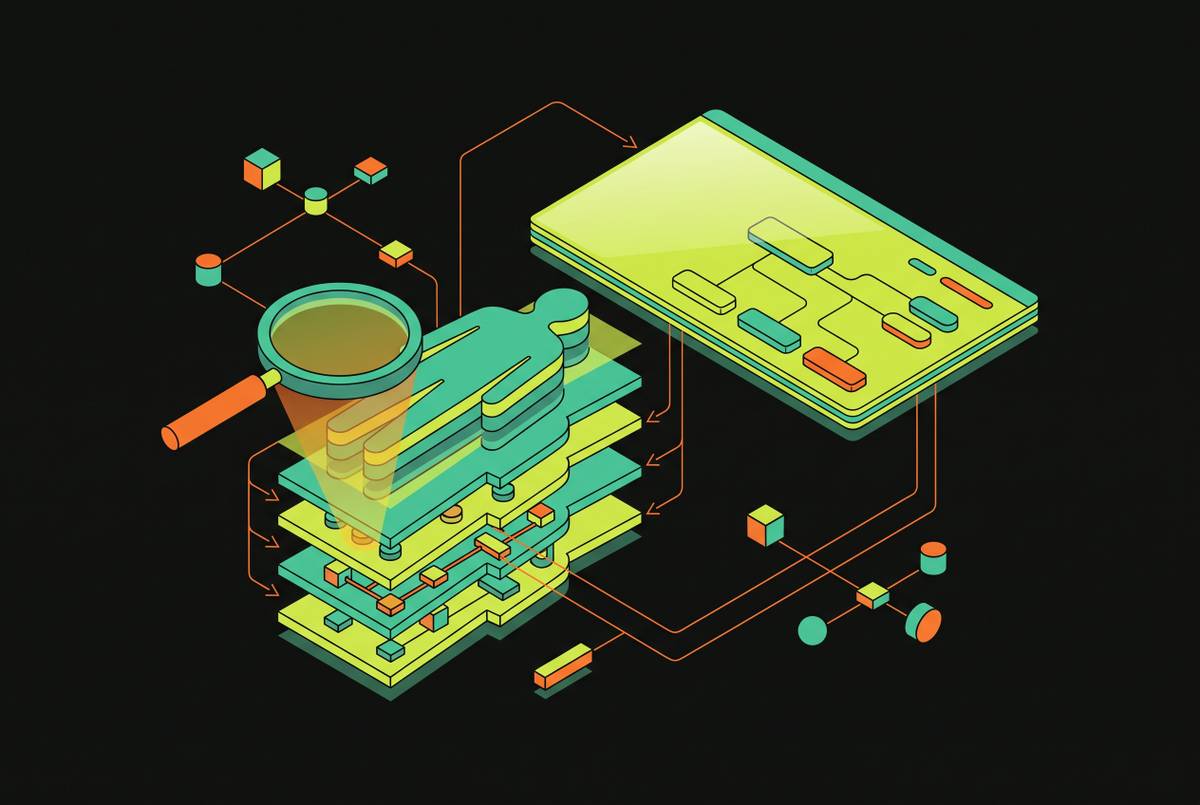
AI-assisted clustering is the mechanism that makes triage work at the volume modern programs face. Rather than treating a failed login, an MFA bypass, and a privilege escalation as three separate tickets, clustering ties related signals into a single investigation-ready case. That shift changes the actual unit of analyst work: instead of triaging hundreds of raw alerts one at a time, a team works a handful of confirmed, correlated clusters, each one already carrying the context that would otherwise take an analyst an hour to reconstruct by hand.
Triage is also where false positives either get contained or start compounding, and unchecked false positives erode trust in the system fast. Analysts start to distrust the system, and distrust is what turns a working program back into a ticket factory.
Speed makes all of this urgent rather than optional. Structured scoring paired with AI clustering is what closes that gap between how fast an insider can move and how fast a program can respond.
Stage 3 (Investigation: building a complete and defensible picture of a case)
Investigation is the longest stage in the lifecycle and the one handled least consistently across programs, because it demands pulling together a complete, defensible account of what happened from systems that were never built to talk to each other.
Investigators need one place to see the full timeline of risky activity, the specific files or communications involved, and a space to document findings as they go. Manually stitching that view together across a SIEM, an EDR console, an HR system, and a separate ticketing tool is where investigation hours disappear and mistakes creep into otherwise sound casework. Centralizing HR data, physical access logs, endpoint telemetry, email metadata, cloud storage activity, and case notes into a single record with chain-of-custody tracking is what separates a case that holds up under legal review from one that was reconstructed after the fact from scattered notes.
The Intel case involving Jinfeng Luo shows why investigating a single channel is not enough. Only full correlation across endpoint and identity data would have caught the bypass, which is the strongest argument available for why single-channel investigation fails even when the first control appears to have worked.
The GE case tells a different kind of cautionary story. Jean Patrice Delia moved thousands of files to a co-conspirator over more than eight years, using both email and cloud storage. Establishing criminal intent required reviewing behavior across a long timeline, which is the reason investigation platforms need to support pattern review over years, not just days, and why a case opened on a single alert has to stay open long enough to ask what else that same user has done.
None of this evidence should be visible to everyone on a security team. Everfox's case management platform enforces that boundary with redaction, in-app viewing that avoids unnecessary downloads of sensitive files, and file-level access controls, an approach that protects the subject's privacy while the case is still unresolved and nothing has been proven.
Every one of these steps only matters if it gets written down as it happens. That documentation isn't a report written at the end of the investigation. It accumulates throughout the case, and Stage 4 depends on its completeness.
Stage 4 (Escalation and adjudication: when security hands off and who takes it from there)
Escalation is the point where most programs show their weakest seams, because handing a case from security to HR, legal, or law enforcement without a pre-agreed framework produces inconsistent outcomes, legal exposure, and damage to the reporting culture the whole program depends on.
The triggers for each handoff need to exist in the charter before any specific case forces the question. Deciding those thresholds in the middle of a live case, under pressure, is how a program ends up with inconsistent outcomes and legal liability it didn't need to take on.
From there, the case follows one of four branches depending on what the investigation actually found. A case that turns out to be a false positive gets documented and closed, with the reasoning fed back into the models that will score the next similar signal.
The 2025 Coinbase case illustrates the law enforcement branch concretely. Choosing to escalate externally rather than contain the incident quietly was itself a governance decision, and one that only worked because the authority to make that call had been established well before the incident occurred.
Different stakeholders need different views into the same case at this stage. Escalation templates built for each audience let every stakeholder see what their role requires without exposing the full record to parties who don't need it, which protects the subject's privacy as much as it protects the organization.
Escalating too early carries its own risk. The adjudication framework needs a path back to investigation, not only a binary choice between escalating and closing, because some cases genuinely need more evidence before anyone makes a decision that affects a person's job.
Every decision made at this stage rests on how well Stage 3 was documented. A case missing that record leaves adjudication guessing, and a defensible program cannot afford to guess.
Stage 5 (Case closure and the feedback loop that prevents re-inflation of false positives)
A case that closes without feeding its outcome back into risk scoring, policy thresholds, and training content leaves the program exactly where it started, no better equipped to catch the next version of the same problem than it was before this case ever opened.
Closure is the point where CISA's maintenance phase becomes concrete rather than theoretical. Every closed case, whether it confirmed malicious intent, corrected negligent behavior, uncovered a compromised account, or turned out to be benign, carries information the program needs. A false positive closed at triage should update the threshold that let it through in the first place, so the same benign pattern doesn't consume analyst time again next month.
Skipping this step is how the ticket-factory failure mode described at the start of this piece re-forms even inside a program that otherwise follows every stage correctly. If false positives aren't tracked and fed back into scoring logic, they don't disappear. They keep reappearing in the queue at the same volume, consuming the same analyst hours, and the triage stage built to catch them starts losing the trust of the people running it. A lifecycle with five well-built stages still fails if the fifth one doesn't report back to the first.
The organizations building this discipline correctly treat closure as the start of the next cycle rather than the end of the current one. The signal thresholds set in Stage 1, the scoring weights applied in Stage 2, and the escalation triggers written into the charter in Stage 4 are not fixed decisions made once. They are living policy, and the only inputs available to revise them honestly are the outcomes of the cases the program has already closed.