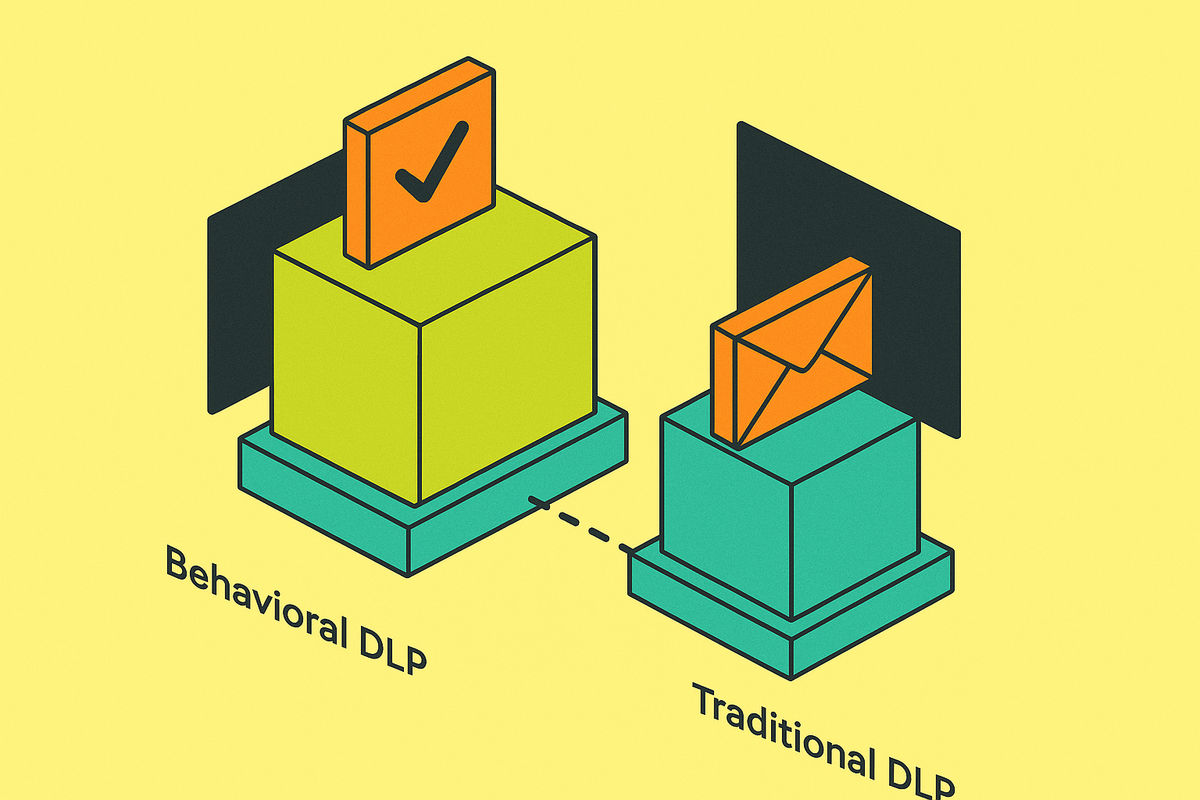
Why Static DLP Rules Generate Excessive False Positives
Context-free pattern matching treats routine file sharing the same as data theft.

Static Data Loss Prevention rules generate a flood of false positives because the model behind them can't read context. A DLP engine scans a piece of data at a single point in time, checks it against a fixed pattern (a keyword list, a regex string, an exact-match fingerprint) and fires an action based on that match alone. Nothing in that model asks who moved the data, why they moved it, or what happened in the hours before. The false positives that follow aren't a bug someone forgot to patch. They're the predictable output of a design choice made decades ago, for infrastructure that looks nothing like what most companies run today.
That design choice made sense at the time. Static DLP was designed for data environments with clear edges, such as a file server, a corporate email gateway, and a small set of predictable exits. In that world, a rule matching a 16-digit number to a credit card pattern, or flagging a keyword like "confidential," carried real signal, because the paths data could travel were few and mostly known. The architecture assumed sensitive content is identifiable by its shape, and that the act of moving it is itself the meaningful event. That assumption breaks down in a world of SaaS collaboration tools, cloud storage synced across a dozen devices, and generative AI workflows where a user can paraphrase a confidential document straight into a prompt window. The rule still evaluates the data object. It never evaluates the person, their role, their history, or the sequence of events around them. Context isn't missing by accident here. It fell outside the architecture from day one.
Why pattern-matching without context misfires by design
A rule that fires on pattern match alone can't tell the difference between the same pattern showing up in two entirely different situations, one routine, one dangerous. An employee sharing a spreadsheet full of financial figures with a colleague for a quarterly budget review trips the same alert as an employee uploading that same spreadsheet to a personal cloud drive on the way out the door. The pattern is identical. The risk isn't even close.
Gartner's 2025 Market Guide for Data Loss Prevention names this directly: traditional DLP tools are data-centric, built around content inspection, and "cannot easily distinguish between malicious and accidental data disclosure." That gap is not minor. It's the central design flaw everything else in this piece traces back to.
Vendors and security teams respond the only way the architecture allows: by writing rules broad. Flag any document with a credit card number. Flag any file transfer to an external domain. Flag any attachment above a certain size. Broad rules catch more real threats, but they also guarantee ordinary, legitimate behavior matches just as often. Narrow the rules to cut the noise, and variants slip through untouched. Widen them back to restore coverage, and the noise returns. Neither direction touches the actual problem, because tuning a pattern-matching engine doesn't add the one thing it's missing: knowledge of who's doing the moving and why.
Unstructured data makes it worse. A 2025 peer-reviewed paper on Zenodo found legacy DLP systems classify unstructured content correctly only 5 to 25 percent of the time. As more sensitive material lives in free-form documents, chat threads, and shared docs rather than structured fields, the pattern-matching model keeps degrading, not because the rules got worse, but because the data stopped looking like what the rules were built to recognize.
Some of the newest exfiltration channels don't register at all. A GenAI prompt that quietly reproduces confidential material, a browser paste operation, a paraphrased summary of a sensitive file: none of these throw off a pattern the rule is watching for. They don't generate false positives. They don't generate true positives either. They just pass through unseen.
How a high false positive rate mechanically produces false negatives
Analysts adapt to noise the way anyone would. When most of the alerts in a queue turn out to be nothing, triage gets faster and shallower at the same time. Thresholds for what counts as "urgent" creep upward. Gut instinct starts standing in for systematic review, because systematic review of thousands of daily alerts isn't something a finite team can sustain.
A survey of 300 information security leaders found 65 percent say their teams feel overwhelmed by benign DLP alerts, and that 51 percent of DLP alerts turn out to be false positives on average. Microsoft and Omdia's State of the SOC 2026 research puts the figure at 46 percent of all alerts across the board. Nearly half of everything landing in an analyst's queue carries no security value at all.
Once trust in the alert stream erodes, a patient attacker, whether an external actor or a slow-moving insider, benefits from operating inside a triage process calibrated to expect noise. A genuine exfiltration event doesn't arrive flagged "this one's real." It lands in a queue where the implicit baseline is "probably nothing," and gets the same abbreviated glance as everything before it. By the time anyone looks closer, the window to intervene has often already closed.
Researchers have documented this for years. A USENIX Security paper carried the title "99% False Positives: A Qualitative Study of SOC Analysts' Perspectives on Security Alarms," which tells you how far the problem had already progressed by the time it reached peer review. The irony sits at the center of the whole system: a tool built specifically to catch data loss, once its false positive rate climbs high enough, actively degrades an organization's ability to catch data loss.
The operational cost alert floods impose on security teams
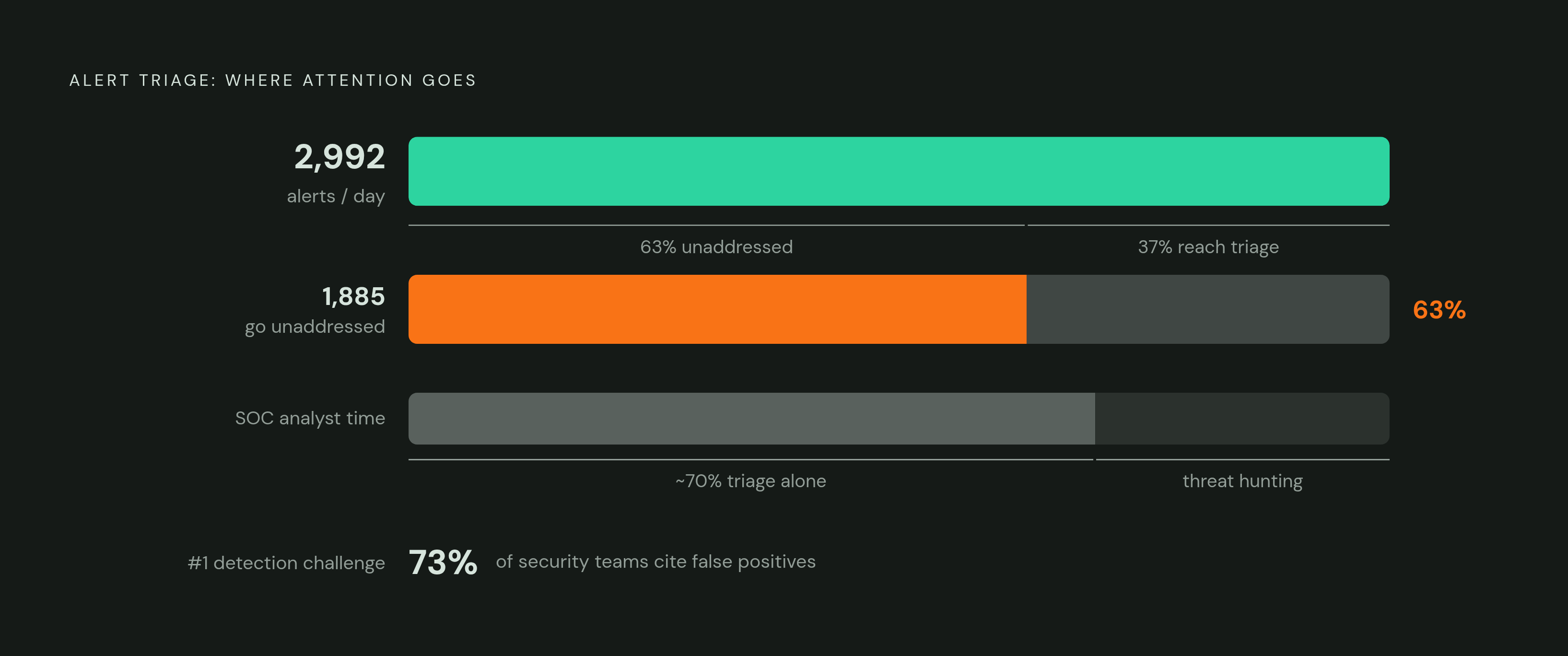
Vectra AI's 2026 research put the average organization at 2,992 security alerts a day, with 63 percent going unaddressed entirely. That's a problem beyond a mere backlog. That's a structural admission that no team, however well staffed, can review that volume with any rigor.
The 2025 SANS Detection and Response Survey found 73 percent of security teams name false positives as their single biggest detection challenge. Separate 2025 research from Cybersecurity Insiders found 76 percent of organizations cite alert fatigue as a top SOC concern, and industry estimates put nearly 70 percent of SOC analyst time into triage work alone, leaving little room for the proactive threat hunting that actually catches sophisticated attacks before they escalate.
None of this happens in isolation, either. The average organization runs about 28 separate security monitoring tools, each producing its own alert stream. The false positive problem compounds across the entire stack. It isn't contained to the DLP layer.
The staffing consequence is measurable too. ISC2's 2024 Cybersecurity Workforce Study found 67 percent of organizations report staffing shortages, and SANS' 2025 research found 70 percent of SOC analysts with five years or less experience leave the field within three years. Alert fatigue is a named driver of that churn. The analysts a lean security team can least afford to lose, the ones still early enough in their careers to burn out on noise, are exactly the ones a triage queue full of false positives wears down first.
Where static DLP fails most visibly: the three insider threat archetypes it cannot catch
Insider risk is where both of static DLP's failure modes collide. It over-alerts on innocent behavior and under-detects the behavior that actually matters, because insider risk lives in a sequence of actions over time, not in any single data event a regex can catch.
Ponemon Institute's 2025 Cost of Insider Risks Global Report put the average annualized cost of insider incidents at $17.4 million, up from $15.4 million in 2022, with incident volume more than doubling from 3,269 in 2018 to 7,868 in the current research period.
The departing employee. A user copying a large volume of files in their final two weeks looks unremarkable in isolation. It only looks like theft once someone plots that activity against a timeline, and a single-event rule has no timeline to plot against. Proofpoint faced exactly this risk when a departing employee copied confidential sales-enablement material to benefit a rival firm, with the data leaving before the company realized it was gone. High-profile cases have involved employees taking large volumes of proprietary files before leaving to join competitors. Research consistently finds that most organizations do not feel fully prepared to handle departing-employee data theft.
Slow, progressive exfiltration. Static rules trigger on volume or content thresholds measured at a moment in time. A patient insider who moves small amounts of data repeatedly over months stays under every individual threshold while blowing past the aggregate one, and no single alert captures that arc. A former staff member at FinWise Bank used retained system access to expose the sensitive data of roughly 689,000 customers, including Social Security numbers, dates of birth, and account numbers. Whether the act was deliberate or negligent has not been confirmed, but the bank reportedly didn't catch the suspicious activity until June 2025, more than a year after the initial unauthorized access in May 2024. A 2025 paper on arxiv.org describing insider risk management stated the underlying problem: traditional approaches "cannot detect subtle, context-dependent behaviors, such as progressive data exfiltration, privilege misuse, or slow insider reconnaissance."
Authorized access abuse. This one doesn't just slip past static DLP, it never trips it in the first place. A user pulling data they're technically entitled to access triggers no policy violation whatsoever. Credentials are valid, permission level is correct, classification is within bounds. Static DLP has no mechanism to ask whether this particular access, at this particular time, given this user's recent pattern of behavior, actually makes sense. Research consistently finds that most organizations do not feel fully prepared to address privileged user abuse.
All three archetypes share the same blind spot. The risk sits in the pattern across days or weeks, never in any single event a static rule was built to catch, and that's exactly the type of signal pattern-matching architecture cannot hold.
Why tuning cannot fix what the architecture never included
The tuning cycle runs the same way every time. Narrow the rules, false positives drop, and false negatives climb as variants slip through the tighter net. Broaden the rules to recover coverage, and the false positives come right back. Repeat.
What tuning actually optimizes is the match between a pattern and a known data type. It adds nothing else: no behavioral history, no peer comparison, no sense of what's normal for this specific user, no sequencing of events over time, because none of those things exist anywhere in the architecture to begin with. You can't tune in a variable the system was never built to hold.
The Zenodo paper's 5 to 25 percent accuracy range for unstructured content classification reflects a structural limit, not a tuning gap. It's a representation problem: the system has no way to represent the thing it needs to detect. Separate analysis from Spin.AI put average false positive rates for legacy DLP at 35 percent in some environments, numbers that describe the floor of what tuning can achieve, not an outlier from a poorly configured deployment.
The resource math bears this out. Ponemon and DTEX's 2025 research found organizations spend far more per insider incident on containment than on monitoring. That ratio describes a detection model that catches problems late, after containment costs have already piled up. Organizations have responded by spending more: Ponemon's 2025 research shows insider risk management budgets rising from 8.2 percent to 16.5 percent of annual IT security spend. More money is chasing a problem that exceeds what the underlying detection model was ever built to solve, and no budget increase changes that math on its own.
The false positive rate is an inherent feature of the system's design. It's the direct, structural output of a model that evaluates data movement without ever asking whether that movement, in context, constitutes risk.
What detection looks like when behavioral context is part of the model
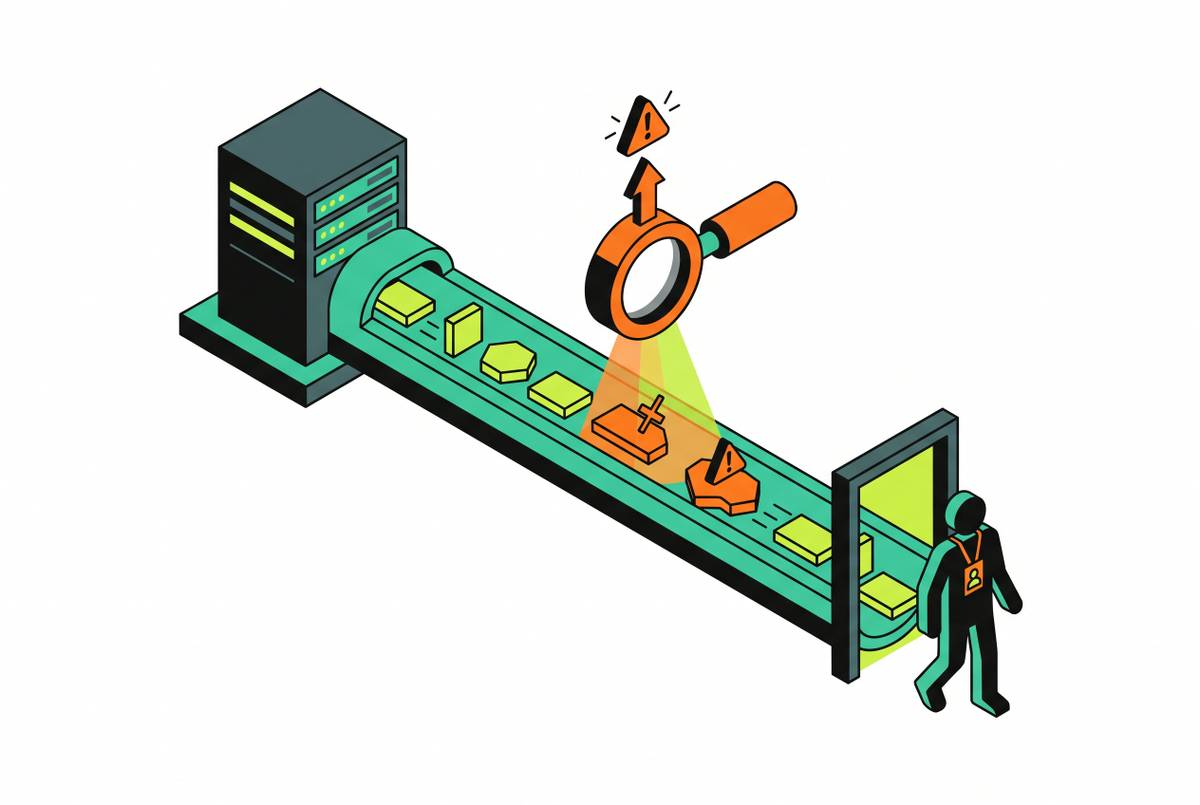
The shift starts with the question being asked. Instead of "does this data match a pattern," a behavioral model asks whether this action makes sense given who the user is, what they normally do, and what happened around them in the surrounding days or weeks. That's a different kind of question, and it needs a different kind of input to answer it.
Behavioral context draws on role-appropriate baselines, comparison against peers in similar positions, sequencing of events across time, and correlation of signals from multiple sources at once: endpoint activity, identity systems, HR records, cloud usage. Those are the inputs that determine whether a given data movement is routine or worth a second look, and none of them live inside a regex engine.
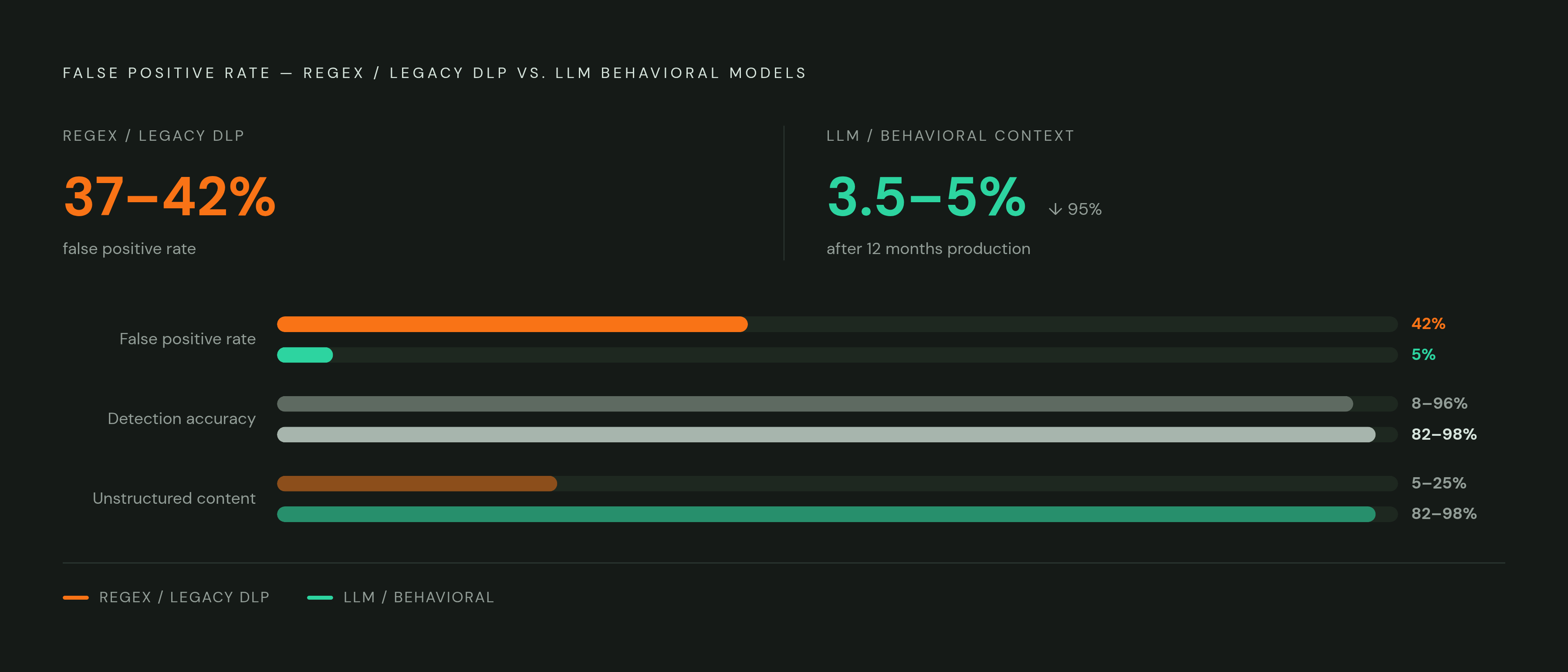
The Zenodo paper found LLM-driven semantic inspection reaching 82 to 98 percent detection accuracy across content types, against a range of 8 to 96 percent for regex-based matching, with false positive rates falling from 37 to 42 percent down to 3.5 to 5 percent over twelve months of production use. Spin.AI's analysis found context-aware machine learning models cutting DLP false positives by as much as 95 percent, with AI-driven automated triage reducing overall alert workload by 61 percent over six months.
None of that works if the system can't show its reasoning. A behavioral model that spits out a risk score without a timeline or supporting evidence just creates a different flavor of the same trust problem: an alert an analyst can't verify is barely more useful than an alert an analyst has learned to ignore. The value of the approach depends on how wide its integration reaches, too. Drawing on identity platforms, endpoint tools, HR systems, and collaboration software builds a fuller record of behavior than any single-channel inspection can produce, and a richer record is what lets slow-moving patterns surface before they turn expensive.
There's already a measurable result tied to this shift. Ponemon's 2025 Cost of Insider Risks Global Report found average time to contain an insider incident fell to 81 days in 2025, down from 86 days in 2023, the first decline the report has recorded in any prior edition. That drop lines up with growing adoption of insider risk management approaches built around behavior rather than pattern-matching alone.
For a security team, the practical difference comes down to alerts that correspond to real issues, arriving with the context already assembled. What's left for the analyst is making a decision, not digging through the history needed to make one.