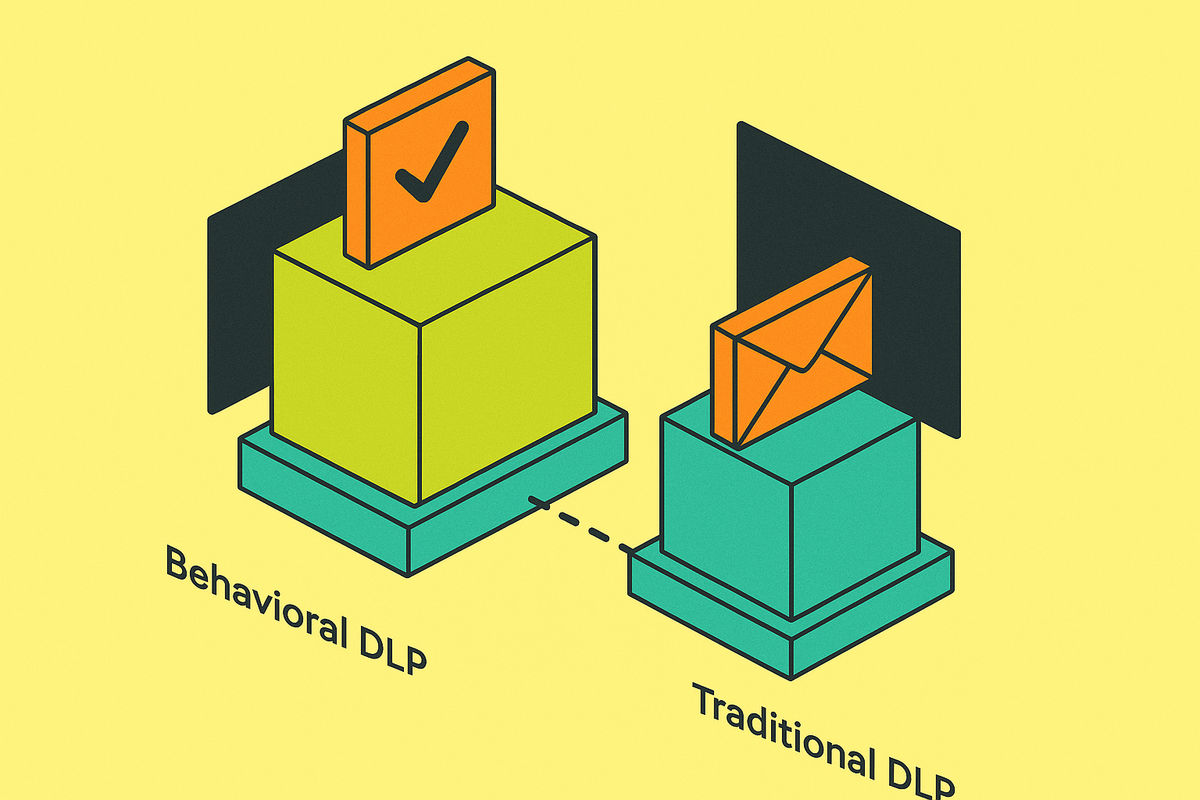
Data Loss Prevention Policy Design for Cloud-First Enterprises
Traditional DLP policies fail when data leaves the corporate network perimeter.
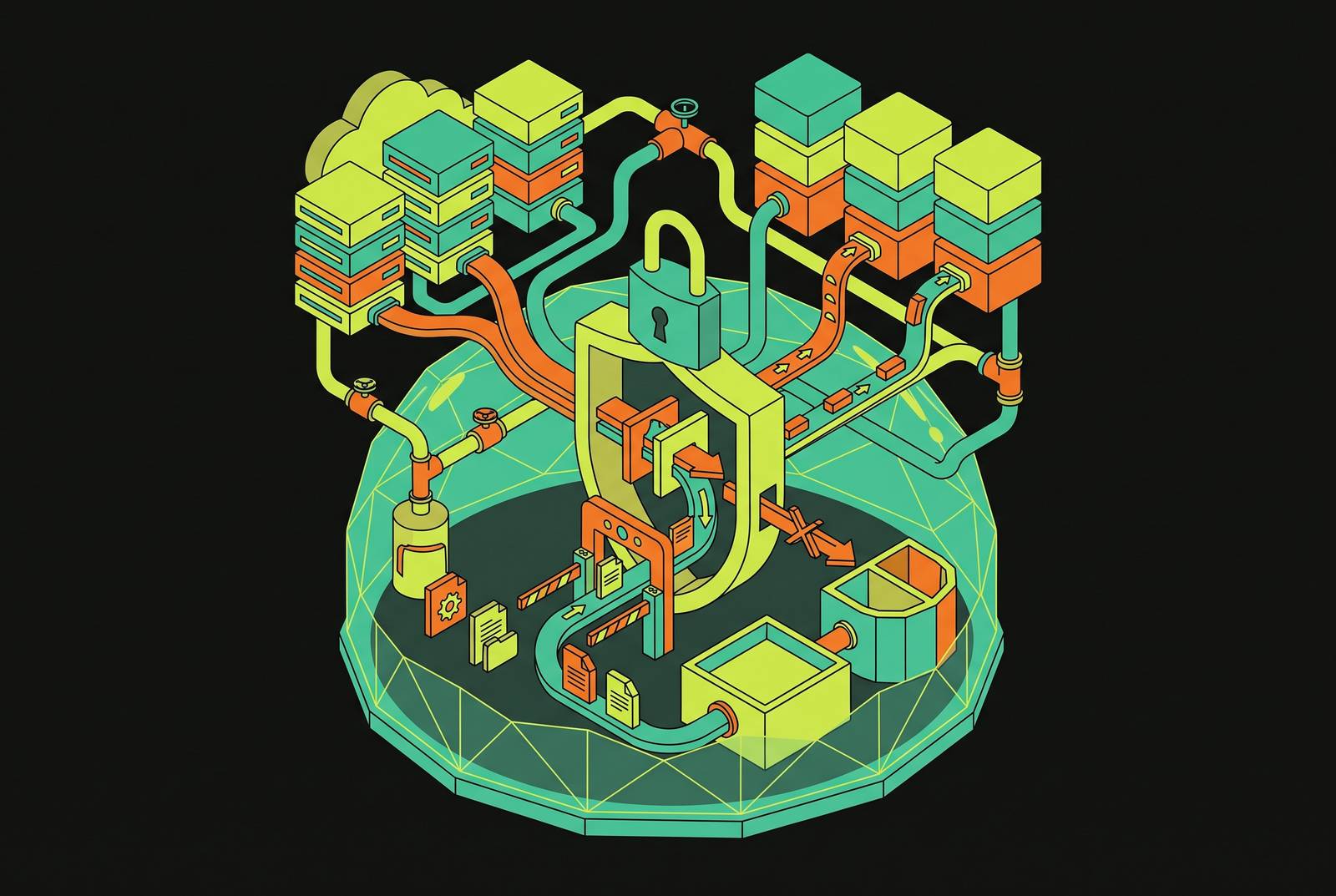
Legacy DLP breakdown under the perimeter model: specific mechanics
Most regulated organizations have a DLP policy on paper. Very few have one that survives contact with where their data actually lives now, which is everywhere except the perimeter that policy was written to defend. The failure runs deeper than a vendor gap that a new contract can fix. It's an assumption baked into the architecture: that data risk equals data crossing a monitored network boundary. That boundary used to matter. It doesn't capture most enterprise data movement anymore, and the mismatch breaks down in four distinct ways.
Network bypass is the simplest to picture. An employee uploads a file to Google Drive or an S3 bucket from a home network on a personal phone. That traffic never touches a corporate firewall, VPN, or proxy, so network DLP has nothing to inspect. The tool doesn't miss the upload. It never sees it exist.
SaaS sprawl compounds the problem by multiplying the number of doors. Each app carries its own upload mechanism, its own API, its own sharing model, and a policy that only governs managed devices leaves most of that surface untouched. That's not a small gap. The LayerX 2025 Enterprise AI and SaaS Data Security Report found most employees logging into Salesforce and Zoom through personal accounts rather than corporate ones. That's the dominant pattern, not a fringe case, and any policy that assumes otherwise is already wrong on day one.
Encrypted and API-layer traffic adds a third failure mode, and this one is structural rather than behavioral. Gartner's research on generative AI and DLP states that conventional DLP "cannot effectively manage GenAI data loss risks, including exposure via encrypted traffic, intent blindness, and shadow AI." Encrypted channels hide content from inspection by design. Intent blindness means the tool can see a transfer happen with no way to judge whether it's malicious, careless, or completely routine.
Then there's authorized-channel exfiltration, probably the hardest of the four to solve because it doesn't look like an attack at all. An insider with legitimate access moves data through the exact path their job requires. Content-match rules can't distinguish that from a normal Tuesday, because on the surface, it is one.
False positives follow directly from how legacy policy gets written: rules drawn too broadly, no behavioral context built in, no real understanding of content beyond pattern matching. Analysts burn out triaging noise, and policies get quietly loosened or bypassed just so people can finish their work. That's a program design failure, not a technology one, and pinning it on the tool lets the actual decision-makers off the hook.
Shadow AI sits on top of all of it. IBM's 2025 report found shadow AI involved in a fifth of breaches, and the overwhelming majority of organizations that suffered an AI-related breach had no AI access controls in place at all. One structural cause produces all four failure modes: legacy tools rarely integrate with SIEM or UEBA platforms, so visibility stays fragmented and incident response starts from an incomplete picture every time. Rules written for a perimeter can't be patched into rules for a distributed environment. The architecture has to change, along with the ruleset sitting on top of it.
Three incidents make the point concrete. Change Healthcare's 2024 breach exposed 192 million individual records, the largest healthcare breach on record per HHS OCR, and the organization had a DLP policy in place when it happened. The MOVEit breach compromised 632,000 DOJ and Pentagon email addresses through a file transfer system that no DLP policy was ever written to govern. The pattern repeats across industries: enterprise-grade tooling in place, sensitive data moving through an unmonitored channel, and no alert fired because the policy was watching the wrong door. None of these are technology failures in the way vendors like to frame them. They're policy design failures, and the fix has to start with the design, not another procurement cycle.
How cloud data moves: the flow map a policy must be built around
Before writing a single rule, an organization needs a map of how its data actually moves. Skip that step and the policy generates false positives and missed controls in roughly equal measure, because it's guessing at a shape it never traced.
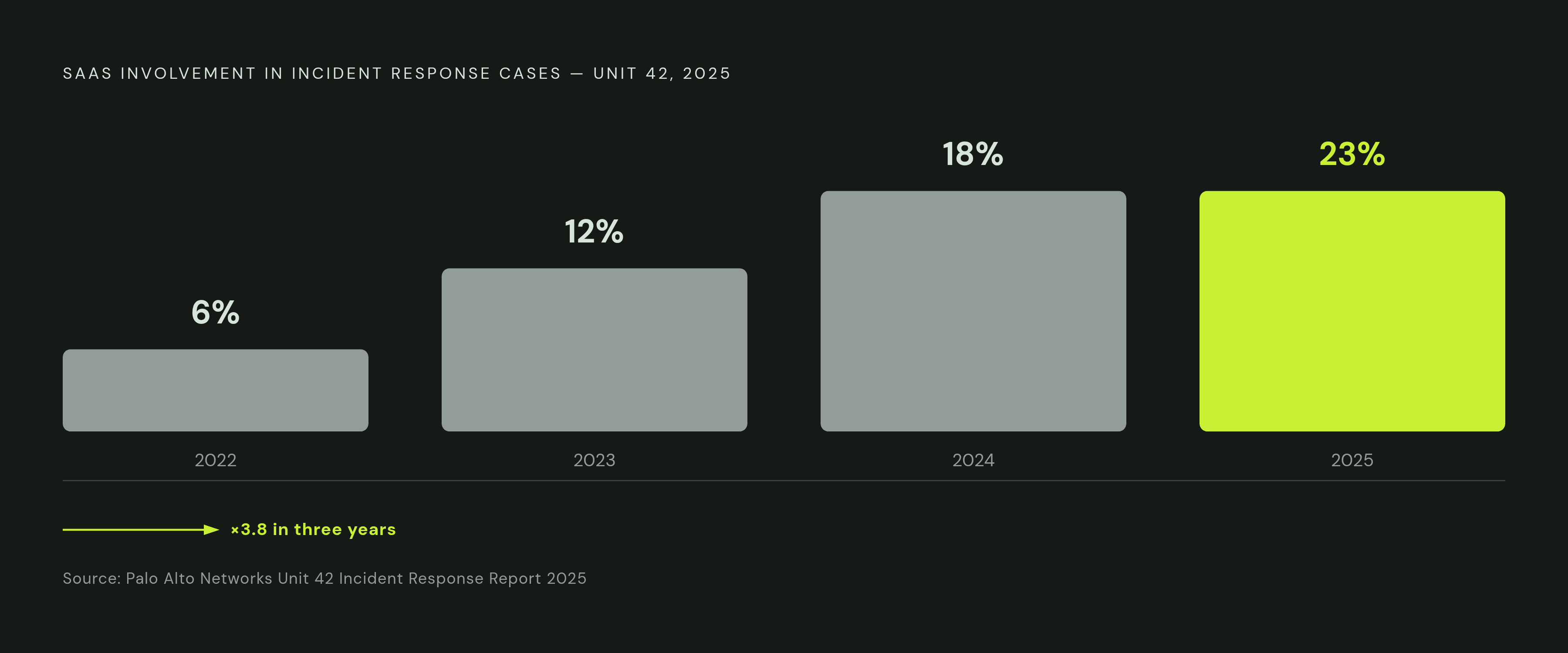
Five surfaces make up that map. SaaS applications like Salesforce, Slack, Microsoft 365, and Google Workspace each have distinct upload and sharing mechanics, and Unit 42's 2025 incident response data shows SaaS environments relevant to 23% of cases, up from 18% in 2024, 12% in 2023, and 6% in 2022. That climb settles any argument about whether SaaS deserves first-class treatment in policy design. It does, and the trend line says the gap is only widening.
Multi-cloud storage across AWS S3, Azure Blob, and Google Cloud Storage lets data cross platforms without ever touching on-premise infrastructure, so policy has to follow the data itself rather than track the location of any one bucket. Collaboration and messaging platforms add another layer entirely: a sensitive file dropped into a Slack DM moves nothing like an email attachment does. The 2024 Disney "Slack Dump" incident is the clearest illustration on record, where a compromised workspace let attackers pull over 1.1 terabytes of data, including unreleased projects, source code, and credentials.
AI and GenAI workflows are the newest and strangest surface, because the data doesn't move as a file at all. Someone pastes a contract clause into a ChatGPT prompt, or feeds a spreadsheet into Copilot for a summary, and there's no file to inspect, just text disappearing into a completion. LayerX's 2025 figures put AI tool use at 45% of all employees in daily workflows already, outpacing most companies' governance policies. That's not a hypothetical risk sitting on some future roadmap.
Third-party integrations and API pipelines round out the map, and the 2025 UNC6395 campaign is the case study to remember: attackers exploited a Salesforce/Salesloft Drift integration to pull CRM data, AWS keys, and Snowflake tokens across multiple organizations at once, through a channel most security teams never thought to monitor. Unmanaged accounts touch all five surfaces at once. Even a sanctioned SaaS platform carries shadow risk if an employee logs in through a personal account instead of a corporate one.
One more concept belongs in the map: data lineage. A sensitive file rarely stays one file. It gets copied, exported, reformatted, and pasted into three other tools within a week, and a policy that only tracks the original document loses the thread the moment a derivative appears. Enforcement has to be at the browser, the API layer, the collaboration platform, and the AI prompt box, extending the reach that used to stop at the network egress point that was once the only door anyone watched.
The four-tier classification foundation, and why unlabeled IP is the hardest problem to solve
Classification still matters as a starting structure, and it isn't going away. Public, Internal, Confidential, and Restricted give each data tier a different set of technical controls, access rules, and handling procedures. But that structure alone is insufficient, and regulatory overlays are the first reason why.
PHI under HIPAA, personal data under GDPR, and classified government material can all sit inside the same "Confidential" tier while demanding entirely different technical controls. GDPR's restrictions on cross-border data transfer show how a flat tier misses the real requirement: a data protection regulator's €1.2 billion fine against Meta in May 2023, the largest GDPR fine on record, came specifically from inadequate cross-border transfer protections. LinkedIn's €310 million fine from the same regulator in October 2024 confirms this isn't a one-off. Government and defense contractors carry a further layer on top through frameworks like FedRAMP, CJIS, and CMMC 2.0, where general alignment with a standard isn't the same thing as control-level compliance.
A harder problem causes most classification programs to quietly fail, because a company's most valuable intellectual property usually carries no classification label at all. IP becomes sensitive because of what it means to the business. The 2024 Google insider case makes this concrete. Software engineer Linwei Ding allegedly exfiltrated more than 1,000 confidential files containing over a decade of proprietary AI chip designs and supercomputing architecture, data whose sensitivity came entirely from its business meaning rather than any tag attached to it. Legacy DLP tools miss this category consistently. Contracts, proprietary research, architectural diagrams: none of it can be weighed for meaning by a pattern-match engine built only to check format.
Classification is necessary, but it stops short of sufficient, and treating it as the finish line is the mistake most programs make. Labels give a policy its skeleton. Content understanding has to fill the gap everywhere a label is missing, wrong, or simply never applied because an employee never got around to tagging the file. That means pairing classification tiers with content-aware discovery that can find sensitive material on its own, rather than leaning entirely on employee-applied labels or a static regex library someone built years ago and never revisited.
Policy scope, roles, and the enforcement architecture that must replace the perimeter
Defining scope is a structural decision. A working policy has to cover endpoints, every cloud layer (SaaS, IaaS, PaaS), API traffic, AI tooling, and third-party processors. A policy governing only managed devices leaves most of the actual risk surface sitting outside it entirely, particularly given how much personal-cloud-app use the earlier figures already put on record.
Browser-based enforcement is the closest thing cloud-first security has to a replacement for network egress inspection. It watches file uploads, form submissions, and copy-paste actions across cloud providers and SaaS tools regardless of network location or VPN status, which puts it exactly where traditional network DLP goes blind: home networks, mobile devices, personal accounts logged in from a coffee shop.
Consistency across cloud providers matters as much as the enforcement point itself. A policy that locks down AWS tightly while leaving Azure loosely governed isn't a policy, it's a set of exceptions wearing a policy's name. Enforcement has to apply the same way no matter which platform the data lands on, full stop.
Roles need scoping with the same discipline as the technology. Security leadership owns the policy and carries regulatory accountability when something goes wrong. The IT security team configures the tooling, triages alerts, and connects everything into SIEM and UEBA platforms. Department managers keep their teams compliant day to day and flag the moments when a policy blocks work that's genuinely legitimate. Individual employees remain the first line of awareness, responsible for handling data properly and reporting incidents when they see them.
Response needs tiers too. High-risk transfers, a government ID number or credit card number headed to personal cloud storage, get blocked. Lower-confidence events, like customer data moving to an unapproved but plausible SaaS tool, get a warning instead. Business-appropriate use gets allowed without friction. A policy needs to define what data can do with the same precision it uses to define what data can't do, and that precision is what keeps the policy usable rather than resented.
Usability is a design requirement from day one. A policy that blocks legitimate work reliably gets circumvented, and a circumvented policy is worse than no policy at all: it creates a false sense that controls exist when they don't. None of this holds together without integration. DLP enforcement has to connect directly to SIEM, UEBA, and identity systems, because fragmented visibility leaves the kind of policy gaps that both MOVEit and Change Healthcare exposed.
Behavioral context and user identity as policy inputs, not post-hoc investigation tools
Most DLP policy treats an authenticated user as a trusted one. That single assumption is what insider threats exploit, because valid credentials are the whole point of an insider attack, not a workaround to it.
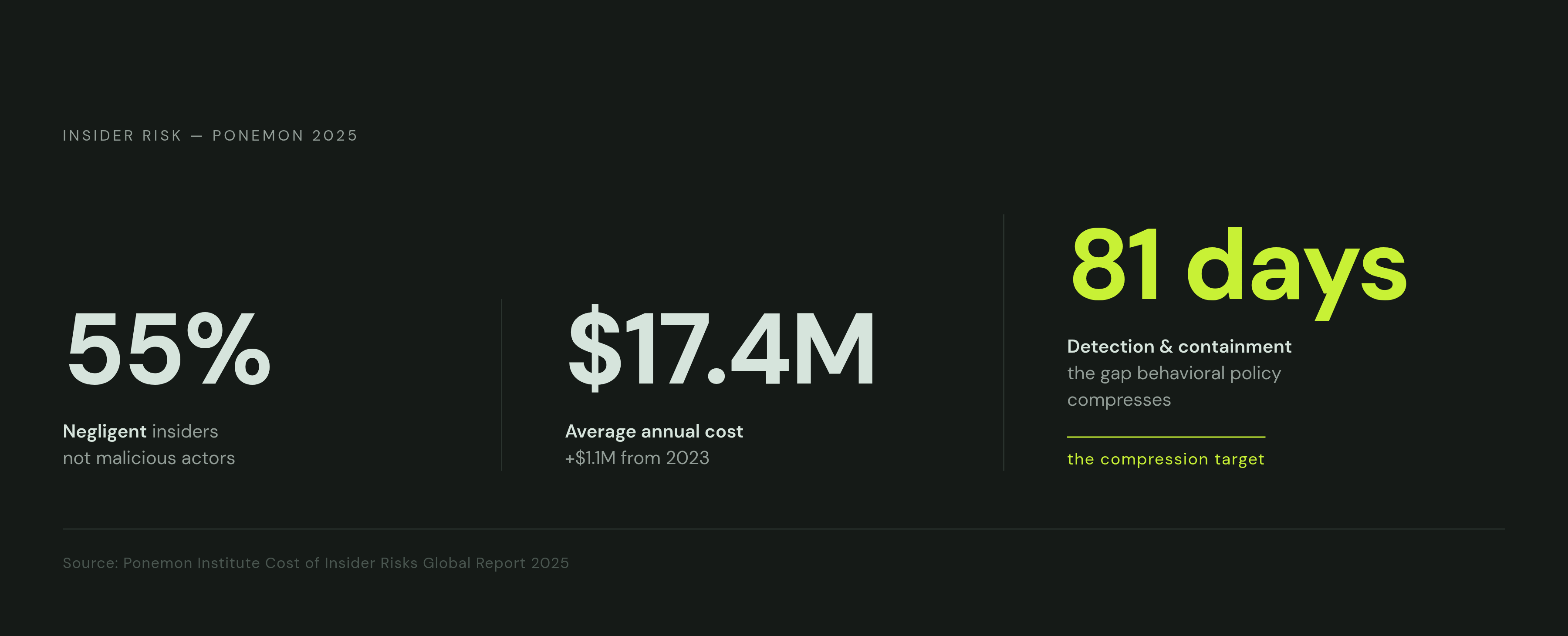
Verizon's 2024 DBIR found 70% of threat actors behind healthcare breaches were internal to the organization. The Ponemon Institute's 2025 Cost of Insider Risks Global Report put the average annual cost of insider-related incidents at $17.4 million, up $1.1 million from 2023. That's a rising cost, not a stable one, and it argues against treating insider risk as a secondary concern behind external attackers.
Three archetypes of insider need three different policy responses, and treating them identically wastes the distinction the data supports. Malicious insiders act out of personal gain, revenge, or ideology. Negligent insiders create risk purely through carelessness, and Ponemon's 2025 data puts this group at 55% of insider incidents. Most of the problem isn't malice at all, and training budgets should be built around that fact rather than around the rarer, more dramatic case. Compromised insiders are the third category, where the person is innocent but their credentials or device aren't. The May 2024 Snowflake breach affected roughly 165 customers, including AT&T, Ticketmaster, and Santander Bank, driven by compromised credentials.
A single event is almost never the actual risk signal. The risk lives in the pattern across someone's timeline. A file download on its own means nothing. That same download following a resignation notice, paired with a spike in after-hours access and a USB device plugged in for the first time in months, tells a completely different story, and only a system tracking the full timeline can tell it.
Behavioral baselines alone aren't enough either. Risk can exist from day one of employment, stay statistically unremarkable the entire time, and occur entirely through channels the person was authorized to use. Baselines need content and identity context layered on top, or they're just noise with a graph attached to it.
What behavioral context actually adds is the ability to separate malicious intent from an honest mistake, which changes the correct response in each case. It surfaces collaboration-platform activity that file-based tools miss entirely, a sensitive document pasted into a Slack channel rather than emailed as an attachment, and it lets a system flag the action, weigh the context, and respond without blocking ordinary teamwork in the process.
Timing is where the case for urgency gets made. Ponemon's 2025 data puts average detection and containment time for insider-driven incidents at 81 days. Behavioral signals built directly into policy are what compress that window, rather than waiting for some fixed threshold of bad activity to finally trip an alert.
Salt Typhoon shows what this looks like at nation-state scale. The Chinese state-sponsored group infiltrated major telecommunications providers across 2024 and 2025, reaching call metadata and communications content, serious enough that CISA, the NSA, and the FBI issued a joint advisory. Because the access patterns looked authorized on their face, behavioral context wasn't a nice addition to detection here. It was the only signal that meant anything at all.
Designing for AI and GenAI workflows as a first-class policy problem
AI use inside the enterprise isn't a future risk to plan around eventually. LayerX's 2025 figures already put 45% of all employees using AI tools in daily workflows, and copy-paste into a prompt window is fast becoming the primary frontier of data exfiltration that traditional DLP simply cannot see. Treating this as a future problem is the single most common mistake in the space right now, and it's already too late for organizations still writing it into next year's roadmap instead of this quarter's policy.
The reason AI workflows break the old model is structural. There's no file to inspect when someone pastes a paragraph of client data into a chat window. The content goes in as text, gets absorbed into a model's context, and comes back out as a completion, all at a speed and frequency that file-inspection-based DLP was never built to catch. A contract clause pasted into ChatGPT for a quick rewrite leaves no attachment, no filename, no hash to match against a policy rule. It's gone into the model before any inspection point even knows to look.
That's a different problem shape entirely from the risk of employees uploading files to a web application discussed earlier, and treating it as an edge case tacked onto an existing DLP program is the mistake to avoid. AI has to be a first-class part of policy design from the start, built in before any incident report gets written. By the time a security team gets around to treating it as an afterthought, the workflow it was supposed to govern will already be everywhere, running through every department, on every laptop, with or without a policy watching it.