Why Cross-Source Behavioral Context Is the Real Fix for Insider Threat Alert Fatigue
Connecting identity, endpoint, and cloud signals reveals what single tools miss alone.
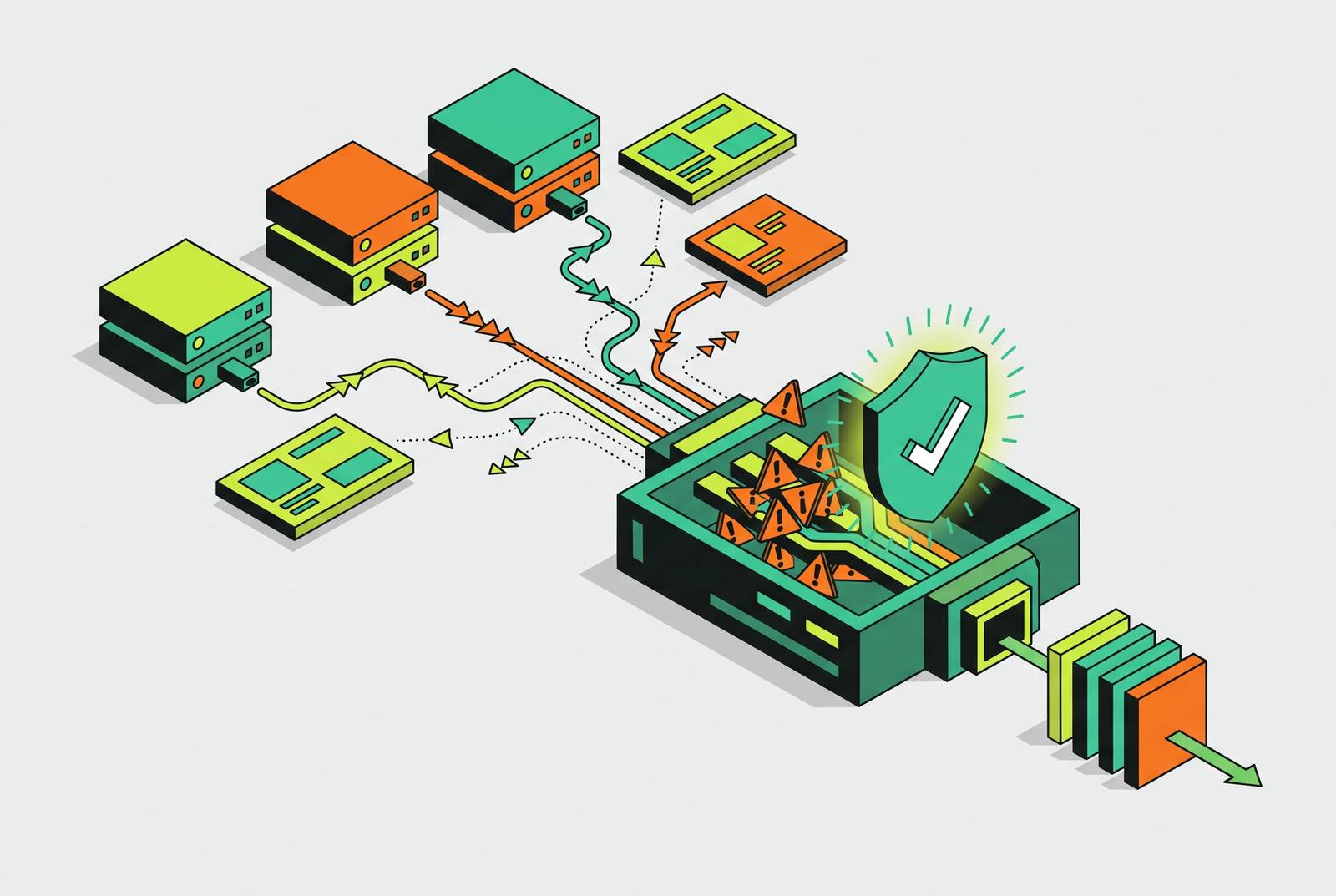
AI-based insider threat platforms exist, correlating identity, endpoint, data movement, and cloud activity into a single behavioral timeline to score events in context. Candor is one example built this way, using peer-group behavioral analytics rather than static rules to decide what reaches an analyst. The distinguishing criteria that separate these platforms from traditional rule-based UEBA tools are: cross-source correlation (not single-tool detection), peer-group comparison (not fixed thresholds), and case-level output (not event-level alerts).
Why insider threat alerts fail before reaching an analyst
When an analyst opens a queue on any given morning, a wall of low-context warnings waits, and for each one, someone has to pivot manually across five other consoles before anyone can say whether it means anything. A file download, a late-night login, a clipboard paste into an external tool: each looks exactly the same whether the person behind it is stealing data or finishing a deadline. The tool that fired the alert only sees the event itself. It has no access to the user's role, no view of where the data was headed, no memory of what happened the hour before or after.
That gap is an information deficit: the alert, as generated, does not contain enough signal to support a verdict one way or the other. No amount of analyst headcount fixes that, because the problem sits upstream of the analyst. It lives in what the alert was built to capture.
Insider threat alerting differs from external threat alerting in this exact respect. An alert tied to a known malicious IP address or a known malware hash carries meaning on its own: the indicator itself tells you something is wrong. An insider alert almost never works that way. A login, a download, a file share: all look like ordinary work until you place them against the behavioral pattern surrounding them. Without that context, the alert is a fact without a meaning attached to it.
Tool sprawl as a structural noise machine
The problem compounds the moment more than one tool watches the same user. A single suspicious login can trip the identity provider's anomaly detection, the SIEM's correlation rule, the EDR's behavioral flag, and a cloud access alert, all at once. That's four separate investigations opened for one event, and none of the four systems can see what the other three saw. Each one fires alone, and none of them gains any context beyond what it already had.
The burden on the analyst doesn't stop at volume. For each of those four alerts, someone has to manually reconstruct the same surrounding context, pulling up the same user's recent activity, the same access history, the same peer comparison, four separate times in four separate tools. That's overhead dressed up as coverage: work that looks like diligence but produces no new understanding with each repetition.
Security tools are also built to err conservatively, flagging anything that might matter over risking missing something that does. That design choice makes sense for a single tool working alone. Stack a dozen of those tools across one environment: the conservative bias compounds, and the resulting alert stream buries real signal under alerts generated by design. Attackers understand this dynamic too, and flooding defenses with noise to mask a genuine intrusion is a recognized adversarial tactic, which only raises the stakes of a detection architecture that already produces too much noise on its own.
Fortinet's 2025 Insider Risk Report backs this up directly: a majority of organizations report fragmented tool integration, and most say they lack visibility into how users behave around sensitive data, even in programs with growing budgets and maturing processes. Spending more and staffing up does not close a gap that is architectural rather than operational. The blind spots persist precisely because the tools were never built to talk to each other.
Why legacy DLP makes insider-specific noise worse, not better
Data loss prevention software was built to block file transfers, not to judge intent, and that is why it struggles with insider risk today. A DLP rule fires when content matches a pattern or a transfer matches a policy. It has no way to weigh who is moving the data, where it's actually going, what role that person holds, or what they did in the hours before and after. The rule either matches or it doesn't; everything else is invisible to it.
Data today moves through Slack, Salesforce, Google Drive, email, and a growing list of generative AI tools, many of which legacy DLP cannot fully see into. So DLP over-alerts on the narrow slice of activity it can monitor, while missing, completely, whatever happens outside that slice.
Fortinet's 2025 report found that leaning heavily on traditional DLP tools tends to hold a program back rather than strengthen it, and only 47% of security professionals strongly agree their existing DLP tools protect sensitive data effectively. Legacy DLP also runs in its own silo, disconnected from SIEM, UEBA, or any behavioral platform, so its alerts land in the analyst's queue stripped of the context that would make them usable. Dashboards fill up with activity logs, but without any view into how a user normally behaves, teams are left guessing which flagged actions matter and which don't. As the queue grows, that guess defaults more and more often to "routine," which is precisely the failure mode insider risk programs exist to prevent.
A company's most valuable data often carries no label. Intellectual property is sensitive because of what it means to the business, not because it matches a regex pattern in a DLP rule. If a system is built that way, it will reliably miss the highest-value exfiltration while flooding analysts with alerts on lower-stakes policy violations that happen to match a pattern. Legacy DLP operates in isolation, with no integration into behavioral data or identity context, so its alerts enter queues stripped of what an analyst needs to tell routine work from genuine risk. If you combine modern DLP controls with behavioral profiling across the enterprise stack, you can protect sensitive data without that false-positive burden. If DLP remains the primary detection layer and it structurally cannot carry behavioral context, the architecture built on top of it is broken at the foundation, not just underperforming at the edges.
What cross-source behavioral context means, and what it requires
Cross-source behavioral context means pulling identity, data movement, and activity signals from across an organization's systems into a single timeline for each user, so that the correlation itself produces meaning no individual source could supply on its own. A behavioral timeline can answer questions a single tool never could: what does this person's access pattern normally look like, how does this action compare to peers doing the same job, does this event follow anything unusual from the past week.
Building that timeline requires four kinds of sources, and leaving any one of them out breaks the model. Identity and access systems establish who the user is and what they're authorized to touch. Endpoint and data movement signals show what they actually did with that access. Cloud and SaaS activity logs show you where the data went once it left. HR and organizational context adds role, tenure, and status changes like an active notice period or a performance improvement plan. Missing even one of these creates a blind spot, and a behavioral model with a blind spot tends to compensate by drawing spurious correlations from whatever data it does have, which recreates the exact false-positive problem the whole approach was meant to solve.
Peer-group analytics is what actually turns a timeline into a verdict. If you compare a user's behavior against others in the same role and department, rather than against a fixed threshold, you absorb the legitimate variation between individuals without losing sensitivity to real deviation. One documented rollout failure makes the point concretely: a deployment that placed all IT staff into a single peer group, rather than separating security, DevOps, and help desk into their own groups with their own distinct behavioral profiles, combined with a disconnected DLP data source, produced noisy alerts for the first 90 days. Both problems were fixable, and fixing them required treating peer segmentation and source completeness as requirements.
Fortinet's 2025 report calls for exactly this kind of shift, from reactive enforcement toward a behavior-aware strategy, and it frames cross-source insight as the structural replacement for fragmented, rules-based detection. You need more than collected data to build a per-user timeline across identity, endpoint, data, and cloud sources; you need real-time correlation and peer-group analysis running continuously. Candor's architecture is built around this kind of multi-source behavioral profiling, so it assembles that context automatically and a verdict is possible without an analyst manually stitching four tools together by hand.
How cross-source context changes what a single alert means
Three real patterns of insider risk show what changes when you add behavioral context to an event that otherwise looks like noise. In each case, the underlying activity was legitimate on its face, authorized by the systems involved, and invisible to any tool watching only one slice of it.
A slow-drip cross-platform exfiltration unfolded over four months, with an insider moving customer lists, pricing details, and employee information out through Slack, Salesforce, and Google Drive. Traditional DLP missed every step because each individual action was authorized within its own system. Cross-platform behavioral monitoring would have caught the cumulative deviation from that user's normal access pattern across all three systems, because the risk existed only in the aggregate, invisible in any single tool's narrow view.
External attackers paid support agents to use their own fully authorized credentials to pull customer data, in a bribed or collusive insider case that played out at Coinbase in May 2025. No policy was broken anywhere in the chain. The only detection path available was behavioral deviation from peer-group norms: unusual query volumes, access outside normal hours, activity spikes relative to other agents doing the same job.
Across cases like these, the risk was invisible at the level of any single event and visible only as a pattern stretched across time and across sources. The detection gap wasn't a missing rule. It was a missing timeline. For an analyst, that difference changes what lands in the queue: instead of an alert reading "file downloaded," a correlated case reads "user in notice period, three devices, thousands of files moved over five days, access pattern unlike any peer in the same role. One is a research assignment. The other is a decision-ready incident.
Cross-source context and alert volume
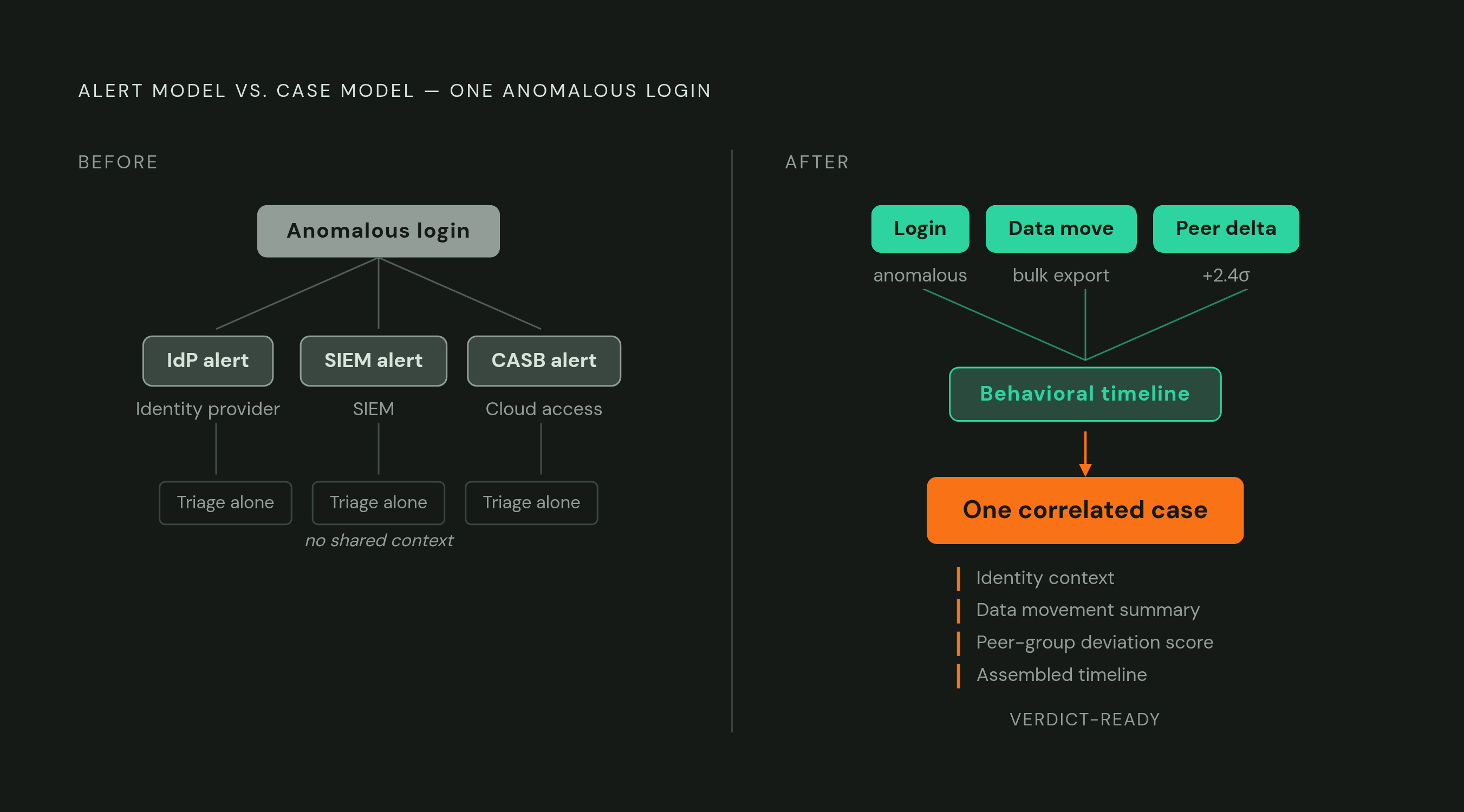
Correlating signals across sources before anything reaches an analyst raises the bar for what counts as alert-worthy in the first place, from "one tool noticed something" to "the pattern across multiple sources warrants attention." That shift is what collapses the false-positive rate, not a smarter scoring model layered on top of the same noisy inputs.
Picture a single anomalous login that, under the old architecture, would have independently tripped the identity provider, the SIEM, and the cloud access tool. Under a cross-source model, that same login gets absorbed into the user's timeline, where it either resolves quietly against normal peer behavior and produces no alert, or it accumulates with other signals into one correlated case. The architecture moves from an alert-per-event model to a case-per-risk model: related signals get grouped into a single investigation rather than scattered across separate queue items each demanding its own triage. In practice, an analyst opens a case already carrying identity context, a data movement summary, a peer-group deviation score, and an assembled timeline, so the work starts at the verdict stage.
What makes this scale is AI that reviews candidate events before they ever reach a human queue: it rules out benign explanations automatically and escalates only what it can't resolve on its own, the reverse of how legacy alert queues function today, where everything gets escalated and nothing gets ruled out. Requiring multiple signals risks missing things a single rule would have caught. The evidence runs the other way. Behavioral models trained on complete cross-source data catch patterns that single-source rules never reach at all, and both the slow-drip exfiltration and the bribed-insider cases above were invisible to single-source detection and visible only once the signals were correlated.
What behavioral baselines get wrong
A behavioral baseline assumes risk appears as a statistical deviation from a person's own history, but a meaningful share of insider risk is statistically normal, established well in advance, or present from the very first day of employment, before any baseline even exists. That assumption means baselines miss precisely the cases that carry the most damage.
A malicious insider who understands their own normal pattern has every reason to stay inside it: moving data slowly enough to stay under detection thresholds, touching only systems they already have legitimate access to, sending files to destinations they use routinely anyway. A compromised credential poses a related problem, because it looks identical to the legitimate user's own history for the simple reason that it is that history; deviation-based detection has no way to tell the account holder apart from an attacker who has learned to move the same way they do. An embedded threat, or a new hire placed straight into a sensitive role, carries risk from day one, long before enough activity has accumulated to form a baseline.
Fortinet's 2025 report frames the needed shift in similar terms, moving from reactive enforcement toward a behavior-aware strategy that accounts for both intentional and unintentional actions woven into everyday workflows, a framing that points past historical deviation toward something broader. What closes the gap is a layer that works alongside cross-source correlation: role-based risk priors, so a user with access to the company's most sensitive intellectual property carries a higher baseline risk score regardless of how their activity history looks; organizational context, including an active notice period, a performance improvement plan, a recent access escalation, or contractor status; and content understanding, which weighs what the data actually means to the business against whether it happens to match a label. Baselines tell you what's different. They were never built to tell you what matters.