DLP Program Metrics That Security Leaders Should Actually Track
Most DLP programs measure noise, not whether they actually stop real data loss.

Most DLP dashboards are exercises in counting. Alerts fired, events blocked, policies triggered: all of it climbs steadily upward, and none of it tells a security leader whether the program stopped a single loss that mattered. That gap between activity and outcome is the subject of this piece, and it's a wider gap than most programs are willing to admit.
Fortinet's 2025 Data Security Report surveyed 883 security and IT professionals and found that 77% had experienced an insider-driven data loss incident. Only 47% said their current DLP solution actually works at stopping sensitive data from leaving. Less than half. That's not a rounding error in a maturing market; it's a majority of practitioners looking at their own tooling and saying that it doesn't do the one thing it exists to do.
Every DLP tool on the market generates volume by design. Every DLP tool on the market generates volume by design. Each policy match logs an event. Each block counts as a save. None of that requires the program to distinguish a real threat from a false one, or a critical document from a routine one. A dashboard can be full and a company can still lose the thing that made it valuable. This is checkbox compliance: the appearance of protection standing in for the practice of it, and the two are not the same, no matter how the quarterly report reads.
What follows is a different set of questions than volume. Not how much did the program do, but how accurately, how fast, and against what actually matters.
False positive rate: the single number that exposes whether a program is tuned or just loud
A false positive is an alert that fires on activity carrying no real risk: an employee attaching a file to a legitimate client email, a contractor exporting a report they're authorized to have, both mislabeled as violations because the policy engine only knows how to match patterns, not read situations.
The scale of this problem is larger than most leaders assume. A survey of 300 information security leaders by Cyberhaven found that 51% of DLP alerts are false positives on average, and 65% of those leaders said their teams are overwhelmed by benign alerts as a result. Seventy-three percent named false positives their single biggest detection challenge. Each alert carries roughly $70 in labor cost to review, dismiss, and document, which turns noise into a budget line rather than just a morale problem.
A high false positive rate is not bad luck. A high false positive rate is not bad luck; it's a symptom. It means policies are written against data content alone, matching keywords or patterns without any sense of who's moving the data, where it's headed, or whether that behavior fits the person's role. The program is pattern-matching, not reasoning.
A reasonable health benchmark sits below 10%, reviewed weekly rather than quarterly. Above that threshold, the fix is a rethink of the detection model itself. It's a rethink of the detection model itself. The research behind these figures shows refined fingerprinting and Exact Data Matching cutting false positives by roughly 48%, and AI-native detection approaches have shown reductions up to 90% compared to rule-based systems, while also improving overall detection rates rather than trading one for the other. A high false positive rate is a metric about what kind of engine sits underneath the alerts, not about the alerts themselves. It's a metric about what kind of engine produces them.
Noise measured is only half the picture, though. The alerts that survive triage still have to get looked at, and that's where the clock starts.
Mean time to investigation: the metric that separates detection from response
Three acronyms get used interchangeably in vendor materials and internal reporting, and the confusion costs accountability. The window from activity start to alert generation is what mean time to detect (MTTD) covers. Mean time to investigation (MTTI) covers alert acknowledgment through investigation to resolution. Mean time to respond (MTTR) is the whole arc, from activity start to containment. Conflating them means nobody can say which part of the pipeline is actually slow.
The AI SOC State 2025 survey put a number on the gap that matters most: it takes an average of 70 minutes to fully investigate an alert, and a further 56 minutes pass, on average, before anyone acts on it at all. Fifty-six minutes of sitting in a queue while whatever triggered the alert keeps happening. Compare that to the other side of the equation. Mandiant's M-Trends 2026 report found the median time between initial access and hand-off to a secondary operator was 22 seconds. Twenty-two seconds against 56 minutes plus 70 more. The adversarial clock and the analyst clock are not running in the same universe, and that mismatch is where damage compounds.
For insider risk specifically, this matters more than it does for external breach scenarios. A departing employee or a compromised credential might have an exfiltration window measured in hours, not days. Detection sitting in a queue is functionally no detection at all.
MTTI also tells a program something about its own architecture, depending on what's paired with it. A long MTTI alongside moderate alert volume points to an analyst capacity problem: not enough people, or not enough time per person. A long MTTI alongside high alert volume points somewhere else entirely, toward a triage model that needs automation, not more hires. When AI takes on initial triage, pulling context together before a human ever opens the ticket, MTTI stops measuring how deep the backlog is and starts measuring how good the eventual investigation actually is. That's a fundamentally more useful number. Leaders should be able to say without hesitating where their own program falls on that range, and whether automation is meaningfully compressing the time between alert and verdict.
Speed against known alerts is one problem. Whether the program can see the data that should trigger an alert in the first place is another, and it's arguably the bigger one.
Data coverage gaps: what percentage of sensitive data is under active monitoring
The research underlying this framework shows that 72% of organizations lack full visibility into how employees interact with sensitive data, and only 28% report having effective data classification and discovery capabilities. Those two numbers describe the same failure from two angles: most programs don't know where their sensitive data lives, and most haven't built the machinery to find out.
The most damaging version of this gap involves data that never got labeled in the first place. Product designs, deal terms, source code, early-stage research: this is often an organization's most valuable material, and it frequently carries no classification tag because nobody ran it through a formal labeling workflow. A DLP tool that depends on labels to trigger policy has no view of any of it. The crown jewels sit outside the monitoring perimeter simply because nobody stamped them.
Programs need a tracked figure here, something like a Data Visibility Index: what percentage of sensitive data sits under active monitoring right now. The research suggests a target around 95% coverage, which is a high bar and a fair one, given what's at stake.
Coverage and accuracy are separate questions, and treating them as one is a common mistake. Coverage asks whether the data is being watched at all. Accuracy asks whether, once it's classified, the classification is correct. A program can score well on one and badly on the other: broad monitoring with sloppy tagging, or narrow monitoring with clean tags. Both failure modes need their own measurement.
Shadow AI has opened a coverage gap that didn't exist in most programs' original design. The 2026 Verizon Data Breach Investigations Report, published in May of that year, found shadow AI to be the third most common non-malicious insider action detected across DLP service datasets, a fourfold increase from the year prior. Source code is the data type most often submitted to external AI models. Coverage means asking a blunt question: are cloud storage, SaaS platforms, collaboration tools, and AI endpoints inside the monitoring perimeter, or is the program still only watching managed endpoints while everything else moves freely around it?
Seeing the data is step one. Knowing which signals inside that data actually matter is the next problem, and it's the one insider risk lives or dies on.
Insider incident containment time and what it reveals about program maturity
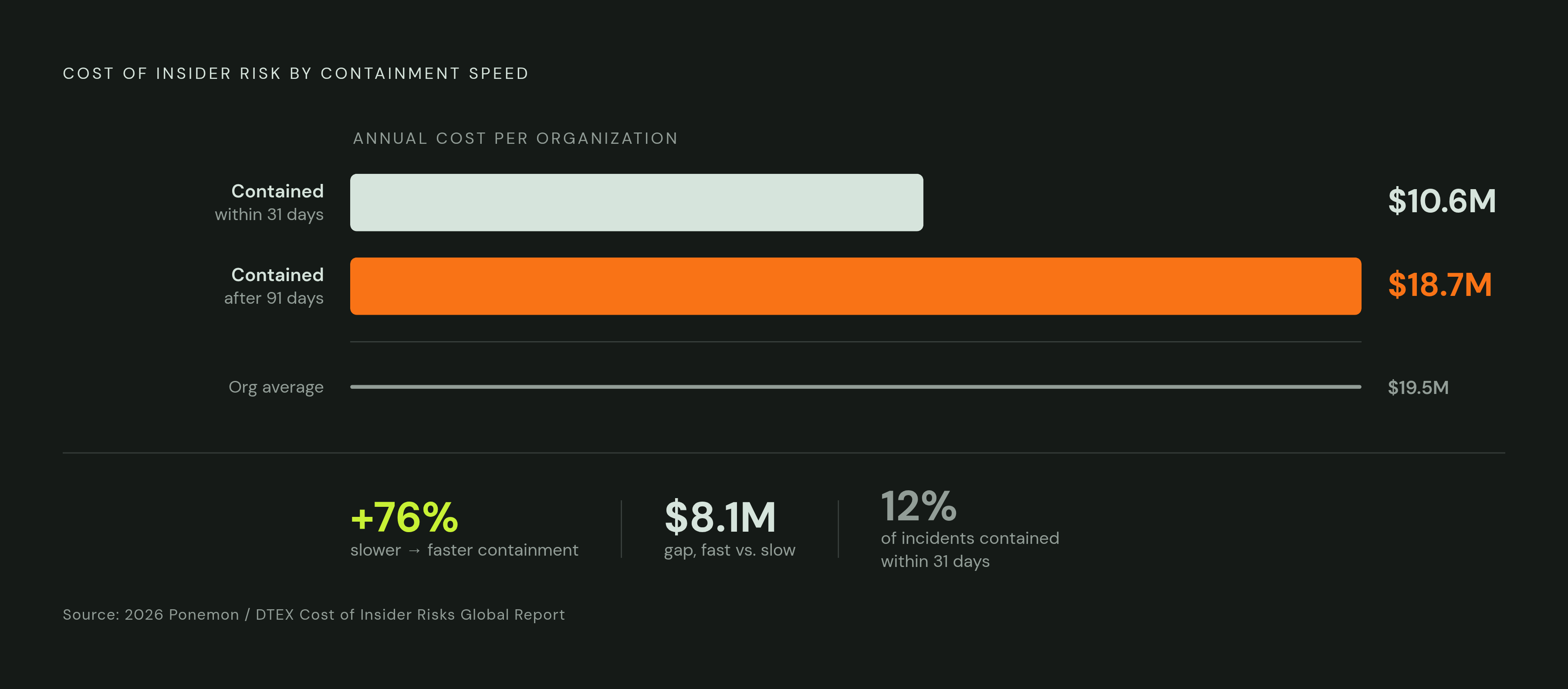
The 2026 Cost of Insider Risks Global Report, from the Ponemon Institute and sponsored by DTEX, put the average annual cost of insider-related incidents at $19.5 million per organization. That figure moves a lot depending on how fast containment happens, and the spread is stark: incidents contained within 31 days cost $10.6 million annually, while incidents taking longer than 91 days cost $18.7 million, a 76% increase. Mean time to contain has improved, dropping to 67 days in 2026 from 86 days in 2023. Progress, but only 12% of incidents get contained within that 31-day window. Most organizations are still paying the expensive version of this problem.
Where the caseload actually comes from should shape how a program is calibrated, and the data here cuts against a common assumption. Research indicates negligent or mistaken employees account for 55% of all insider incidents, with credential theft accounting for another 20%. Combined, the majority of insider incidents are non-malicious: a program tuned primarily to catch intentional theft is built for the minority of what it will actually face. Credential theft, notably, is among the costliest categories per event, which tracks: stolen credentials operate through legitimate, authorized access, and that's exactly the kind of activity rule-based detection struggles to flag.
Program maturity itself is measurable. Fortinet's Insider Risk Report 2025 put 51% of organizations at Level 2, meaning defined processes but limited tooling. Twenty-five percent sit at Level 1, reactive and ad hoc. Eighteen percent have reached Level 3, formal governance with consistent monitoring. Six percent have no formal program at all, Level 0. Ponemon's 2026 research ties maturity directly to dollars: organizations running formal programs avoid roughly 7 incidents and $8.2 million in breach costs annually compared to those without one. Maturity is a savings account. It's a savings account.
Containment time belongs on the same dashboard as MTTI, even though the two measure different things. MTTI clocks how fast an investigation starts and moves. Containment time clocks how fast the whole thing gets resolved. A program can be fast at one and slow at the other, and leadership needs to know which.
The ratio of investigated alerts that represent actual risk, the metric programs almost never track
Of the alerts that make it past triage and get a full human investigation, what percentage turn out to represent genuine risk behavior? This is a different question than false positive rate, which filters noise before investigation ever starts. This metric asks about the quality of what survives that filter, and almost nobody tracks it.
The reason is structural. Most DLP programs measure inputs: policies written, events logged, blocks executed. Very few measure outputs: investigations that produced an actual finding, confirmed incidents, identified risk behaviors. Counting inputs is easy. Counting outputs requires someone to close the loop on every case, and that discipline is rare.
A low ratio here points to one of two problems, and they call for different fixes. Either the detection model is producing high-confidence false positives sophisticated enough to survive triage, or the triage process itself lacks the context needed to separate real risk from noise. Both are real findings. Neither gets fixed by the same intervention.
Both share a context problem underneath. Effective data protection has to account for why data is moving. Timing, velocity, and intent are far more useful signals than keyword matching alone, and without them, even an alert that gets a full investigation may not have enough story attached to reach a verdict. Investigation completeness is its own separate question from whether an investigation happened at all: did the analyst have access to the user's history, the surrounding activity pattern, the destination, the role, everything needed to reach a confident conclusion, or did they have a raw event and a guess?
Given the $70 per-alert labor cost and the 70-minute average investigation time reported by the AI SOC State 2025 survey, a poor signal-to-noise ratio in final investigations is an expensive problem even when those investigations do reach a verdict. It's an expensive one. Programs should track this as confirmed risk incidents per 100 investigated alerts, and watch the trend line over time. A ratio that's falling is a leading indicator, often months ahead of an actual incident, that the detection model is drifting toward noise.
Why rule-based detection architectures structurally limit what these metrics can achieve
None of the problems described above are tuning failures. They're design outcomes. Traditional DLP tools rely on static rules that match patterns in data content without any understanding of the person or the behavior behind the action, and a high FPR, thin coverage of unlabeled data, and slow containment all follow directly from that architecture. You cannot tune your way out of a structural limitation.
Gartner's November 2025 report, "How to Overcome DLP Challenges Posed by Generative AI," states that conventional DLP cannot effectively manage GenAI-driven data loss risk, citing exposure through encrypted traffic, intent blindness, and shadow AI by name. These aren't edge cases the industry hasn't gotten around to. They're named, acknowledged limitations of the architecture itself.
Much of this traces to isolation. Most legacy DLP tools run without deep contextual awareness of user behavior or the broader environment around an alert, andegration into SIEM, UEBA, or other behavioral analytics platforms, so an alert appears with no surrounding context attached. That isolation is a large part of why investigations take 70 minutes and sometimes still don't reach a conclusion: the analyst is reconstructing context by hand that the system should have handed over already.
The deeper issue is intent blindness. Knowing that a file moved used to be enough. Knowing that a file moved used to be enough, but it isn't anymore. Security teams need to know whether that movement was routine, careless, malicious, or the result of a compromised account, and a rule-based system can only ever answer the first, narrowest version of that question: did the pattern match?
Next-gen and agentic DLP actually diverge here, and it's easy to miss because the marketing language overlaps. Next-gen DLP typically bolts AI onto a legacy rule engine, which speeds up alert sorting but leaves the underlying detection model unchanged. Agentic DLP rebuilds detection around AI from the ground up, so the engine itself evaluates intent and returns a verdict rather than another alert to sort. The labels sound similar. The architectures are not, and that difference appears in every metric covered so far.
The maturity data from earlier reinforces this from a different angle: many organizations are running defined processes on limited tooling. Most programs, in other words, are operating architectures with a hard ceiling on how far FPR and MTTI can improve, no matter how much tuning effort goes into them.
What a detection model needs to move these metrics in the right direction
Reducing false positive rate takes more than better keyword lists. Detection needs to combine content understanding with behavioral context together: what the data actually is, who's moving it, where it's headed, and whether that pattern fits the person's role and history. Miss any one of those four elements and some single signal will end up over-firing on its own.
Reducing MTTI means moving investigation earlier, before a human analyst ever opens the alert. AI-assisted pre-investigation that assembles a full user timeline, destination context, and surrounding behavior pattern turns a raw event into something closer to a finding by the time it reaches a person. As covered earlier, that shift changes what MTTI actually measures, from queue depth to investigation quality, which is a far more honest number.
Closing coverage gaps requires classification that works without a label already attached. That means recognizing what information means to the business from its content, its context, and where it's headed, rather than waiting for someone to have tagged it first. It's the only realistic way crown-jewel material gets protected before anyone gets around to formally categorizing it, which, given the coverage numbers above, is most of the time.
Shadow AI needs its own answer, and blanket bans aren't it. Visibility alone doesn't solve the problem either. Given that source code submission to external AI models is now an active, measurable event inside DLP datasets, effective controls need to understand the data type, the destination service, who owns the account, and whether the action was authorized, then intervene before the data actually leaves. That's a harder standard than a rule matching a keyword. It's also the only standard that matches what the problem has become.