How AI-Native Insider Threat Platforms Use Behavioral Analytics Instead of Static Alert Rules
Behavioral analytics catches insider threats by tracking sequences, not isolated events.

Insider threat detection has gotten harder in a short window, and the cause sits in the environment security teams have to watch rather than in any sudden leap in attacker skill. The data now flowing through cloud platforms, collaboration tools, and AI assistants looks legitimate even when it isn't, and that shift is what the rest of this piece works through.
Insider threats harder to detect now than two years ago
The trend line reversed fast. The share of organizations saying insider attacks are harder to detect than external threats climbed from roughly a third to a majority in a single year, a shift traced to insider activity blending into cloud platforms, collaboration environments, and shadow AI tools. That shift erases ground security teams believed they'd already gained.
The underlying cause is where people and data actually live now. Work happens across cloud SaaS, chat and document platforms, AI copilots, and identity systems spread across multiple providers, and all of that activity generates behavior that looks normal on its face even when it covers something else. A file move that would have stood out five years ago, routed through a single corporate network with a handful of sanctioned applications, now blends into hundreds of similar, legitimate transfers happening every hour.
The problem also became a headline story. SpyCloud's 2026 guide points to the widely-publicized North Korean IT worker schemes, which touched most if not all of the Fortune 500, as a major reason insider threats dominated security coverage in 2026, pushing boards and security leaders to treat the problem as mainstream rather than niche. And the cost of getting this wrong is not abstract. More than half of insider incidents cost half a million dollars or more to remediate, with a meaningful share running into the millions. Detection difficulty and financial exposure are rising at the same time, in the same environment, for the same reason: the signal insiders leave behind no longer looks different from the noise around it.
Static alert rules and their limits
Rule-based detection, the kind that has anchored data loss prevention products for over a decade, asks one question of every event: does this match a known pattern? A Social Security number leaving through an email attachment, a large file copied to a USB drive: the system checks the pattern and either fires or stays silent. There's no third option, no partial credit, no sense of who did it or why.
That narrowness produces three failure modes. The first is volume: any event matching the defined pattern triggers an alert regardless of whether the person, the timing, or the destination make it actually dangerous, and analysts facing hundreds of these a day stop trusting the queue and start ignoring it. The second is context blindness: a regex built to catch a credit card number can't tell a finance analyst running a routine reconciliation apart from an employee staging an exfiltration, because the rule sees the identical string of digits in both cases. The third is shadow AI: employees paste source code, contracts, and customer records into browser-based AI tools through personal accounts that sit completely outside IT's visibility, and legacy DLP was never built to inspect a browser session or tell a sanctioned AI tool from an unsanctioned one.
These failures compound operationally. Legacy DLP demands constant human intervention just to manage the sprawl of exceptions it generates, so teams spend more hours tuning policy than they spend investigating anything real. Gartner's November 2025 assessment put the ceiling on this approach in direct terms: conventional DLP cannot effectively manage GenAI data loss risks, including exposure through encrypted traffic, blindness to intent, and shadow AI.
The structural issue underlying all three failure modes is this. A single event, taken alone, is almost never the risk. The risk lives in the sequence of behavior leading up to that event and surrounding it, and a rule that evaluates one moment in isolation has no way to reconstruct a sequence it was never built to see.
Behavioral analytics and the pattern static rules miss
Behavioral analytics changes what gets measured. Instead of checking a single event against a fixed pattern, it tracks the full sequence of a user's or entity's activity across time, which is the scale at which insider risk becomes visible. The engine behind this is User and Entity Behavior Analytics, or UEBA: machine learning models build a baseline of what normal looks like for each user and entity, including devices, service accounts, and AI agents, then watch continuously for deviation from that baseline.
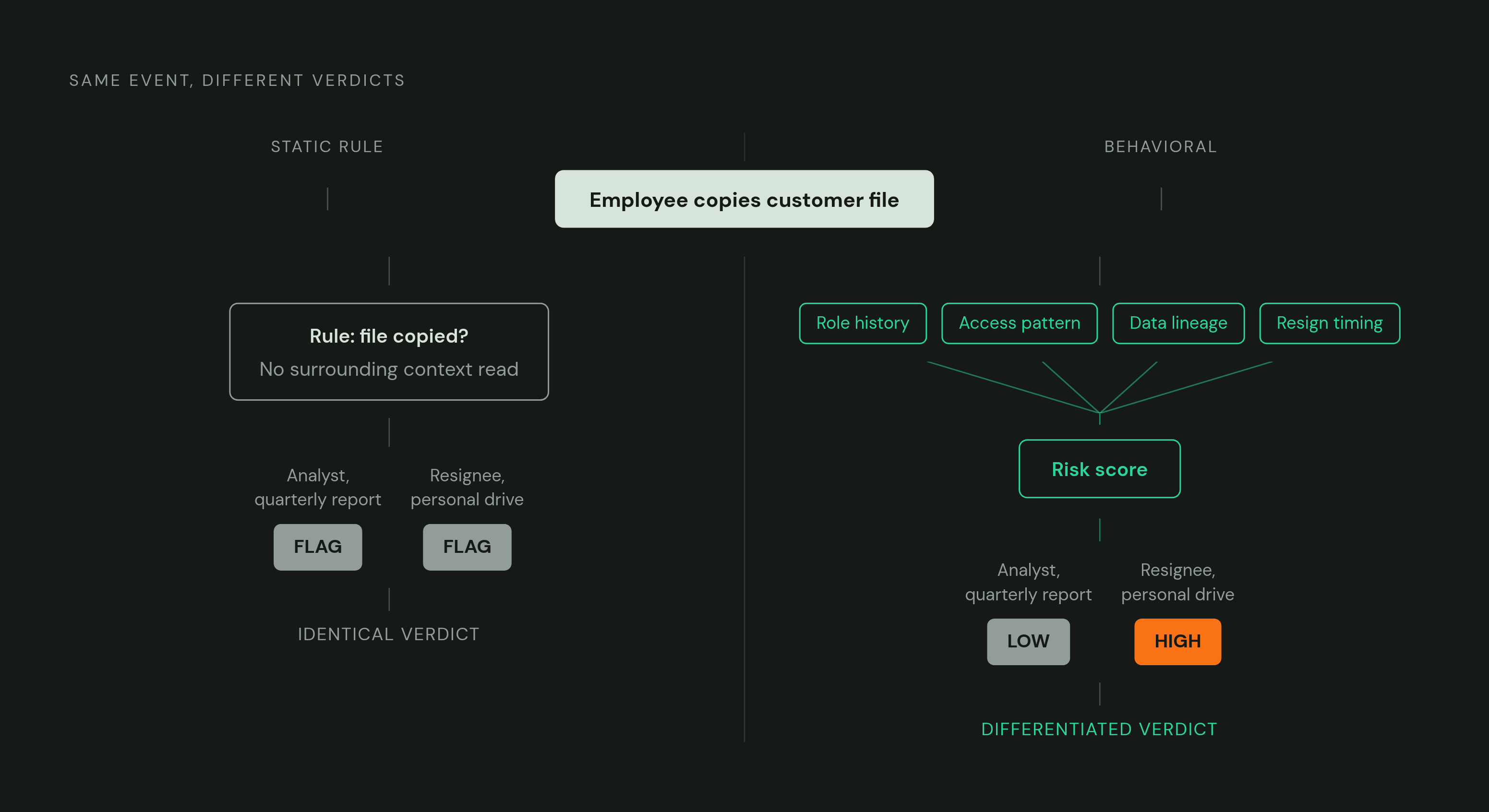
The questions change along with the method. A rule-based system asks whether a file is leaving the network. A behavioral system asks what the data actually is, who should reasonably have access to it, whether this person's role and history make this particular movement expected, and how the risk attached to that data changes as it gets copied, transformed, or reused somewhere else. Consider two employees performing what looks, on paper, like the same action: a data analyst exporting a customer file for a quarterly report, and an employee two weeks from resignation copying the same kind of file to a personal drive. A static rule sees identical events and either flags both or neither. A behavioral system sees two different histories, two different access patterns, two different contexts surrounding an outwardly similar action, and scores them accordingly.
Risk scoring itself has moved away from binary triggers. The Vectoredge IRM paper describes a hybrid scoring approach that starts from a static model and transitions to an adaptive AI-based model using an autoencoder neural network trained on expert-annotated activity data, refined through iterative feedback loops and continuous learning, a shift that cut false positives by 59% in Vectoredge's own analysis. Part of what makes that possible is tracking data lineage: following a file as it gets copied, transformed, or re-uploaded elsewhere, so the system sees the full chain of decisions that moved it, not just where it landed.
This is also the logic behind what's sometimes called policyless DLP: a detection approach that judges, in real time, whether a specific data movement is actually dangerous, without requiring a security team to write a rule in advance for every possible scenario, using behavioral context and AI classification instead. A cross-disciplinary paper presented at ISBM 2025 and published by Springer pushes the idea further, arguing for folding cognitive science principles into the machine learning layer to capture psychological indicators that precede malicious insider activity, so the behavioral signal appears before anyone has violated an explicit policy. That matters because insider risk often starts from a place of full authorization. A person's access can be entirely legal, their behavior can look statistically ordinary for months, and the risk can still be building, so any system worth relying on has to judge behavior in context rather than hunting for a clean statistical outlier.
Real cases where the behavioral pattern was the only detectable signal
Documented insider cases share a structure: the damaging event sat at the end of a behavioral sequence that only becomes visible when someone reads activity across time, not at a single moment.
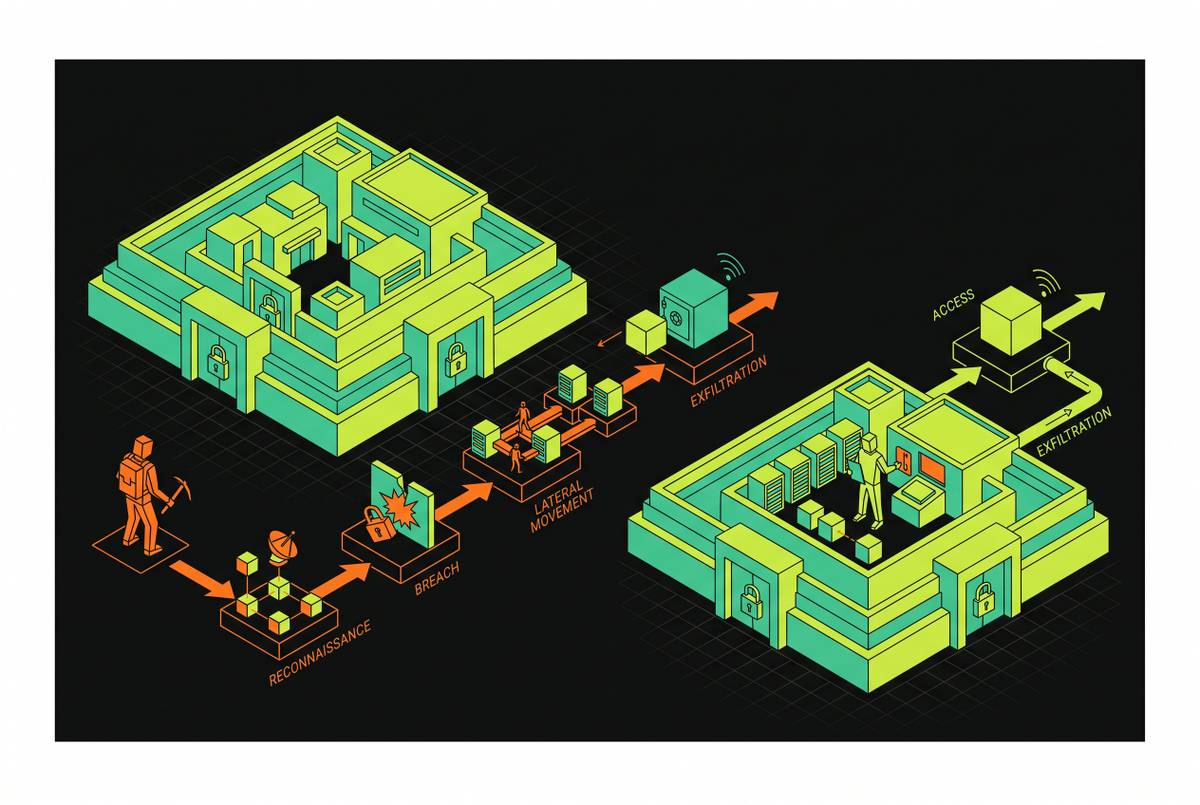
Pre-resignation staging is the clearest recurring pattern. Measurable signs of exfiltration can start months before an employee leaves, beginning with reconnaissance such as directory lookups and file access, then moving to a dry-run data copy through an unapproved medium. The Apple Vision Pro case fits this shape exactly: engineer Di Liu downloaded thousands of confidential files to his personal iCloud account before resigning to join Snap, and Apple settled the resulting lawsuit in March 2026. The exfiltration happened before the resignation, so a rule triggered by the resignation itself would have caught nothing until well after the files were already gone. The Yahoo case from May 2022 shows the same logic on a faster clock: research scientist Qian Sang downloaded hundreds of thousands of pages of Yahoo's AdLearn intellectual property to personal devices within minutes of receiving a job offer from competitor The Trade Desk. The signal was the sequence itself, an offer arriving followed immediately by a mass download, and a rule simply watching for "large file transfer" would either have missed the context entirely or fired constantly on ordinary business activity.
Access that should have been revoked produces a different but related pattern. In the Geisinger case, a former engineer's credentials at a healthcare technology vendor stayed active for two days after termination, and he used that window to steal millions of patient records before pleading guilty on February 27, 2026. The control failure here is straightforward: access was not revoked on schedule. But the behavioral signal, a terminated employee's account still active and still pulling patient records, is precisely the kind of cross-domain anomaly a system correlating identity status against access activity should catch the moment it starts.
Nation-state espionage follows a slower, more targeted version of the same arc. Former Google engineer Linwei Ding was convicted on January 29 and 30, 2026 of economic espionage and trade-secret theft for stealing hundreds of pages of confidential AI supercomputing intellectual property, including TPU and GPU designs and related software, for China's benefit, a case reported as the first U.S. conviction involving AI-related economic espionage, though the trial judge later set aside the seven economic-espionage convictions in August 2026 and left the seven trade-secret-theft convictions standing. Pulling highly specific technical IP over an extended stretch of time is a pattern of targeted, purposeful access that looks nothing like a typical engineer's day-to-day profile.
Sabotage tied to termination rounds out the pattern. In February 2025, two OPEXUS engineers, Suhaib and Muneeb Akhter, used their insider access to erase numerous databases and steal a large cache of sensitive U.S. government files during and immediately after receiving notice of termination. Neither the termination notice nor the destructive action means much alone. Together, placed next to each other in time, they form the kind of correlation a behavioral system is built to surface.
AI and non-human identities expanding the insider threat surface
AI copilots and autonomous agents now operate inside the same trust boundaries as human employees, often with delegated access to the same systems, and that shift is creating a category of insider risk that static rules have no framework for recognizing. Nearly half of organizations now classify AI copilots and generative AI tools as insider risk in their own right, and a large majority say they're concerned about autonomous AI agents acting as non-human insiders with privileged access. Nearly all organizations surveyed said AI adoption is increasing their insider risk exposure, and more than half acknowledged confirmed or suspected AI-related insider incidents already on record.
The trust models most organizations run today were built for human users with predictable schedules and stable access patterns. AI agents don't fit that frame: they operate at machine speed, inside email, documents, workflows, and identity systems, and there's no human activity profile to measure their behavior against. Shadow AI compounds the gap. Employees routinely paste source code, contracts, and customer data into AI tools tied to personal accounts, completely outside corporate visibility, so the data movement is real even though the channel carrying it is invisible to legacy DLP.
Closing that gap means building behavioral models that treat human and machine identity as one unified picture of access and activity, scoring an AI agent's deviation from its expected pattern the same way the system would score a person's. None of this gets solved through visibility alone, and banning AI outright isn't a realistic option for most organizations. Controls need to track the data itself, where it's headed, who owns the account moving it, and the behavioral context around that movement, with the ability to step in before anything sensitive actually leaves.
Alert fatigue as the operational consequence of applying static logic at behavioral-analytics scale
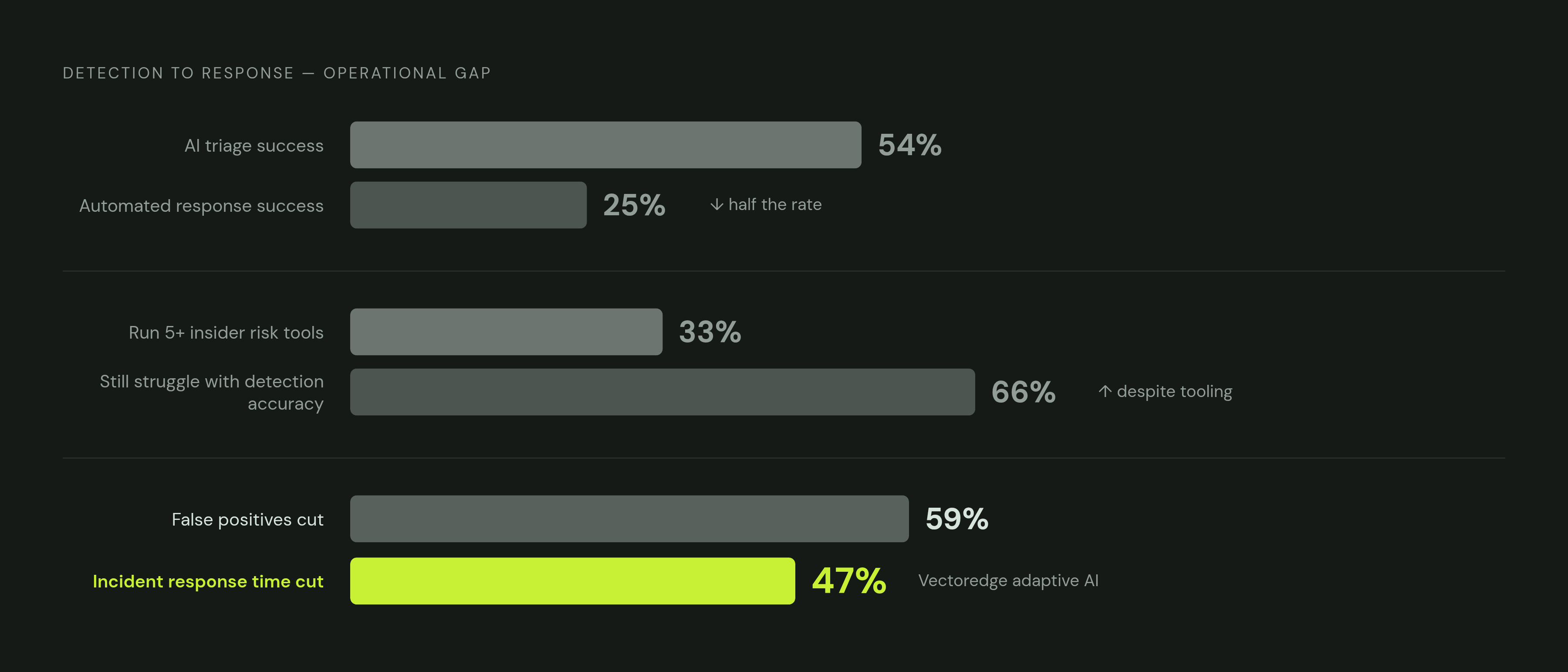
Even when a static rule correctly flags something real, the sheer volume those rules generate at enterprise scale can make investigation practically impossible, which turns detection accuracy into a number that doesn't matter much on its own. More than half of organizations report success using AI for alert triage and risk scoring, but only about a quarter report success automating the response that follows, a gap that marks the real bottleneck between spotting a threat and actually containing it. Running more tools doesn't close that gap. A third of organizations operate five or more separate insider risk tools, yet two-thirds still struggle with detection accuracy and more than half point to tool and data fragmentation as a primary challenge. Stacking additional alert sources on top of each other produces more noise without producing better detection.
Alert fatigue has stopped being a morale problem and become a measurable operational one. When analysts can no longer trust what's sitting in the queue, they start ignoring it wholesale, and the alerts that get ignored are sometimes exactly the ones that mattered. The metric that captures this most precisely is mean time to investigate, or MTTI: the average time between an escalation and an explained incident. A platform that surfaces the correct alert but buries it under thousands of low-value ones hasn't actually solved detection, because MTTI still carries the real cost.
Behavioral analytics attacks this problem at its source rather than downstream. Because the system evaluates risk in context instead of matching isolated patterns, it produces far fewer alerts that require a human to look at them in the first place, and organizations running AI-driven DLP see dramatically fewer false positives than those running rule-based systems. The Vectoredge IRM paper reports a concrete version of that payoff: its adaptive AI scoring model cut incident response times by 47% alongside its false-positive reduction, a direct measure of what changes operationally when scoring moves from static to adaptive. This is not a claim that AI performs better in some general sense; it's a claim that the behavioral-analytics model reduces the alert burden at the point where alerts get generated. MTTI is the number that ties that reduction back to something security leaders already measure, connecting detection quality directly to how fast a team can actually investigate what it finds.
Sources
- Integrating AI and Behavioral Analytics for Advanced Insider Threat Detection: A Cross-Disciplinary Approach Combining Cybersecurity and Cognitive Science
- AI-Driven IRM: Transforming insider risk management with adaptive scoring and LLM-based threat detection
- [GUIDE] Best Insider Threat Detection Tools & Solutions for 2026