The 2025 Insider Threat Tool Landscape From a Security Engineer's Bench
Legacy tools miss the patterns that define real insider threats.
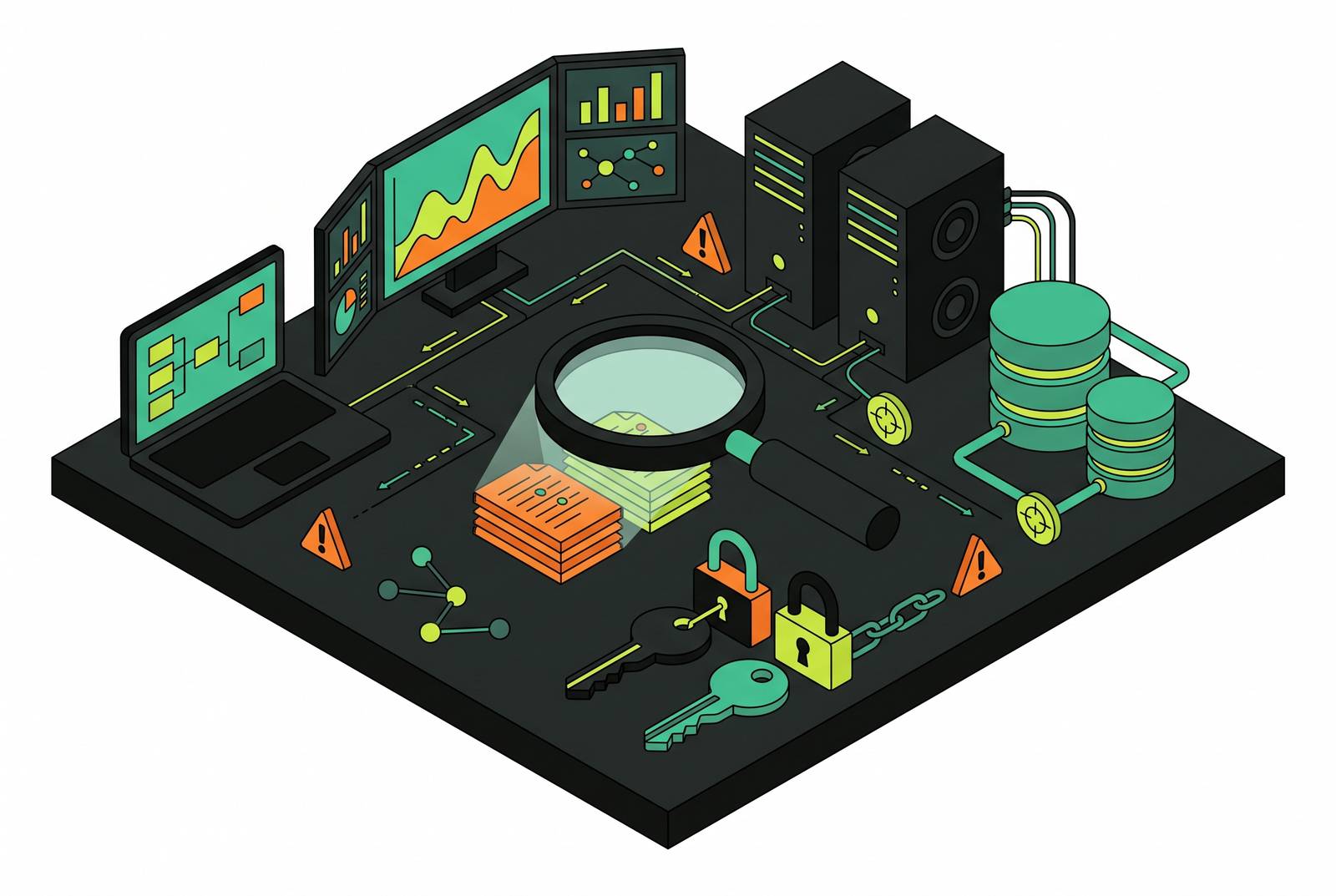
The insider threat tool market in 2025 is crowded with categories that overlap in marketing copy and diverge sharply in actual coverage. If you want a program that detects insider risk instead of one that just generates alerts, you need to know where each category's claims hold up against real incident patterns, not vendor data sheets.
The standard tool category map misleads practitioners before they even start evaluating
Pull up any vendor comparison matrix for insider threat tooling and nearly every row claims coverage: DLP vendors claim behavioral detection, UEBA vendors claim data loss prevention, SIEM vendors claim both. Insider threat is fundamentally a human problem wedged into a technical toolchain. The actor already has legitimate access and already knows the systems, so in many cases no rule tied to that control trips until the damage is done. That is a different adversary model than the one most detection categories were architected against, and it is why a tool's marketing claim of "insider threat coverage" tells a practitioner almost nothing about whether it covers the risk that actually matters to their organization.
The risk surface itself has also outgrown the old map. AI-native platforms, Candor among them, stitch behavioral profiling across that full stack, because they exist to close that correlation gap, not to add another siloed signal to it. That gap, not the absence of any single tool, is the actual subject of this piece.
The real detection gap mapped against actual incident archetypes
The abstract claim that categories overlap and leave gaps becomes concrete when you map it against how insiders actually move data: real exfiltration rarely resembles the bulk-transfer pattern most tools are tuned to catch.
Consider slow exfiltration over authorized channels. Each individual action appears authorized at the moment it happens. Traditional DLP, built to watch for bulk transfers or outright policy violations, produces no alert, because no single event crosses the threshold that would trigger one.
Consider IP theft by a departing employee. In the Google insider theft case, software engineer Linwei Ding exfiltrated hundreds of confidential files, and they contained proprietary AI chip designs and supercomputing architecture. The sensitivity of that data was a function of what it meant to Google's business, not whether it happened to match a classification label a DLP rule was watching for.
Consider the compromised-credential, nation-state variant. By mid-2025, DPRK-affiliated operatives had interviewed at thousands of companies, and they got hired under fake identities so they could gain legitimate access. That threat presents as an ordinary new hire from day one and generates no anomaly signal, because there is no baseline deviation to detect.
Consider financial fraud carried out through entirely legitimate tooling. UEBA detects abnormal database queries and a high-frequency pattern of deactivating account notifications, both outside the adviser's established baseline, but rule-based tools miss it, because the adviser used legitimate credentials and authorized applications the whole time.
Consider the third-party SaaS integration exploit. The cybercriminal group UNC6395 exploited a third-party Salesforce integration to siphon corporate CRM data, including AWS keys and Snowflake tokens, from multiple organizations. That exfiltration moved through a channel that most outbound DLP rules simply do not model.
The common thread across all five archetypes is that the risk lived in the pattern across a user's timeline, and the data's sensitivity was defined by business context. That is why you need platforms that understand both the data in motion and the person moving it and assemble the full story before an alert surfaces in the analyst's queue, so they catch what purely event-driven tools miss.
Legacy DLP's coverage and structural limits
Legacy DLP is the right tool for a specific and narrowing problem. It reliably blocks known sensitive content moving across known channels, and you get real value from that. But its architecture makes it structurally unable to catch the exfiltration patterns that dominate real insider incidents today.
The mechanism of failure is straightforward. Content matching against rules reveals nothing about whether the data should have moved. They match content against rules, not behavior against context, and that distinction is the entire gap. Legacy DLP misses data that has been copied, pasted, renamed, paraphrased, or edited, which is how employees work every day, because the tool relies on static content matching rather than data lineage or semantic understanding of what the content actually is.
When security teams try to compensate for that coverage gap by casting rules wider, the result is a ticket factory. Shadow AI has made the problem worse by breaking the perimeter legacy DLP was built around in the first place: sensitive data now moves through browser-based AI assistants, code completion tools, and personal AI accounts that static rules cannot reliably classify or intercept.
None of this means legacy DLP should be discarded. Legacy DLP functions as a necessary baseline rather than a sufficient one, and the practical question for a security engineer is not whether to keep it, but where to stop trusting it to catch what it was never built to see.
How behavioral DLP changes the decision model
Behavioral DLP does not add rules to the legacy model; it changes the question the model asks. Instead of matching content against a policy, it evaluates the actor, the data, the destination, and the action together, then reasons about whether that combination represents risk. That is an architectural shift rather than an incremental upgrade to an existing product line.
The agentic DLP frame extends this further still. A system built this way can reason about paraphrased content, AI prompts, screenshots, and unfamiliar workflows that would never match a classic rule, and it can intervene before sensitive data leaves the organization. That intervention point matters enormously for the shadow AI gap specifically: controls that depend on understanding the data, the destination, the account ownership, and the surrounding context, with intervention before data leaves, close a channel that legacy DLP cannot model and that UEBA, on its own, cannot block.
This shift comes with a real operational cost that deserves honest treatment. A system that has not yet learned a given user's baseline can generate its own false positives during that early period, and security teams need to plan for that calibration window operationally. That tradeoff is also the strongest argument for combining behavioral DLP with UEBA rather than treating either as a complete solution on its own.
What UEBA adds that DLP cannot provide
UEBA detects risk embedded in a user's behavioral pattern over time, a gap DLP structurally cannot close. Its own baseline model, though, creates a blind spot, and practitioners rarely account for it when they treat UEBA deployment as the finish line.
What UEBA does well is substantial. The integration value compounds when UEBA is paired with a SIEM, since UEBA-enabled SIEMs correlate identity, endpoint, and network telemetry in a way that neither tool achieves running on its own. Compromised credentials appear so often across breach investigations that the identity layer has to be the highest-priority integration point in that pairing.
But baselining has a structural limit that is most visible in the cases where the stakes are highest. Risk can also run entirely through authorized access, as with a nation-state operator who was hired legitimately and never deviates from expected behavior.
The offboarding window sharpens this problem further. When analysts deprioritize those alerts out of fatigue, insider threats go undetected for longer, so UEBA without real investigation support shifts the burden of detection.
What SIEM contributes as the correlation spine
SIEM's value in this stack is as a correlation substrate, not as a source of detection in its own right.
Speed compounds the problem. Mandiant's M-Trends 2026 report found that the median time from initial access to attacker hand-off fell to 22 seconds in 2025 investigations, and that makes even routine SIEM alerts time-critical in a way traditional triage workflows were never built to support. Identity and SaaS logs now carry as much weight as disk forensics once did: Unit 42 research found identity weaknesses present in 89% of investigations, and SaaS integration exploits like UNC6395's Salesforce attack never appear in traditional endpoint log sources.
What SIEM cannot do matters just as much as what it can. It cannot understand the content being moved, cannot contextualize a user's behavioral history on its own, and cannot tell a policy violation from a genuine threat unless analytics are layered on top. Treating SIEM as an insider threat tool in its own right, rather than as the enabler of one, produces exactly the ticket-factory dynamic that alert fatigue research has documented. The fix is not a better SIEM configuration, it is a clearer understanding of what role SIEM is actually supposed to play.
Zero Trust and IAM closing the access layer gap
Detection tools identify risk after a behavior has already occurred. Access controls limit what an insider can do before detection ever fires, and the space between those two moments is where the most damaging insider incidents actually play out.
Zero Trust works here as a behavioral control plane, and not as a static perimeter. When behavioral risk increases, Zero Trust controls can respond dynamically, triggering step-up authentication, restricting session access, or revoking permissions outright, all without waiting for an analyst to act on an alert that may sit in a queue for hours. That responsiveness is what turns access control from a passive governance exercise into an active part of the detection stack.
Access scope itself is a persistent structural weakness. Access revocation delays during the resignation window create exactly the conditions where IP theft most commonly occurs, and no detection tool resolves that gap, however well-tuned it is, if the access itself was never actually removed.
Category overlap, redundancy, and coverage gaps
The hardest engineering problem in insider threat is understanding where categories overlap without actually covering the same risk, and where apparent coverage hides a genuine gap that duplicated coverage conceals.
Redundancy is visible constantly in the bulk-download scenario. SIEM, UEBA, and DLP may all alert on the same single bulk file download, producing three separate tickets for one event, none of which tells the analyst whether the download was authorized or malicious, and none of which assembles the behavioral context an analyst actually needs to make that call.
Gaps occur just as often, sometimes for the same underlying event type. The slow-exfiltration-over-authorized-channels archetype, where data moves across Slack, Salesforce, and Google Drive over months, can generate no alert from any of the three categories at once. SIEM has no cross-channel correlation rule built for this pattern, so it stays quiet too.
The reason this happens is structural: most organizations' tools do not share a data model. SIEM aggregates logs, UEBA runs its own independent baseline, DLP maintains its own separate policy engine, and the full story of a given user's risk is never assembled in any one place. Even if an organization has invested in every major tool category, this fragmentation still produces genuine coverage gaps.
A platform can surface the right alert, but if it forces analysts to stitch context across multiple silos, the detection problem remains unsolved. It has moved the bottleneck from detection to investigation, and the practical outcome is identical either way: threats that go unaddressed until damage is already done.
A coverage-complete stack built around detection workflows
Coverage completeness in insider threat requires a stack where content, identity, behavior, and destination all get evaluated together as part of the same decision, not sequentially across siloed tools that hand signals off to one another after the fact.
A few baseline technical requirements follow from the gaps this piece traces. DLP needs to understand data semantically rather than by label or regex match alone, so it catches derivative, paraphrased, or transformed content and can decide, based on context, when a shadow AI destination matters. Behavioral analytics need to span a user's full timeline, not just recent deviations from a narrow statistical baseline, so they cover risk from day one, through normal-looking authorized activity, and across the offboarding window, where baselines offer the least protection. Identity and access integration needs to translate risk signals into actual access enforcement in real time, not as a manual step an analyst gets to eventually. Log correlation needs to ingest HR, SaaS, identity, and endpoint telemetry, not just network and endpoint logs, so the correlation layer can actually see the channels where slow exfiltration happens in practice. Investigation support needs to assemble context before an alert reaches an analyst, so it cuts mean-time-to-investigation, not just mean-time-to-detection.
Vendors are approaching pieces of this differently. Everfox, for instance, has built its offering around government and defense-grade insider risk monitoring, and it has a long track record in regulated environments. Candor is built directly around the integration requirement traced through this piece: the platform combines behavioral DLP with insider risk detection and investigation across enterprise systems, understands both the content moving and the person behind it, and is designed to assemble the full story before a candidate event ever becomes an analyst alert, cutting mean-time-to-investigation as directly as it addresses detection itself. That placement follows from the specific gaps this analysis identified, not from any claim of category superiority.
The practitioner must determine which tool or platform closes a specific, already-identified gap, without duplicating alerts already in place, and without forcing analysts to stitch context by hand across systems that were never built to share one. The answer differs for every organization's existing stack, but the framework for finding it stays the same regardless of which vendors are already in the environment.